

The three archangels named in canonical Scripture are Michael, Gabriel, and Raphael. Those three names carry the clearest scriptural and liturgical weight across Catholic, Orthodox, and Protestant traditions. Beyond them, a wider roster of names appears in deuterocanonical books, apocryphal texts, and later tradition:
- Uriel — “God is my light” (apocryphal / 1 Enoch)
- Azrael — “Whom God helps” (Islamic and later tradition)
- Jophiel — “Beauty of God” (later tradition)
- Chamuel — “He who sees God” (later tradition)
- Zadkiel — “Righteousness of God” (later tradition)
- Jeremiel — “Mercy of God” (apocryphal)
- Raguel — “Friend of God” (1 Enoch / apocryphal)
Only Michael, Gabriel, and Raphael appear in texts recognized as canonical Scripture by most Christian denominations, while other names come from non-canonical or later sources. The rest come from deuterocanonical books (like Tobit), apocryphal writings (like 1 Enoch), or later liturgical and mystical tradition. The Sources and Traditions section below explains exactly where each name originates.
Key Takeaways
The three archangels named in canonical Scripture are Michael, Gabriel, and Raphael, and every archangel name ending in “-el” carries the Hebrew word for God as a built-in theological declaration.
| Point | Details |
|---|---|
| Canonical three only | Michael, Gabriel, and Raphael are the only archangels named in canonical Scripture across most Christian traditions. |
| “-el” means God | Every archangel name ending in “-el” contains the Hebrew word for God, making each name a statement of divine mission. |
| Lists vary by tradition | Catholic tradition recognizes three; Eastern Orthodox venerates seven to eight; Islamic tradition names a different roster entirely. |
| Apocryphal names have context | Names like Uriel, Raguel, and Remiel come from 1 Enoch and deuterocanonical texts, not the canonical Bible. |
| Divineprints for devotional art | Divineprints offers museum-grade archangel prints and canvases suited for prayer spaces, gifts, and parish settings across the United States. |
Table of Contents
- Archangel names and meanings at a glance
- The canonical three: Michael, Gabriel, and Raphael in depth
- Other widely venerated archangels and what their names mean
- Where archangel names come from across traditions
- How people connect with archangels through prayer and devotion
- Why the names matter more than the lists
- Archangel art for your prayer space
- Sources
Archangel names and meanings at a glance
The suffix “-el” at the end of nearly every archangel name is the Hebrew word for God. Every name on this list is, at its root, a theological statement about that angel’s relationship to the divine. EWTN explains that this theophoric element makes archangel names direct declarations of mission, not just labels.
| Name | Literal Meaning | Role / Association | Source Label |
|---|---|---|---|
| Michael | “Who is like God?” | Defender, warrior, protector | Canonical (Daniel, Jude, Revelation) |
| Gabriel | “God is my strength” | Messenger, herald of revelation | Canonical (Daniel, Luke) |
| Raphael | “God heals” | Healer, guide, companion | Deuterocanonical (Tobit) |
| Uriel | “God is my light” | Illumination, wisdom, repentance | Apocryphal (1 Enoch, 2 Esdras) |
| Azrael | “Whom God helps” | Death, transition, comfort | Islamic tradition / later |
| Jophiel | “Beauty of God” | Wisdom, beauty, creativity | Later tradition |
| Chamuel | “He who sees God” | Love, compassion, relationships | Later tradition |
| Zadkiel | “Righteousness of God” | Mercy, forgiveness, freedom | Later tradition / apocryphal |
| Jeremiel | “Mercy of God” | Visions, hope, souls of the departed | Apocryphal (2 Esdras / 4 Ezra) |
| Raguel | “Friend of God” | Justice, harmony, oversight of angels | Apocryphal (1 Enoch) |
| Ariel | “Lion of God” | Nature, earth, elemental stewardship | Later tradition |
| Selaphiel | “Prayer of God” | Intercession, prayer leadership | Eastern Orthodox liturgical |
| Jegudiel | “Praise of God” | Reward, encouragement of workers | Eastern Orthodox liturgical |
| Barachiel | “Blessing of God” | Blessings, family, guardian of the home | Eastern Orthodox liturgical |
| Remiel | “Mercy of God” / “Thunder of God” | Souls of the faithful, resurrection | Apocryphal (1 Enoch) |
| Phanuel | “Face of God” | Repentance, hope | Apocryphal (1 Enoch) |
Notice that Remiel and Phanuel sometimes overlap in function and are occasionally treated as variant names for the same figure across different manuscript traditions.
The canonical three: Michael, Gabriel, and Raphael in depth
Catholic guidance is clear that only Michael, Gabriel, and Raphael are named in the canonical Bible. Their names are not incidental. As the Catholic Apostolate Center notes, each name encodes a distinct mission: Michael as defender, Gabriel as herald, Raphael as healer.
Michael: “Who is like God?”
The name is a rhetorical question in Hebrew, Mi-ka-El, and the answer it implies is “no one.” That defiant declaration shapes everything about Michael’s role. He appears in Daniel 10 and 12 as the great prince who stands guard over Israel, in Jude 1:9 disputing with the devil over the body of Moses, and in Revelation 12 leading the heavenly army against the dragon. Scripture applies the title “archangel” explicitly to Michael in Jude 1:9, making him the only angel the New Testament directly calls by that rank.
- Iconography: Michael is typically depicted in armor, sword raised, standing over a defeated serpent or dragon. His imagery connects directly to Revelation 12.
- Patronage: Soldiers, police, paramedics, the sick, and the dying. He is the patron of the Church universal in Catholic tradition.
- Feast: September 29 (shared with Gabriel and Raphael in the Roman Rite); May 8 marks an earlier apparition feast in some traditions.
Gabriel: “God is my strength”
Gabriel carries the weight of divine announcement. He appears in Daniel 8 and 9 to interpret visions, and in Luke 1 he delivers the Annunciation to Mary and the birth announcement to Zechariah. His name fits his function precisely: the strength he carries is not his own but God’s, channeled through the message he bears.
- Iconography: Gabriel is shown with a lily (purity, the Annunciation) or a trumpet, and sometimes holding a scroll. EWTN notes that Gabriel’s image in Catholic tradition is among the most clearly defined of any angel.
- Patronage: Messengers, postal workers, broadcasters, diplomats, and those in communications. Also venerated as a patron of pregnant women.
- Gabriel’s feast is celebrated on September 29 in Western Christianity, with some Eastern Christian calendars observing it on alternate dates.
You can see Gabriel’s archangel imagery rendered in devotional art that captures this herald role.
Raphael: “God heals”
Raphael’s name and story are inseparable. The entire Book of Tobit is, in effect, a narrative about healing: Tobit’s blindness, Sarah’s affliction, Tobias’s dangerous journey. Raphael accompanies Tobias in disguise, and at the end reveals himself: “I am Raphael, one of the seven angels who stand in the glorious presence of the Lord and are ready to serve him” (Tobit 12:15). That verse is also the primary textual basis for the concept of seven archangels.
- Iconography: Raphael appears with a fish (referencing the Tobit narrative) and a pilgrim’s staff, often alongside the young Tobias.
- Patronage: Healers, physicians, travelers, the blind, and those seeking a spouse.
- Raphael’s feast is celebrated on September 29 in Western Christian liturgy. Raphael’s name appears in the deuterocanonical Book of Tobit, accepted as canonical by Catholic and Orthodox Christians but not by most Protestant denominations.
A Saint Raphael devotional print makes a meaningful gift for anyone navigating illness or a difficult journey.
Other widely venerated archangels and what their names mean
The names below come from apocryphal texts, Eastern liturgical lists, Islamic tradition, or later mystical sources. None appear in the canonical Old or New Testament. Multiple historical and religious sources compile these variant lists differently, and the count of seven (or eight) archangels shifts depending on the tradition consulted.
Wisdom and illumination
- Uriel (“God is my light”): Associated with wisdom, repentance, and the illumination of truth. Appears in 2 Esdras and 1 Enoch; venerated in Eastern Orthodox and Ethiopian traditions but not formally recognized in Roman Catholic practice. A Uriel archangel print captures his luminous symbolism well.
- Jophiel (“Beauty of God”): Linked to wisdom, beauty, and creative inspiration. Appears primarily in later Kabbalistic and mystical sources; not attested in early Christian canonical or apocryphal texts.
Healing and comfort
- Azrael (“Whom God helps”): The angel of death and transition in Islamic tradition and some later Jewish sources. Associated with comfort for the dying and the bereaved. Not named in Christian canonical Scripture.
- Chamuel (“He who sees God”): Connected to love, compassion, and peaceful relationships. Largely a product of later Western esoteric and New Age tradition; not found in early Christian or Jewish canonical texts.
Intercession and prayer
- Selaphiel (“Prayer of God”): The archangel of prayer and intercession in Eastern Orthodox tradition. Venerated in the Synaxis of the Archangel Michael on November 8. See also Selaphiel devotional art for prayer spaces.
- Barachiel (“Blessing of God”): Archangel of blessings and family life in Eastern Orthodox lists; depicted holding a white rose or scattering rose petals, symbolizing divine favor.
- Jegudiel (“Praise of God”): Associated with rewarding those who labor for God’s glory. Venerated in Eastern Orthodox tradition; depicted with a golden crown and a whip, symbolizing reward and correction.
Justice and ordering
- Raguel (“Friend of God”): Appears in 1 Enoch as an overseer of other angels, tasked with maintaining justice and harmony among heavenly beings. Ethiopian and Coptic traditions include him in their liturgical lists.
- Zadkiel (“Righteousness of God”): Associated with mercy, forgiveness, and freedom. Appears in later Jewish and mystical traditions; sometimes identified with the angel who stayed Abraham’s hand at the sacrifice of Isaac.
- Jeremiel (“Mercy of God”): Mentioned in 2 Esdras (4 Ezra) as an angel who oversees souls and grants prophetic visions. Venerated in some Eastern traditions. Browse Jeremiel archangel art for a visual representation.
- Ariel (“Lion of God”): Associated with nature, the earth, and elemental stewardship. Appears in some apocryphal texts and later mystical sources; not a standard figure in mainstream Catholic or Orthodox liturgy.
- Remiel / Phanuel: Remiel (“Mercy of God” or “Thunder of God”) and Phanuel (“Face of God”) both appear in 1 Enoch. Remiel is linked to the souls of the faithful and resurrection; Phanuel to repentance and hope. Some manuscript traditions treat them as distinct figures; others conflate them.
Regional note: Ethiopian and Coptic traditions maintain their own extended lists, sometimes including Sariel, Fanuel, or Suriel where other traditions use different names. The Eastern Orthodox Church venerates seven to eight archangels in liturgical practice, with the exact roster varying by regional custom.
Where archangel names come from across traditions
Understanding why archangel name lists vary so widely requires a quick look at the texts behind them.
The canonical layer: The Hebrew Bible names no angel with the title “archangel.” Daniel names Michael and Gabriel. The New Testament applies “archangel” explicitly only to Michael (Jude 1:9) and references “the voice of an archangel” at the return of Christ (1 Thessalonians 4:16), without naming the speaker. Raphael’s name appears in the Book of Tobit, accepted as deuterocanonical by Catholics and Orthodox Christians.
The apocryphal layer: The Book of 1 Enoch, written between roughly the 3rd century BCE and 1st century CE, supplies a list of seven archangels that includes Uriel, Raguel, Remiel, Phanuel, and others. Tobit 12:15 references “seven angels who stand before God,” which became the textual anchor for later seven-archangel lists. Wikipedia’s compilation of variant lists shows how differently these rosters read across sources.
The theological layer: Pseudo-Dionysius the Areopagite (likely 5th–6th century) developed an elaborate angelic hierarchy that influenced medieval Catholic theology. His framework shaped how later tradition organized and named angelic ranks, though he did not always supply individual names.
Denominational comparison:
| Tradition | Recognized Named Archangels | Key Notes |
|---|---|---|
| Roman Catholic | Michael, Gabriel, Raphael | Only three formally recognized; cautions against other names |
| Eastern Orthodox | Michael, Gabriel, Raphael, Uriel, Selaphiel, Jegudiel, Barachiel, Jeremiel | Seven to eight; commemorated Nov. 8 (Synaxis) |
| Protestant | Michael, Gabriel (Raphael less emphasized) | Most denominations do not venerate archangels liturgically |
| Jewish | Michael, Gabriel, Raphael, Uriel (and others in mystical texts) | Talmudic and Kabbalistic traditions vary widely |
| Islamic | Jibril (Gabriel), Mikail (Michael), Israfil, Azrael | Quranic and hadith sources; different roster and emphasis |
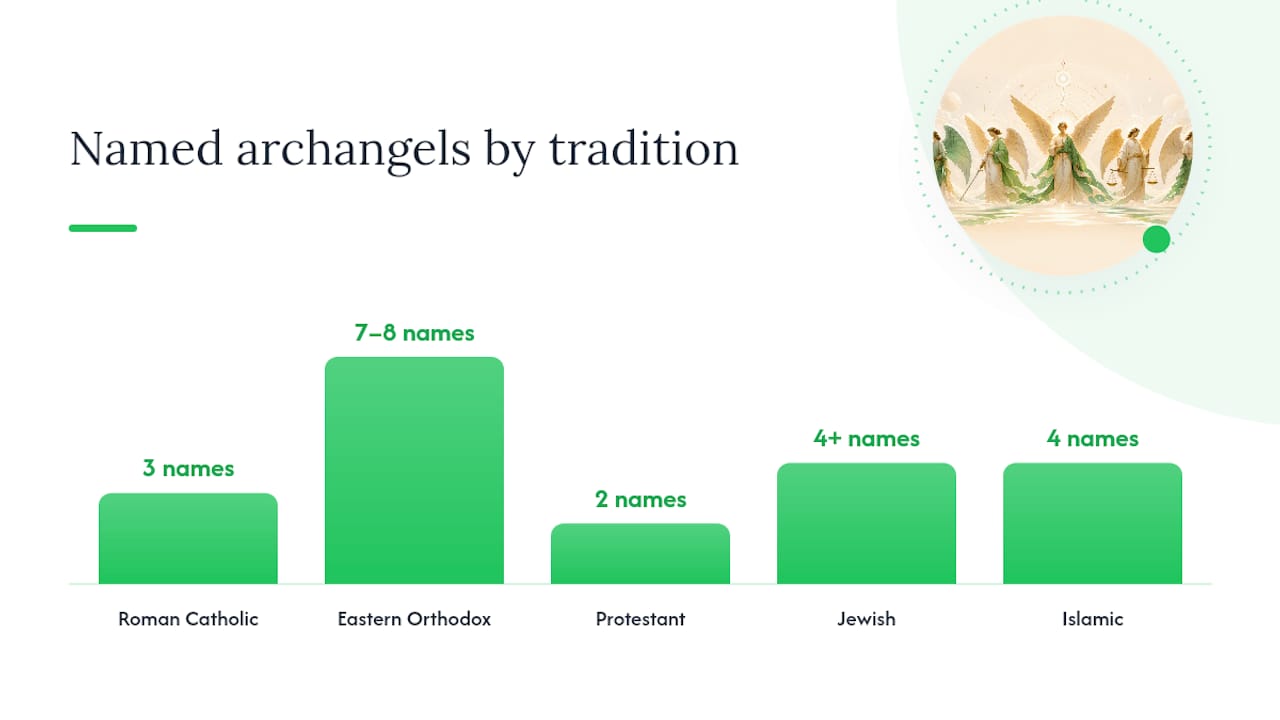
The caution worth noting: Catholic guidance actively discourages assigning names to angels drawn from non-canonical sources. The reasoning is straightforward. Speculative naming can distort devotion by focusing on invented personalities rather than the missions God actually assigns. EWTN states plainly that Michael, Gabriel, and Raphael are the angels whose names and images have come down through the ages with genuine clarity in Catholic tradition.
How people connect with archangels through prayer and devotion
Devotional engagement with archangels follows patterns that have been stable for centuries, even as popular interest in extended name lists has grown.
Liturgical feasts as anchors:
- September 29 (Michaelmas): The Roman Rite celebrates Michael, Gabriel, and Raphael together. This is the most widely observed archangel feast in Western Christianity.
- November 8 (Synaxis of the Archangel Michael): The Eastern Orthodox commemoration of Michael and all the bodiless powers, including the broader roster of venerated archangels.
- May 8: Commemorates an apparition of Michael at Monte Gargano in some Western calendars.
Practical devotional approaches:
- Invoke Michael for protection, especially in spiritual conflict. The Prayer to Saint Michael, composed in the 19th century and still widely used, asks for defense against evil.
- Invoke Raphael for healing, safe travel, and guidance in finding a spouse. The Tobit narrative provides the scriptural template for this.
- Invoke Gabriel when seeking clarity in communication, discernment of God’s will, or strength to accept a difficult calling.
Signs and symbolic cues: Many people report a sense of connection through recurring imagery (a feather, a particular light quality, a dream) or through patronage synchronicities (praying to Raphael before a medical appointment and feeling calm). These experiences are real to those who have them. The responsible approach is to treat them as invitations to prayer rather than proof of a specific archangel’s direct intervention, and to bring any significant spiritual experiences to a confessor or spiritual director.
Pro Tip: Focus your archangel devotion on the three canonical names first. Michael, Gabriel, and Raphael have centuries of liturgical, scriptural, and theological grounding. Once that foundation is solid, exploring the broader tradition through reliable sources is far more fruitful than starting with extended popular lists.
Why the names matter more than the lists
There is a tendency in popular spirituality to treat archangel names as a kind of catalog, the longer the better. Seven archangels, twelve archangels, fifteen. The number keeps expanding, and with it, the sense that knowing more names equals deeper spiritual knowledge.
That framing gets it backwards. The Catholic Apostolate Center’s insight that an angel’s name is a theological statement about its mission is the more useful lens. Michael’s name is not a label; it is a declaration that nothing rivals God. Gabriel’s name is not a title; it is a description of where his strength comes from. Raphael’s name is not a category; it is a promise about what God does through him.
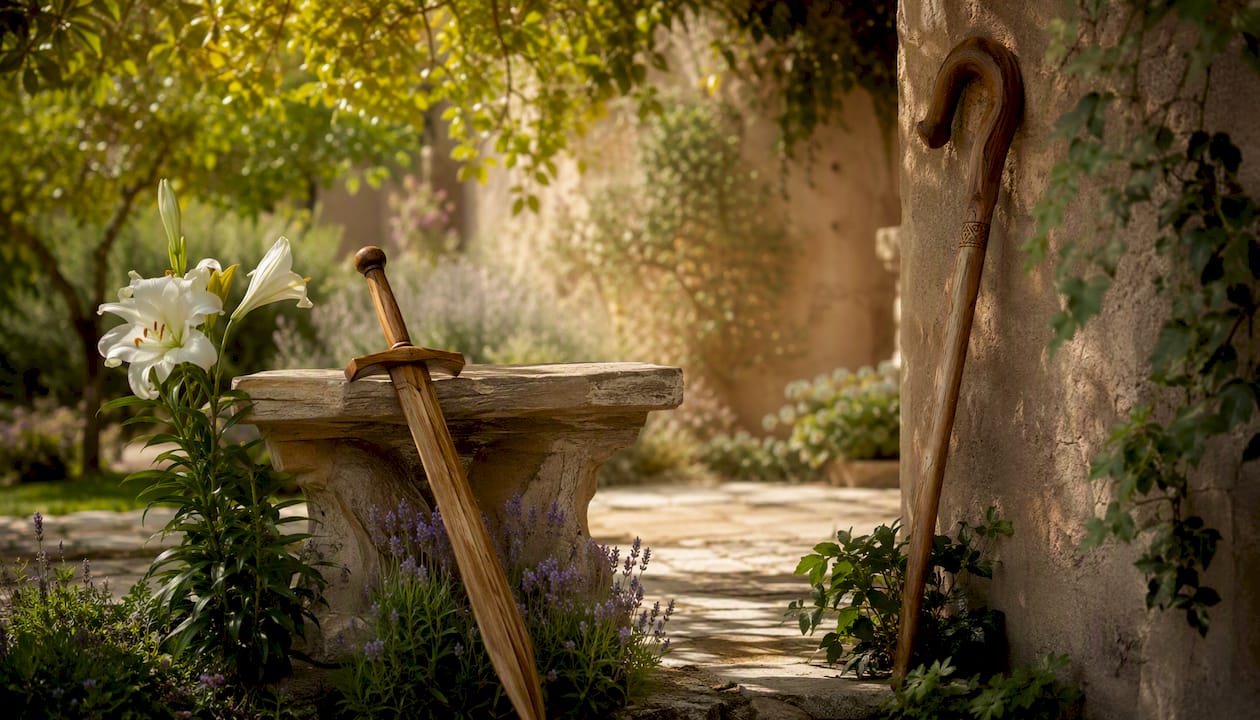
When devotional art depicts these figures, the best work carries that theological weight visually. The sword, the lily, the fish and staff: each image is a compressed version of the name’s meaning. That is why archangel imagery has persisted in Christian art for two millennia. It is not decoration. It is theology made visible.
The extended lists from Enoch and later tradition are worth knowing as historical and literary context. But treating Chamuel or Jophiel with the same devotional weight as Michael or Raphael conflates very different levels of attestation. The National Catholic Register’s scriptural guide recommends focusing on intercession and protection rather than speculative cataloging, and that advice holds whether you are approaching archangels through prayer or through art.
Archangel art for your prayer space
Archangel imagery belongs in devotional spaces the same way the names belong in prayer: grounded, purposeful, and connected to a real tradition. Divineprints offers museum-grade fine art prints and canvases of Michael, Gabriel, Raphael, and other archangels, available in multiple sizes and frame options, suited for home chapels, bedrooms, offices, and parish walls.

Whether you are looking for a Saint Michael print that captures his warrior iconography, or browsing the full saints and archangels collection for a Confirmation gift, baptism gift, or First Communion present, Divineprints ships across the United States with quality that holds up in any devotional setting. Browse the collection and find the archangel whose name and mission speaks to where you are right now.
Sources
These sources let you verify the claims in this article against primary texts and authoritative commentary. Compare how each tradition handles the same names, and check liturgical calendars for feast observances in your own denomination.
- Synaxis of the Archangel Michael and the Other Bodiless Powers — OCA
- What Is the Meaning Behind the Names of Three Archangels? | uCatholic
- Archangels, Names, and Mission — Catholic Apostolate Center
- Angels with names — EWTN
- Fallen Angels, Guardian Angels and Archangels: A Scriptural Guide — National Catholic Register
- Seven Archangels — Wikipedia
When using these sources, read them in sequence: canonical Scripture first, deuterocanonical books second, apocryphal texts third, and later tradition last. That order reflects the weight each layer carries across the broadest range of Christian denominations.