

Christian wall art is the use of visually expressive religious artwork designed to inspire faith and spiritual reflection within home environments. It goes beyond decoration. A crucifix above the bed, a print of the Sacred Heart in the hallway, or a Nativity scene in the living room each serve as daily reminders of what matters most. This guide covers traditional placement, gallery wall design, style selection, and how to build a devotional space that feels both beautiful and genuinely sacred.
What is Christian wall art and why does it matter for your home?
Christian wall art refers to any religious artwork placed in the home to express faith, encourage prayer, and keep sacred figures and scripture visible in daily life. The category includes icons, classical paintings, stained glass motifs, scripture prints, and modern watercolor interpretations of biblical scenes. Subjects range from Jesus Christ and the Holy Family to patron saints, angels, and Gospel narratives.
Faith expressed through visual art supports spiritual growth in a concrete way. When you see a print of the Transfiguration or the Sacred Heart every morning, it shapes how you start your day. That is the core purpose of religious wall art: not to fill empty wall space, but to fill your home with meaning.
The recognized industry term for this category is devotional art, a tradition stretching from Byzantine icons to Renaissance altarpieces. Christian wall art is the modern, accessible form of that same impulse. Both terms are useful, and both describe the same goal: keeping faith visible.
What are the traditional and devotional placements for Christian wall art?
Placement is not an afterthought. Where you hang religious artwork shapes how often you engage with it and how deeply it supports your prayer life.
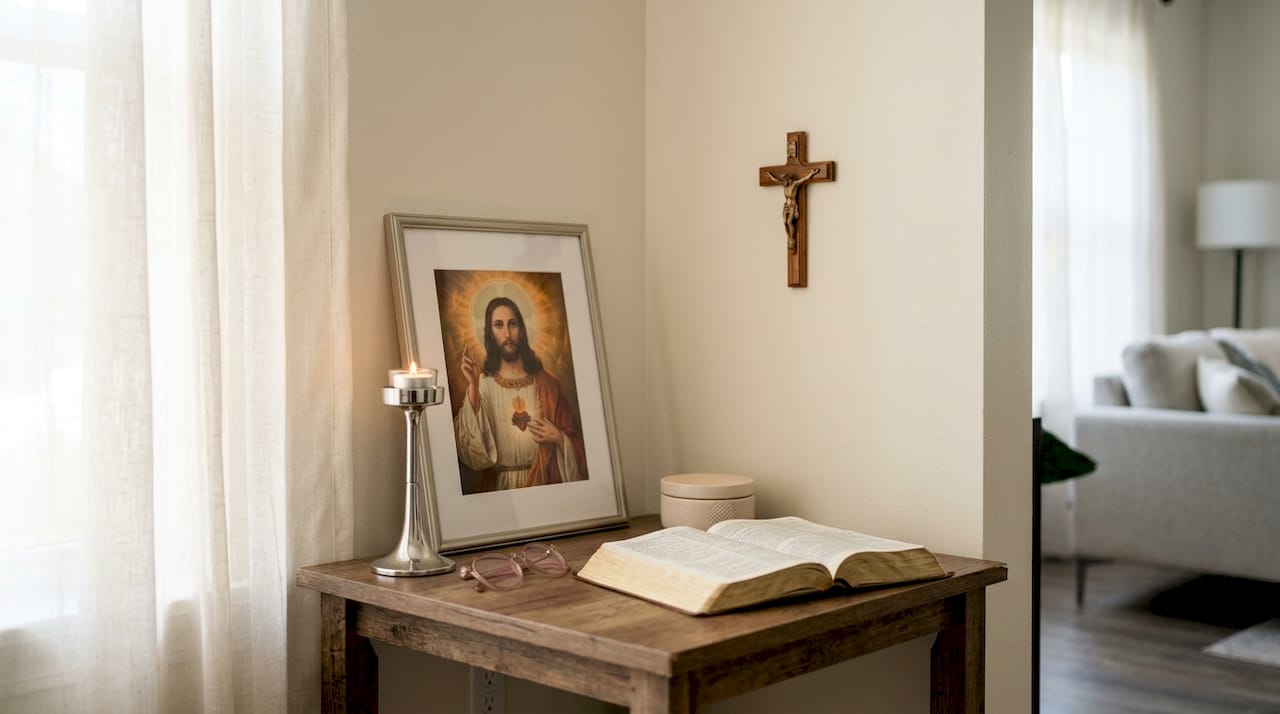
The crucifix serves as a primary anchor for domestic prayer, traditionally placed above the bed or at the main entrance of the home. This positioning is intentional. It means the first thing you see in the morning and the last thing you see at night is a symbol of Christ’s sacrifice. The same logic applies to the front door: a cross or icon greeting you as you leave reminds you to carry your faith into the world.
Common placement choices for devotional art include:
- Above the bed: Crucifix or image of the Holy Family for morning and evening prayer focus.
- Main entryway: Cross, icon of Christ, or a patron saint print to bless comings and goings.
- Living room: Larger biblical scenes such as the Last Supper or the Nativity, where family gathers.
- Home office or study: Scripture prints or saint portraits that encourage patience and wisdom during work.
- Children’s bedroom: Guardian angel prints or images of the child’s patron saint.
Home altars avoid clutter with mundane items, maintaining focus on Christ and the Word of God. A devotional space loses its power when it becomes a catch-all shelf. Keep the area reserved for sacred objects only: a crucifix, a Bible, a rosary, and one or two meaningful images.
Pro Tip: Place your most meaningful piece at natural eye level in the room where you spend the most time. Repeated, effortless visual contact builds the habit of prayer far more reliably than a dedicated space you rarely visit.
How to design a gallery wall with Christian religious artwork
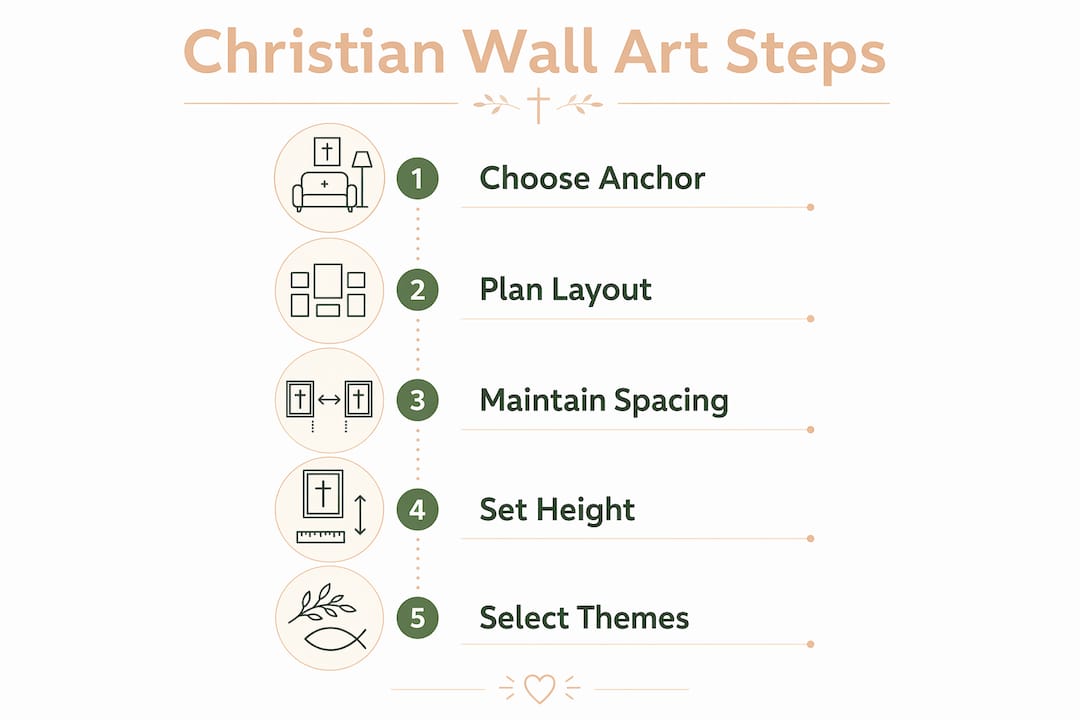
A gallery wall of religious artwork can be one of the most powerful statements in a home. Done well, it feels like a chapel wall. Done poorly, it feels like a cluttered bulletin board. The difference comes down to a few clear principles.
Start with an anchor piece
Use one large anchor piece at least 50% larger than the other frames to create a visual focal point and unify the composition. For a faith-inspired gallery wall, this anchor is often a crucifix, a large print of Jesus Christ, or a significant biblical scene such as the Transfiguration. The anchor piece gives the viewer’s eye a place to rest before exploring the surrounding images.
The Transfiguration of Jesus print works exceptionally well as an anchor piece. Its vertical orientation and luminous imagery draw the eye immediately and hold it.
Plan before you hang
Follow these steps to avoid the most common mistakes:
- Lay all frames on the floor in your intended arrangement before touching the wall.
- Trace each frame onto paper and cut out the templates.
- Tape the paper templates to the wall with painter’s tape to test spacing and balance.
- Adjust until the layout feels right, then mark nail positions through the paper.
- Hang the anchor piece first, then build outward from the center.
Planning before hanging avoids common mistakes such as hanging too high or creating inconsistent spacing. This single step saves hours of patching nail holes.
Follow the spacing and height rules
Maintain 2–3 inch spacing between frames for a cohesive gallery wall composition. Gaps smaller than 2 inches make the arrangement feel crowded. Gaps larger than 3 inches make it feel scattered.
The optical center of the arrangement should sit at 57–60 inches from the floor. This is the standard museum hanging height, and it ensures the art reads comfortably at eye level without neck strain. Note that this refers to the center of the entire arrangement, not the center of any single frame. That distinction matters when your grouping is asymmetrical.
For art hung above a sofa or bed, keep art width at about two-thirds of the furniture’s width and hang the lowest frame 6–8 inches above the furniture. This creates proportional balance between the art and the furnishings beneath it.
Pro Tip: Mix frame sizes and orientations, but limit yourself to two frame finish families, such as black and natural wood. Visual variety in size creates energy; consistency in finish creates calm.
What styles and themes work best for Christian artwork for home?
The range of styles available in Christian artwork for home is wider than most people realize. Choosing the right style means matching your personal devotion with your home’s existing aesthetic.
Traditional Christian art styles include icons, classical paintings, and stained glass motifs. Modern interpretations include abstract, minimalist, and watercolor designs that carry the same sacred subjects in a contemporary visual language. Neither approach is more devout than the other. The question is which one invites you to stop and reflect.
Popular subjects for biblical wall art for home include:
- Jesus Christ: The Sacred Heart, the Transfiguration, the Road to Emmaus, and the Resurrection.
- The Nativity: A perennial subject that works year-round, not just at Christmas.
- The Last Supper: A powerful choice for dining rooms, where its meaning resonates directly.
- Saints: Patron saints, martyrs, and holy men and women who model specific virtues.
- Scripture: Verses from the Psalms, the Gospels, or the letters of Paul rendered in calligraphy or modern typography.
Matching or harmonizing frame finishes unifies varied art collections into cohesive displays. If you mix a classical icon with a modern watercolor print, a shared frame finish ties them together visually. Limiting frame finishes to one or two families creates consistency without requiring every piece to look the same.
Authentic devotional art avoids decorative excess that distracts from sacred narratives. A print of the Sacred Heart should draw your attention to Christ, not to an ornate border. Reverence in design is a feature, not a limitation.
How can Christian wall art enhance your home altar or prayer corner?
A home altar is the most intentional devotional space in the house. The art you choose for it carries more weight than art placed anywhere else.
Home altars can be simple, using a small stable surface with essential devotional objects: a crucifix, a Bible, a rosary, and one or two meaningful images. Simplicity and consistency in prayer matter more than elaborate design. A single powerful image of Christ or a beloved patron saint often creates more focus than a crowded arrangement of many pieces.
When selecting art for a prayer corner, consider these principles:
- Choose subjects that speak to your specific devotion. A print of your patron saint, the Holy Family, or the Sacred Heart creates a personal connection that generic religious imagery cannot.
- Scale to the space. A small corner altar calls for one medium print or a small triptych. A larger dedicated room can support a fuller arrangement.
- Avoid non-sacred items. Books, candles, and rosaries belong. Mail, keys, and phone chargers do not.
- Use consistent framing. One or two frame styles keep the altar looking intentional rather than assembled from whatever was available.
The Sacred Heart of Jesus print is one of the most widely used images in Catholic home altars. Its direct gaze and warm color palette create an atmosphere of intimacy and invitation that suits prayer well.
Pro Tip: Place a small candle or votive holder near your altar art. The combination of a sacred image and soft candlelight creates a sensory environment that signals to your mind and body that it is time to pray.
Key Takeaways
Thoughtful placement and intentional selection make Christian wall art a living part of your daily faith, not just decoration.
| Point | Details |
|---|---|
| Placement shapes prayer habits | Hang the crucifix above the bed or at the main entry to build consistent daily engagement. |
| Gallery walls need an anchor | Use one piece at least 50% larger than the rest to unify the arrangement visually and spiritually. |
| Follow the 57–60 inch rule | Center your gallery wall arrangement at eye level to match standard museum hanging height. |
| Keep altars simple and sacred | Limit altar art to one or two meaningful images and remove all non-devotional objects. |
| Match frame finishes | Limit finishes to one or two families to unify diverse art styles into a cohesive display. |
What I have learned from living with devotional art every day
People often treat religious artwork as a category problem. They ask which style is most appropriate, which subjects are most reverent, which arrangement looks best. Those are real questions, but they miss the deeper one: does this art make you stop?
The most effective piece of religious art in my home is not the largest or the most expensive. It is a small print of the Sacred Heart hung at the end of a hallway I walk through a dozen times a day. Every time I pass it, I pause for two seconds. That pause, multiplied across a year, adds up to something real.
The mistake I see most often is quantity over intentionality. Families fill walls with religious imagery and then stop seeing any of it. The eye habituates to what is always there. A single powerful image in a well-chosen location does more work than ten prints competing for attention.
The design principles in this article, the anchor piece, the 57–60 inch center height, the 2–3 inch spacing, are not arbitrary rules. They are tools for making art visible. When art is visible, it does its job. When it blends into the background, it does not matter how sacred the subject is.
Start with one wall, one anchor piece, and one clear intention. Build from there. The goal is not a beautiful home. The goal is a home where faith is impossible to ignore.
— Griffin
Divineprints: faith-centered art for every room in your home
Divineprints offers a curated collection of prints designed specifically for Christian homes, from intimate prayer corners to full living room gallery walls.
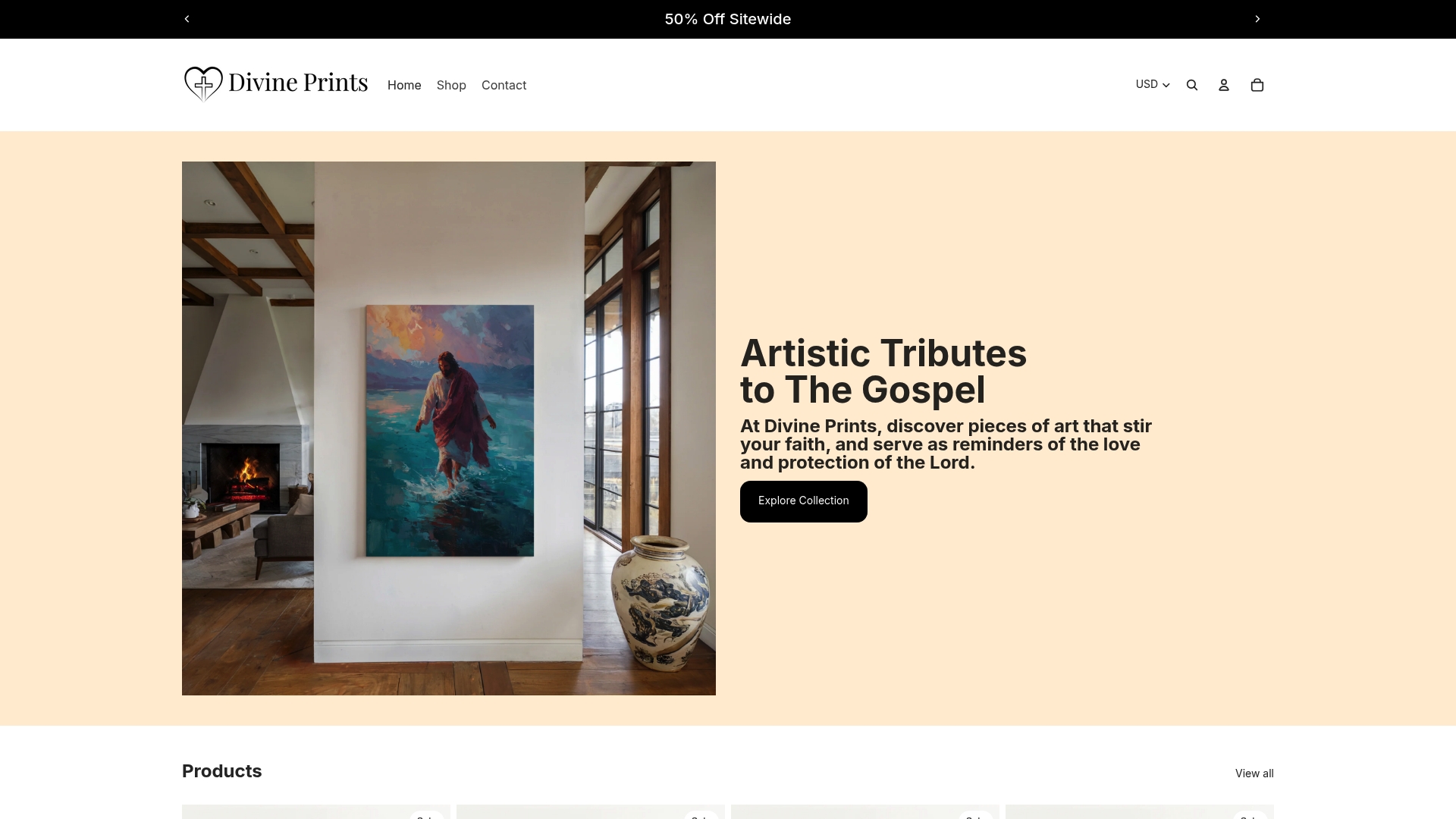
The Transfiguration of Jesus watercolor print and the Sacred Heart of Jesus print are two of the most popular choices for anchor pieces and home altars. Both combine reverent subject matter with high-quality printing that holds up in any room. Divineprints also carries the Nativity Scene and a range of saint prints for those building a more personal devotional collection. Every piece is designed to invite reflection, not just fill wall space.
FAQ
What is the best placement for a crucifix in a Christian home?
The crucifix is traditionally placed above the bed or at the main entrance of the home to anchor daily prayer. Either location ensures consistent visual contact with the central symbol of the faith.
How far apart should frames be on a Christian gallery wall?
Maintain 2–3 inches of spacing between frames for a unified, cohesive gallery wall. Gaps smaller than 2 inches feel crowded; gaps larger than 3 inches fragment the arrangement.
What height should I hang a gallery wall of religious artwork?
Center the entire gallery wall arrangement at 57–60 inches from the floor. This is the standard museum hanging height and keeps art at a comfortable eye level for most adults.
What art works best on a home altar or prayer corner?
A crucifix, one or two devotional images such as a patron saint or the Sacred Heart, and a Bible are the core elements. Keep the space free of non-sacred objects to preserve its atmosphere for prayer.
What are the most popular subjects in Christian pictures for wall display?
The most popular subjects include Jesus Christ in various scenes, the Nativity, the Last Supper, patron saints, and scripture verses. The right choice depends on your personal devotion and the room where the art will hang.