

Saint Anthony of Padua is the patron saint of lost things. When something goes missing, the fastest first step is to say the short rhyme that Catholics have used for centuries: “Tony, Tony, turn around, something’s lost and must be found.” For a more serious loss, move directly to the Unfailing Prayer or begin a nine-day novena.
Here is what you need to know right now:
- Who to pray to: St. Anthony of Padua, a 13th-century Franciscan friar, Doctor of the Church, and one of the most widely invoked saints in Catholic tradition.
- Quickest prayer: The short rhyme above, said with genuine intention.
- Deeper prayer: The Unfailing Prayer to St. Anthony, available from the St. Anthony Shrine in Boston.
- Sustained intercession: A nine-day novena, which you can submit to the Franciscan Friars of the Atonement at Graymoor, New York.
- Shrine resource: The National Shrine of the Immaculate Conception in Washington, DC, offers additional devotional context and prayer support.
Table of Contents
- What prayers do you actually say to St. Anthony?
- Why is St. Anthony the saint for lost things? The stolen psalter story
- How to pray to St. Anthony step by step
- How is St. Anthony’s feast day celebrated in the United States?
- What does St. Anthony’s patronage actually mean theologically?
- Key Takeaways
- St. Anthony’s prayers work best when you actually use them
- Keep St. Anthony close with devotional art from Divineprints
- Authoritative sources and further reading
What prayers do you actually say to St. Anthony?
Most people start with the rhyme. It is informal, quick, and has been passed down through Catholic families for generations. Say it once, with focus, and then go look.
For a slightly more formal moment, the short “Help me find” prayer from the Franciscan Basilica of Saint Anthony in Padua reads simply: “Dear St. Anthony, please come around — something is lost and cannot be found.” Both versions work as an immediate, sincere petition.
The Unfailing Prayer
When the loss is more serious, or when the rhyme has not produced results, Catholics turn to the Unfailing Prayer. The full text, as published by the St. Anthony Shrine:
"O Holy St. Anthony, gentlest of saints, your love for God and charity for His creatures made you worthy, when on earth, to possess miraculous powers. Miracles waited on your word, which you were ever ready to speak for those in trouble or anxiety. Encouraged by this thought, I implore you to obtain for me [request]. The answer to my prayer may require a miracle; even so, you are the saint of miracles. O gentle and loving St. Anthony, whose heart was ever full of human sympathy, whisper my petition into the ears of the sweet Infant Jesus, who loved to be folded in your arms; and the gratitude of my heart will ever be yours. Amen."
Notice the Christ-child imagery. Anthony is traditionally depicted holding the Infant Jesus, and the prayer leans into that iconography directly, asking him to “whisper” the petition to the child. It is a theologically layered request, not just a plea to a saint.
The Novena to St. Anthony
A novena is nine consecutive days of prayer, drawn from the nine days the apostles prayed between the Ascension and Pentecost. The Sacred Heart Parish novena opens with this invocation:
“O wonderful St. Anthony, glorious on account of the fame of your miracles, strong through the condescension of Jesus who listened to you, mild and full of compassion for those who have recourse to you…”
To pray a novena: choose a consistent time each day, say the opening invocation, state your specific intention clearly, and close with a prayer of thanksgiving. Nine days is the commitment. Many parishes offer a communal novena to St. Anthony on Tuesdays, which has become a widespread tradition in the United States.
Why is St. Anthony the saint for lost things? The stolen psalter story
The origin traces to a single incident in Bologna, likely around 1220. Anthony was teaching theology to novices and had lent his annotated psalter, a handwritten book of psalms with his personal teaching notes, to a novice who then left the Franciscan order. The book went with him.
Anthony prayed for its return. According to the tradition recorded by the National Shrine of the Immaculate Conception, the novice was compelled to return the psalter intact. The story spread through Franciscan communities across Europe, and Anthony’s reputation as someone who could recover what was lost became embedded in popular devotion.
| Event | Date |
|---|---|
| Joins the Franciscan Order | 1220 |
| Psalter legend (Bologna) | around 1220 |
| Death in Padua, Italy | June 13 |
| Feast Day (universal) | June 13 |
Canonized less than a year after his death, Anthony holds one of the fastest canonizations in Catholic history. His feast day falls on the anniversary of his death, June 13. The Our Sunday Visitor account notes that Franciscan missionaries carried his story across continents, which explains why devotion to him for lost things appears in Catholic communities from Brazil to the Philippines to the American Midwest.
How to pray to St. Anthony step by step
Praying to St. Anthony does not require a formula, but a clear sequence helps, especially when you are stressed and distracted by the loss itself.
- Give thanks when the item is found — Gratitude is not optional in Catholic devotional practice. Many people make a small donation to a charity in Anthony’s name, a custom called “St. Anthony’s Bread,” when their prayer is answered.
The attitude matters as much as the words. Petition with confidence, not demand. Anthony intercedes; the outcome belongs to God.
Pro Tip: Pair prayer with practical action. Check the last three places you used the missing item before you pray, then pray, then check again. Devotion and common sense are not in competition.
How is St. Anthony’s feast day celebrated in the United States?
June 13 is the feast day of St. Anthony of Padua, and in the United States it is observed with a range of parish and shrine devotions that go well beyond a single Mass.
At the parish level, June 13 typically brings a special Mass in Anthony’s honor, often followed by a blessing of bread (the “St. Anthony’s Bread” tradition), a procession, and the distribution of prayer cards. Many parishes in Italian-American communities hold outdoor festivals tied to the feast.
The Franciscan Friars of the Atonement at Graymoor in Garrison, New York, maintain a perpetual novena that has run continuously since 1912. You can submit a prayer request directly to Graymoor online or by mail, and the friars will include your intention in their ongoing novena. This is one of the most organized forms of communal intercession available to American Catholics outside of a pilgrimage.
The National Shrine of the Immaculate Conception in Washington, DC, features a chapel dedicated to St. Anthony and offers resources for feast day observance and ongoing devotion.
What does St. Anthony’s patronage actually mean theologically?
Anthony was declared a Doctor of the Church in 1946, one of only 37 saints to hold that title. His designation as a “wonder-worker” (Thaumaturgus) predates that honor by centuries, rooted in the rapid miracles attributed to him both during his life and immediately after his death.
The theological argument for his patronage runs like this: God cares about daily details, not only grand spiritual crises. Anthony’s intercession for lost objects signals that nothing is too small to bring to prayer. Franciscan and shrine materials consistently extend this beyond physical objects. You can invoke Anthony for a lost sense of vocation, a lost friendship, or a lost feeling of peace. The Atonement Friars explicitly frame his patronage as covering spiritual losses alongside material ones.
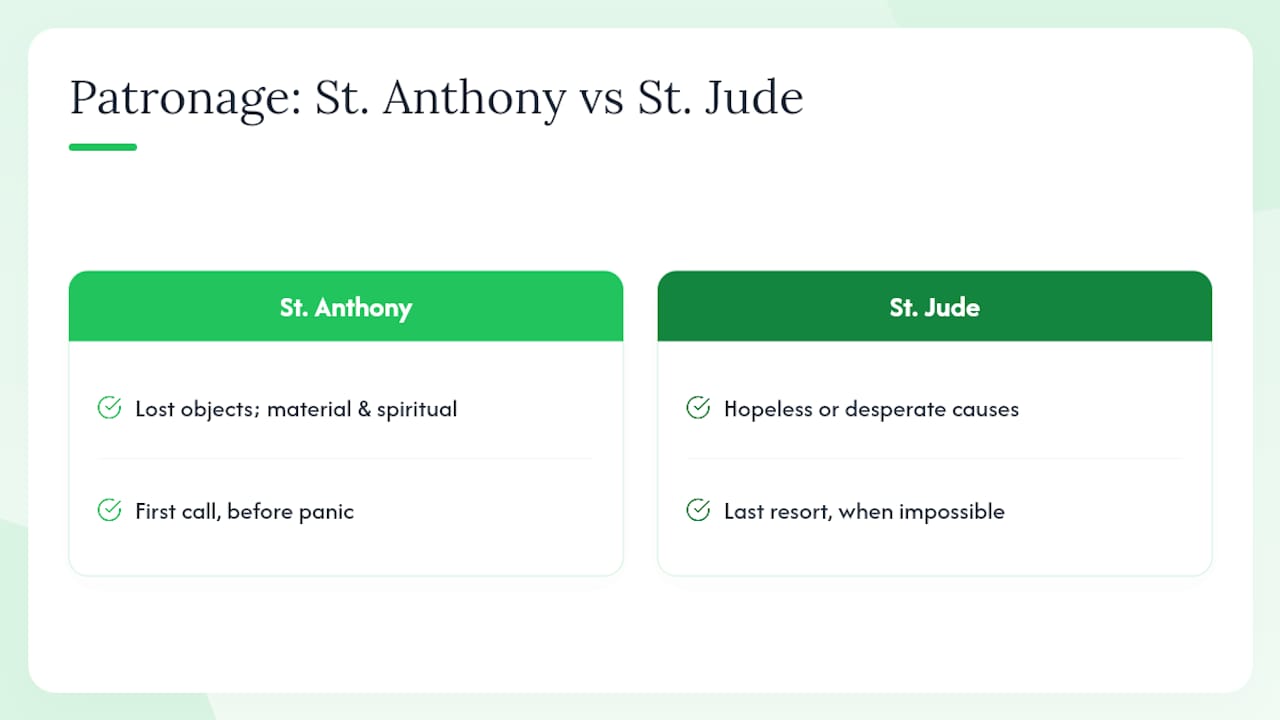
Compared to St. Jude, who is invoked for hopeless or desperate causes, Anthony’s patronage is more everyday. Jude is the last resort; Anthony is the first call. That distinction shapes how Catholics approach each saint: Jude when the situation feels impossible, Anthony when something specific has gone missing and you want to pray before panic sets in.
Pro Tip: If you want organized prayer support beyond your own novena, contact the Franciscan Friars of the Atonement at Graymoor or your local Franciscan parish. Many friaries accept written or online prayer intentions and include them in communal novenas.
Key Takeaways
Saint Anthony of Padua is the patron saint of lost things; start with the short rhyme or the Unfailing Prayer, and move to a nine-day novena when the need is serious or persistent.
| Point | Details |
|---|---|
| First prayer to say | Use the short rhyme or the Unfailing Prayer immediately when something goes missing. |
| When to use a novena | Begin nine days of prayer for serious losses: important documents, missing persons, or spiritual needs. |
| Feast day observance | June 13 brings special Masses, processions, and the St. Anthony’s Bread tradition at parishes nationwide. |
| Shrine and friary support | The Franciscan Friars of the Atonement at Graymoor have maintained a perpetual novena since 1912. |
| Devotional reminder | Divineprints offers saint prints as visual anchors for daily prayer near keys, desks, or home altars. |
St. Anthony’s prayers work best when you actually use them
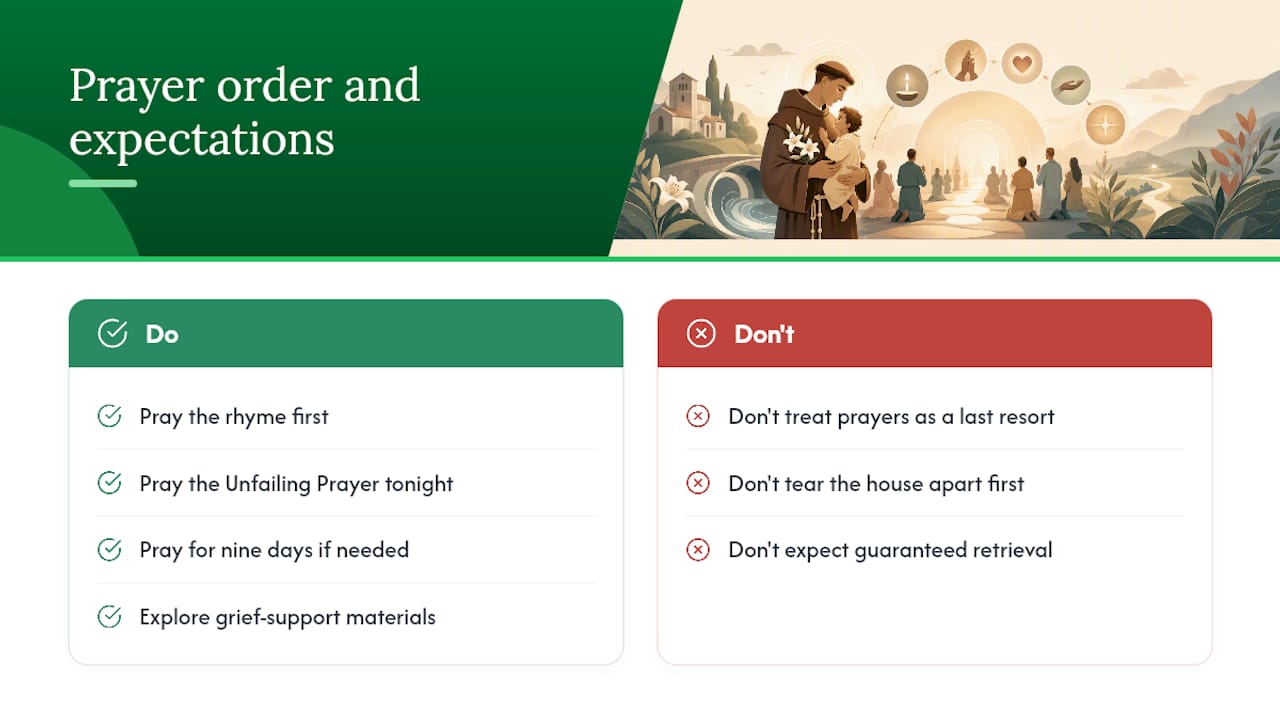
There is a temptation to treat these prayers as a last resort, something you say after you have already torn the house apart. Try flipping that order. Say the rhyme first, before the search escalates into frustration. The act of pausing to pray does something practical: it slows you down, which is often exactly when you remember where you left the thing.
That said, unanswered prayers are real, and it is worth naming that honestly. Not every lost item comes back. Not every novena ends with the outcome you wanted. The tradition does not promise retrieval; it promises that your petition is heard and that God’s care extends to the ordinary details of your life. That reframing, from “will I get my thing back” to “am I bringing this to God,” is where the devotion actually lives.
Start with the rhyme. If the loss matters, pray the Unfailing Prayer tonight. If nine days from now you are still searching, you will have prayed your way through something, and that is never wasted; for additional support, explore these grief-support materials that offer spiritual consolation during difficult times.
Keep St. Anthony close with devotional art from Divineprints
A saint print placed near your front door, your desk, or your prayer corner does something a phone reminder cannot: it makes the invitation to pray visible every single day.

Divineprints offers a growing collection of saint prints printed on museum-grade fine art paper and canvas, in multiple sizes and frame options. The Saint Anthony of Padua print is a natural fit for anyone who prays to him regularly, whether for lost items, lost people, or the quieter spiritual losses that do not have a name. Place it near your keys, your filing cabinet, or your home altar, and let it serve as a daily prompt to pray before the panic starts. Browse the full saints collection at Divineprints and find the print that fits your space and your devotion.
Authoritative sources and further reading
These are the primary sources used throughout this article. Each one is worth bookmarking for prayer texts, historical background, and shrine information.
- St. Anthony of Padua | Biography, Patron Saint, Facts, Prayer, & Feast Day | Britannica
- Unfailing Prayer to St. Anthony - St. Anthony Shrine
- Help me find | Saint Anthony of Padua - Santantonio.org
- Who is the Patron Saint of Lost Things? - National Shrine of the Immaculate Conception
- Why is St. Anthony the patron saint of lost things? - Atonement Friars
- Why is St. Anthony the patron saint of lost things? - Our Sunday Visitor
- Sacred Heart Parish — Prayer to St. Anthony
For local Mass times and community novenas on or near June 13, check your diocesan website or contact your nearest Franciscan parish directly.