

St. Joseph is usually shown with carpenter’s tools, a white lily or flowering staff, the child Jesus, and a pair of turtledoves. Together these mark him as provider, protector, and chaste, righteous Jew. Other recurring motifs, the Star of David, a rod of authority, sandals, and a loaf of bread, round out a visual language built over centuries of devotion. The sections below unpack where each symbol came from and what it means.
TL;DR:
- The carpenter’s tools reflect Joseph’s broad skill set as a builder and often symbolize his role as a working man and provider.
- The lily and flowering staff emphasize his chastity, divine selection, and connection to the Holy Trinity, with the staff deriving from apocryphal Legends.
- Symbols like the turtledoves and star of David highlight his modesty and Jewish heritage, but many icons incorporate legends rather than direct scriptural references.
- Artistic depictions have shifted from an elderly, sidelined figure in medieval times to a vigorous, protective figure in Renaissance and modern art, reflecting changing Church priorities.
- Symbols such as the lily, tools, and cloak remain vital in devotion, each representing purity, labor, and protection, and are used in feast days, household prayer, and devotionals today.
Table of Contents
- What Are the Main St. Joseph Symbols and Their Meanings?
- Where Do St. Joseph’s Symbols Actually Come From?
- How Has St. Joseph’s Image Changed in Art Over Time?
- How Do St. Joseph’s Symbols Appear in Feast Days and Devotion?
- How Do You Choose and Display St. Joseph Devotional Art?
- What Does the Oak Tree Symbol Mean for St. Joseph?
- What Does the Rod or Staff Represent Beyond the Flowering Legend?
- How Do Joseph’s Symbols Reflect Humility and Obedience?
- Why Do Artists Include the Carpenter’s Apron and Belt?
- What Does Joseph’s Cloak Symbolize in Traditional Art?
- Why St. Joseph’s Symbols Still Matter for Modern Believers
- Bring St. Joseph’s Symbols Into Your Own Prayer Space
- Sources
What Are the Main St. Joseph Symbols and Their Meanings?
Every symbol attached to St. Joseph does a specific job. Some point to his trade, some to his marriage, some to his place in salvation history. Reading them correctly changes how you see a painting, a holy card, or a print hanging in your own home.
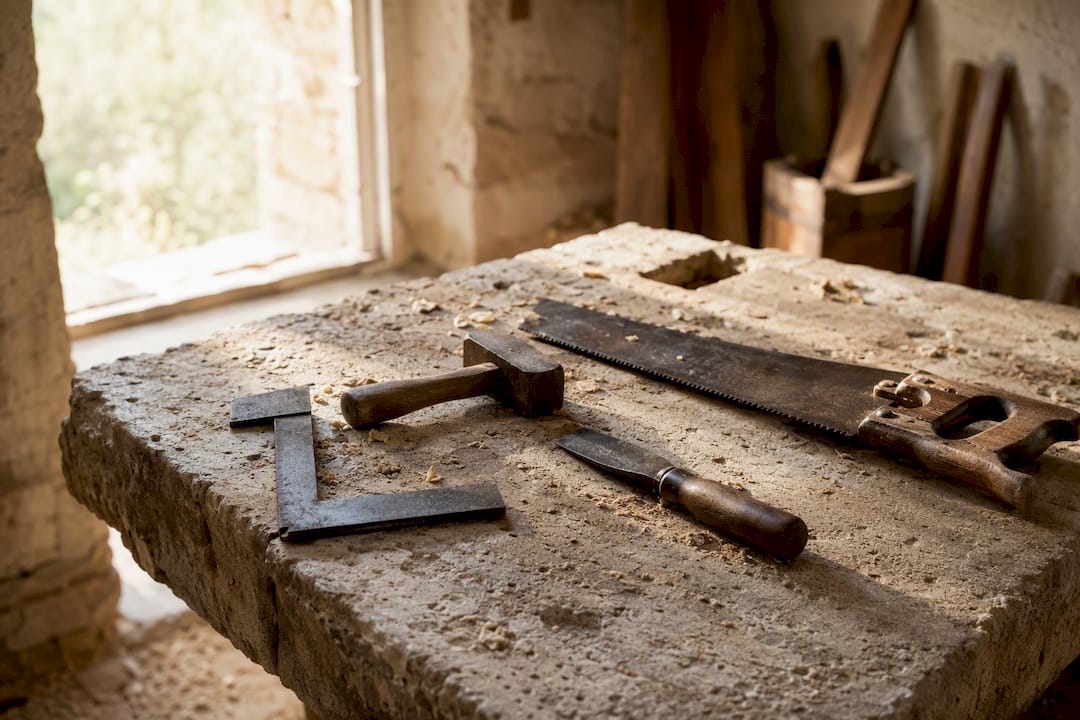
Carpenter’s tools. The Gospel of Matthew calls Joseph a tekton, a Greek word usually translated “carpenter” but closer in meaning to “craftsman” or “builder.” Art responded by handing him the tools of that trade: a builder’s square, hammer, saw, axe, planer, and workbench. The University of Dayton’s Marian Library notes these tools reflect the broad skill set an ancient artisan actually needed, not a narrow specialty. The square in particular recurs so often it functions almost as shorthand for Joseph himself, standing for his dignity as a worker and his role providing for Mary and Jesus through manual labor.
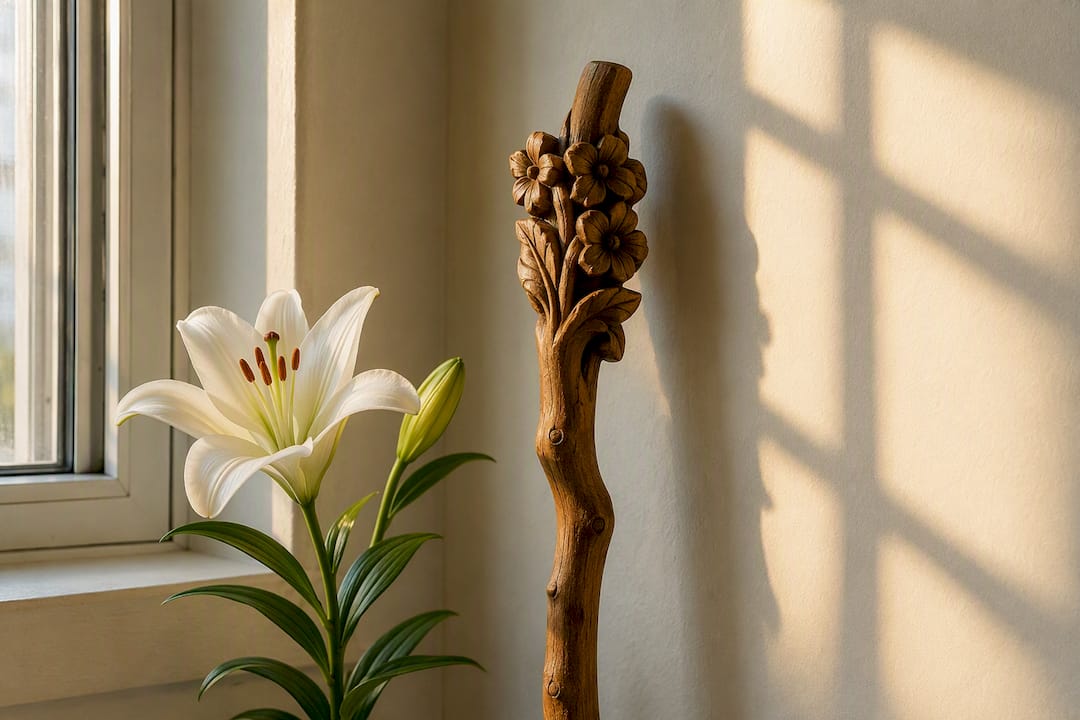
White lily and flowering staff. The lily is Joseph’s second most recognizable attribute, and it carries the heaviest theological weight. Devotional writing consistently ties the flower to his chastity and his respect for Mary’s virginity, a point Catholic365 lays out in detail. The flowering staff variant comes from a specific legend: when suitors for Mary’s hand presented their staffs at the Temple, Joseph’s alone bloomed, marking him as her divinely chosen husband. When the staff shows three flowers rather than one, it adds a second layer of meaning, a nod to the Holy Trinity, according to the Marian Library. Some art historians draw a parallel to Aaron’s rod in the Book of Numbers, another staff that blossomed as a sign of divine selection.
Child Jesus imagery. Joseph holding, carrying, or gazing at the infant Christ is less a single symbol than a whole visual argument: this man is guardian, protector, and father-figure to the Son of God, even without being his biological father. This motif carries different weight than the tools or the lily since it depicts relationship rather than attribute.
Pair of turtledoves. Luke’s Gospel records that Mary and Joseph brought two turtledoves to the Temple for the Presentation, the offering permitted under Leviticus 12:8 for families who could not afford a lamb. The Marian Library points out that the birds function as a quiet marker of the Holy Family’s material poverty, a detail artists include to humanize Joseph as a working man of modest means rather than a distant, idealized figure.
Star of David and “son of David” references. Matthew’s genealogy roots Joseph in the royal line of David, and artists sometimes work a six-pointed star or explicit Davidic reference into a composition to signal that lineage. This detail also underscores Joseph’s Jewish piety and his careful observance of the Law, visible in his willingness to follow Temple customs even under difficult circumstances.
Other identifying motifs fill out the catalog:
- The letter “J” or monogram, used mainly in later devotional graphics and holy cards for quick identification.
- A loaf of bread, referencing his role as provider and sometimes his patronage tied to daily sustenance.
- Sandals, a simple marker of a traveling, working man rather than nobility or clergy.
- A cloak, often depicted in warm brown or gold tones, discussed further below.
None of these symbols works alone. As the Gospel Weeklies overview points out, artists across centuries adapted tool depictions to whatever material culture they knew, so a square or hammer in a given painting often reflects the artist’s own era rather than authentic first-century Nazareth woodworking. That is exactly why identification usually depends on combinations, a lily plus tools plus the child, rather than any single object.
Where Do St. Joseph’s Symbols Actually Come From?
Not every symbol traces back to scripture, and knowing which is which matters if you want devotionally accurate art rather than pious guesswork.
The canonical anchors are narrow but solid. Matthew’s Gospel identifies Joseph as a tekton and places him in David’s lineage. Luke records the Presentation at the Temple and the turtledove offering. That is essentially the full scriptural footprint. Joseph speaks not a single recorded word in the New Testament, and his story is told almost entirely through action rather than dialogue.
Most of the richer, more evocative symbols come from later sources:
- The Protevangelium of James, a second-century apocryphal text, introduces the story of suitors presenting staffs at the Temple, with Joseph’s staff singled out by a sign from heaven.
- The Golden Legend, a thirteenth-century collection of saints’ lives compiled by Jacobus de Voragine, elaborated and popularized many of these stories for a medieval audience already hungry for vivid religious narrative.
- Later medieval devotional writing built on both, adding details about Joseph’s age, his prior marriage in some traditions, and the specifics of the flowering staff.
The Marian Library is direct about this layering: many of Joseph’s most beloved symbols come from apocryphal or medieval devotional stories rather than the Gospel narrative itself. That is not a mark against them. Apocryphal material shaped an enormous amount of Christian visual tradition, nativity scenes, images of Mary’s childhood, and plenty of saints’ iconography included, long before art historians started drawing sharp lines between “canonical” and “legendary.”
The more useful way to think about these symbols is as theological parables rather than historical reportage. The flowering staff was never meant to function as a documentary claim about a botanical miracle at a specific Temple gate. It communicates something true about Joseph’s character and calling, his purity, his divine selection, his quiet righteousness, using narrative imagery instead of doctrinal statement. Readers who understand this distinction get more out of devotional art, not less. You can hold a symbol as spiritually meaningful without needing it to be a literal newsreel of first-century events.
This layering also explains why some symbols feel more “official” than others. The carpenter’s tools and the turtledoves have Gospel backing and appear consistently across traditions. The flowering staff, while beloved and nearly universal in Western art, rests entirely on apocryphal and medieval sources, which is part of why Eastern Christian traditions handle it differently than Western Catholic devotional art does.
How Has St. Joseph’s Image Changed in Art Over Time?
Joseph’s visual treatment shifted dramatically over the centuries, and the shift tells you almost as much about Church priorities as it does about art history.
Medieval art frequently sidelined Joseph. When he appears in nativity scenes from this period, he is often drawn as elderly, stooped, sometimes even comic, seated off to the side while the real theological action happens between Mary and the newborn Christ. This wasn’t accidental. Medieval theology tended to emphasize Mary’s perpetual virginity so heavily that Joseph’s presence needed careful handling, and giving him an advanced age helped defuse any implication of a conventional marriage.
Art UK’s survey of the tradition traces a real turning point starting in the Renaissance, when Joseph moves from marginal figure to central, vigorous protector. Painters began depicting him as a younger, physically capable man actively engaged in raising and defending the Holy Family, a shift that tracked a broader theological turn toward honoring his guardianship rather than merely explaining away his marriage. By the time you reach later Catholic devotional art, Joseph frequently appears strong, alert, and tender all at once, cradling the child Jesus with the same physical presence you would expect from any working father.
Eastern icon traditions took a somewhat different path. Byzantine and Orthodox iconography tends to preserve older conventions, Joseph often depicted at a distance from the manger scene, sometimes shown in quiet conversation with a shepherd figure representing doubt or temptation, a detail almost never used in Western art. This isn’t a flaw in either tradition; it reflects different theological emphases about how much narrative “humanity” belongs in icons versus devotional paintings.
A few motifs recur across both traditions and are worth learning to spot:
- Sleeping Joseph, receiving angelic instruction in a dream, tied directly to Matthew’s Gospel and popularized in modern devotion partly through Pope Francis’s personal attachment to the image.
- Joseph with apron and tools, emphasizing the working man over the royal or priestly figure.
- Joseph carrying the child, a composition that became far more common as devotional focus shifted toward his paternal, protective role.
Each shift in emphasis came from pastoral need as much as artistic fashion. When the Church wanted to promote Joseph as patron of workers, tool imagery multiplied. When devotion to the Holy Family intensified, images of Joseph holding or walking with Jesus became more common. Art followed theology, not the other way around.
How Do St. Joseph’s Symbols Appear in Feast Days and Devotion?
St. Joseph’s symbols aren’t confined to museum walls. They show up in living parish practice, household prayer corners, and specific liturgical dates that Catholics and other Christians mark every year.
Two feast days anchor this devotion. March 19 honors Joseph as spouse of Mary and patron of the universal Church, while May 1 celebrates him under the title Joseph the Worker, a date deliberately chosen to align with International Workers’ Day. The symbols emphasized on each occasion differ slightly, tools and workbenches for May 1, the lily and flowering staff for March 19, reflecting the two dominant faces of his patronage.
The St. Joseph’s Table tradition, especially strong in Sicilian and Italian American Catholic communities, turns his symbols into shared food and physical objects:
- Fava beans, historically credited with saving crops (and lives) during a Sicilian famine attributed to Joseph’s intercession, now placed on tables as a reminder of that provision.
- Bread shaped into symbolic forms, sandals, a staff, or a carpenter’s tool, connecting the meal directly to his iconography.
- Pastries and cream puffs called “St. Joseph’s zeppole”, prepared specifically for the feast and shared with the poor as an act tied to his patronage of the needy.
- Palm fronds and candles, used in altar arrangements alongside statues or images of the saint.
The Virtual St Joseph Altar project documents how these elements function as visual shorthand for specific titles: protector of families, patron of workers, chaste spouse of Mary. A parish setting up a St. Joseph altar isn’t decorating at random; every object on that table answers to one of his established patronages.
Color use in devotional practice tends toward warm, earthy tones, browns and golds for his cloak, deep greens for the staff’s leaves, white for the lily, echoing the palette artists have used for centuries. If you’re arranging a home prayer space, this palette pairs naturally with wood tones and warm lighting, which suits Joseph’s identity as a craftsman far better than the cooler blues typically reserved for Marian imagery.
Household devotion often mirrors parish practice at a smaller scale: a small print or statue near the kitchen table, a lily placed nearby in March, a workbench-themed image in a home office or workshop. None of this requires elaborate setup. A single well-chosen symbol, placed where you’ll actually see it daily, does more devotional work than an elaborate arrangement gathering dust in a rarely used room.
How Do You Choose and Display St. Joseph Devotional Art?
Picking the right image starts with naming what you actually want Joseph’s intercession for. That sounds obvious, but a lot of devotional art gets chosen on looks alone, and the symbolism ends up mismatched to the intent.
If you’re praying for protection, guardianship, or guidance as a parent, look for imagery centered on Joseph with the child Jesus, ideally showing physical closeness or an active protective gesture. If your focus is work, career decisions, or patronage for tradespeople, tool-centered compositions, the square, the workbench, the carpenter’s apron, speak more directly to that need. For prayers tied to purity, discernment, or vocation, the lily or flowering staff carries the clearest symbolic weight, a point Catholic365 emphasizes repeatedly in its coverage of the flower’s meaning.
Pro Tip: Match the symbol to the moment. A young father might choose an image of Joseph holding the child Jesus for a nursery, while a tradesperson might prefer a workbench-and-tools composition for a home office or garage prayer corner.
Placement matters almost as much as subject. A small print near an entryway or kitchen works well for daily, passing acknowledgment. A larger canvas in a dedicated prayer corner or bedroom supports longer, more contemplative prayer. Scale should match the room, an oversized print in a small hallway crowds the space, while a tiny image on a large blank wall gets lost.
When combining symbols, coherence matters. Pairing a lily-and-staff image with a separate tools-focused print in the same small space can feel visually cluttered without adding theological clarity; one well-chosen piece that already integrates multiple symbols, lily, tools, and the child together, often communicates more than several competing images. A devotional piece showing Joseph holding the infant Jesus accomplishes this kind of integration in a single composition.
Museum-grade prints matter here for a practical reason beyond aesthetics: devotional images meant to be seen daily for years need to hold their color and detail. A print that fades or yellows within a couple of years undercuts the very purpose of keeping a saint’s image close at hand, whether that image lives in a home prayer corner, a classroom, or a parish office. Contemporary devotional art, as Catholic365 notes, increasingly aims to present Joseph as an accessible model for today’s fathers and workers by foregrounding both his strength and his purity, a balance worth looking for when you’re comparing options.
What Does the Oak Tree Symbol Mean for St. Joseph?
The oak tree appears less frequently than the lily or the carpenter’s tools, but it shows up often enough in regional devotional traditions and folk art to merit its own mention. Where the lily speaks to purity and the tools speak to labor, the oak speaks to endurance, the quiet, load-bearing strength of a man who held a family together through displacement, poverty, and uncertainty without ever being named in a single line of recorded Gospel dialogue.
Oaks are famously slow-growing and famously long-lived, and folk devotional art has long borrowed that association for figures associated with steadfastness. In Joseph’s case, the tree works almost as a counterweight to the lily: one flower signals delicate purity, the other, a massive and weathered trunk, signals the unglamorous strength required to actually raise a child, run a workshop, and protect a family fleeing danger into Egypt. Some regional shrines and folk art traditions place a small oak or oak leaf motif near images of Joseph specifically to evoke this sense of quiet, rooted reliability.
It’s worth noting this symbol carries less scriptural or even apocryphal backing than the lily or tools; it functions more as a folk and artistic addition than an established universal attribute. Treat it as a meaningful regional variant rather than a core identifying symbol.
What Does the Rod or Staff Represent Beyond the Flowering Legend?
The staff in Joseph’s hand does double duty in Christian iconography. Most commonly it’s the flowering staff tied to the Temple suitor legend, discussed at length earlier in this guide. But a plain, unflowered staff or rod carries a separate, older symbolic thread: authority and leadership within a household.
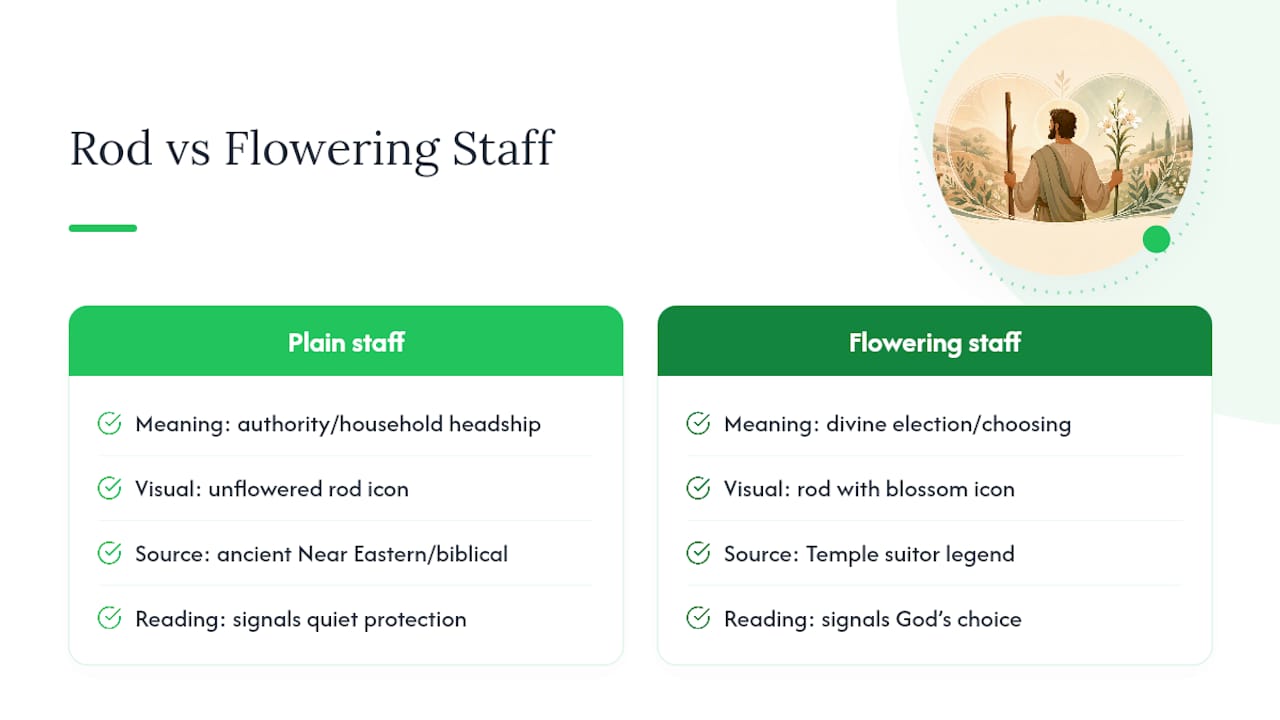
In ancient Near Eastern and biblical imagery generally, a rod or staff frequently marks headship, think of Moses’ staff, or the shepherd’s crook associated with pastoral authority and, later, with bishops. When Joseph holds a plain staff rather than a flowering one, artists are often reaching for this older visual vocabulary to mark him as head of the Holy Family, the one entrusted with its protection and daily decisions, even though scripture never records him issuing a single command.
That distinction, plain staff for authority, flowering staff for divine election, is subtle but real, and it’s easy to miss if you’re not looking for it. A staff resting quietly at Joseph’s side in a nativity scene usually signals this quieter form of headship rather than referencing the Temple legend directly. It’s a small detail, but noticing it changes how you read an otherwise familiar composition.
How Do Joseph’s Symbols Reflect Humility and Obedience?
Joseph’s defining scriptural trait isn’t strength or skill. It’s obedience carried out in near total silence. He appears in Matthew’s Gospel receiving instructions through dreams, angels telling him to take Mary as his wife, to flee to Egypt, to return to Nazareth, and every single time, he simply acts. No recorded objection, no negotiation, no recorded words at all.
Artists translate that silence visually rather than verbally, since there’s no dialogue to depict. The sleeping Joseph motif, showing him receiving angelic instruction mid dream, is the most direct symbolic expression of this obedience: it captures a man acting on faith received passively, in the most vulnerable state a person can be in. His frequently lowered gaze in traditional compositions, looking toward Mary or the child rather than out at the viewer, reinforces the same theme, a man deliberately stepping back from center stage.
Even the plain, unadorned tools carry a whisper of this humility. Joseph isn’t depicted with symbols of wealth, priestly vestments, or royal insignia despite his Davidic lineage. He’s shown with a hammer and a workbench, the equipment of an ordinary tradesman, doing ordinary work, without complaint or visible frustration at circumstances that would test most people’s patience. That visual restraint is itself the point: obedience and humility, in Joseph’s iconography, look like showing up and doing the next necessary thing.
Why Do Artists Include the Carpenter’s Apron and Belt?
The apron and work belt are smaller details than the square or hammer, but they carry their own layer of meaning: diligence and daily craftsmanship as a form of holiness in its own right, not merely a backdrop to Joseph’s more “spiritual” attributes.
A tekton in first-century Galilee worked with wood, sometimes stone, using hand tools that demanded real physical skill and patience. An apron protected clothing during that work; a belt held tools within reach for efficiency. When artists include these details, they’re emphasizing that Joseph’s sanctity wasn’t separate from his labor. It ran through it. The Marian Library’s overview of his symbols frames the full tool set, square, hammer, saw, axe, planer, and workbench, as evidence of a broad, practiced skill set rather than a single narrow trade, and the apron and belt are the visual accessories that complete that working portrait.
This detail matters for how the Church has used Joseph’s patronage over time. His designation as patron of workers rests directly on this imagery: an ordinary craftsman, properly equipped and genuinely skilled, sanctified through consistent, honest labor rather than through miracles or public ministry. For anyone who spends their days doing unglamorous, repetitive work, that’s a strikingly relatable form of holiness, and it’s exactly why tool-and-apron imagery remains one of the most requested devotional themes tied to his patronage of laborers.
What Does Joseph’s Cloak Symbolize in Traditional Art?
Joseph’s garments, especially his cloak, carry meaning through color and posture more than through any single object. Painters across centuries have leaned on warm browns, deep golds, and occasionally muted reds to clothe him, a palette distinct from Mary’s traditional blue and meant to signal earthiness, groundedness, and a protective, sheltering presence rather than heavenly transcendence.
The cloak itself frequently appears wrapped around or extended toward Mary and the child, physically as well as symbolically covering them. This gesture is a direct visual translation of Joseph’s role as protector and provider: a garment doing double duty as shelter, exactly as Joseph himself provided physical shelter during the flight into Egypt and throughout the family’s ordinary life in Nazareth. Some depictions of the Holy Family show Joseph’s cloak forming a kind of visual canopy over Mary and the infant, reinforcing the same idea architecturally rather than just through fabric.
The relative plainness of the cloak also matters. Despite his Davidic royal lineage, Joseph is essentially never dressed in anything resembling royal or priestly clothing. That restraint keeps the visual emphasis on his lived identity, a working man who protected and provided through ordinary means, rather than his ancestral status. Combined with his tools and his humble posture, the cloak completes a consistent artistic message: greatness expressed through quiet service rather than outward display.
Why St. Joseph’s Symbols Still Matter for Modern Believers
Joseph never gets a recorded line of dialogue in scripture, and yet he’s become one of the most requested patrons in the Christian calendar, for fathers, for workers, for anyone quietly holding a household together through difficulty. I think that gap, between his silence in the text and his enormous presence in devotion, is exactly why the symbols matter so much. They do the talking he never got to do.
The tools tell you he worked with his hands and never complained about it. The lily tells you purity and strength aren’t opposites. The child in his arms tells you protection can be tender rather than domineering. These aren’t abstract theological points; they’re visual cues that let your eye do what your mind sometimes can’t during prayer, land quickly on a truth without needing paragraphs of explanation.
If you’re looking for a practical way into this, don’t overthink it. Pick one symbol that matches something happening in your life right now, work, fatherhood, a season of quiet obedience, and place an image built around it somewhere you’ll actually see it every day. A hallway. A desk. A kitchen wall. Let it do its slow, quiet work the way Joseph did his.
— Griffin
Bring St. Joseph’s Symbols Into Your Own Prayer Space
Divine Prints turns the imagery covered in this guide into museum-grade fine art you can actually live with, at a price that doesn’t require choosing between quality and your budget. The saints collection includes St. Joseph pieces spanning the carpenter, the flowering staff, and the tender father holding the Christ child, available as unframed prints or framed canvases in multiple sizes to fit anything from a hallway nook to a dedicated prayer room.

Each print is made to order, so the colors that carry meaning, the warm cloak tones, the deep green of the lily’s leaves, hold up the way they should for years of daily viewing rather than fading into something forgettable. Whether you’re setting up a home prayer corner, buying a Confirmation or First Communion gift, or outfitting a parish office, a well-chosen image does more spiritual work than a crowded wall of mismatched pieces. If a specific piece from the collection catches your eye, browse Saint Joseph holding the infant Jesus to see the framing options and sizing details, and place your order when you find the one that matches what you’re praying for.
Sources
For readers who want to go deeper into the scholarship and devotional writing behind these symbols:
- The Silent Saint : University of Dayton, Ohio
- Saint Joseph in art: from innuendo to veneration · Art UK
- The Symbols of St. Joseph · Virtual St Joseph Altar
- The lilies of St Joseph · Catholic365