

Archangels in art are the named, visually distinct angelic figures — chiefly Michael, Gabriel, Raphael, and Uriel — identified by a consistent set of attributes that artists have used across more than fifteen centuries of Christian visual culture. Knowing those attributes is the fastest route to identifying a work correctly.
Quick identification checklist:
- Michael: sword or lance, scales, armor, dragon or demon underfoot
- Gabriel: lily, scroll or scepter, Annunciation posture (kneeling or standing before Mary)
- Raphael: pilgrim’s staff, fish or fish-shaped vessel, traveling companion (Tobias)
- Uriel: lamp or flame, book, occasionally a sword pointing downward
Archangels are theologically genderless, yet artists almost universally rendered them with masculine features and warrior dress from the Early Christian period onward. More overtly feminine and gender-ambiguous representations began appearing in the 19th century, particularly in funerary and Romantic-era imagery, and continue in contemporary devotional art.
Key Takeaways
Archangels in art are identified by a small, stable set of attributes — sword, scales, lily, staff, lamp — that have remained consistent across fifteen centuries and dozens of regional traditions.
| Point | Details |
|---|---|
| Primary identification cues | Michael: sword, scales, armor, dragon; Gabriel: lily, scroll, Annunciation posture; Raphael: staff, fish; Uriel: lamp or flame |
| Period markers | Costume and medium reliably date a work: loros = Byzantine; contrapposto armor = Renaissance; arquebuses = colonial Andean |
| Gendering conventions | Archangels are theologically genderless but rendered masculine through most of art history; feminine forms appear from the 19th century onward |
| Regional exceptions | The Andean ángeles arcabuceros tradition fuses European iconography with colonial military dress, producing a visually distinct regional type |
| Divineprints archangel prints | Museum-grade reproductions of archangel and saint imagery, available framed or unframed for devotional or decorative display |
Table of Contents
- How archangels in art changed across fifteen centuries
- Iconographic attributes and how to read them
- Profiles of the four major archangels
- What narrative scenes feature archangels?
- How medium and region shaped archangel depictions
- Notable works and where to see them
- How to analyze archangel imagery: a practical methodology
- Why archangel imagery still matters to collectors and congregations
- Archangel prints that bring this iconography home
- Sources
How archangels in art changed across fifteen centuries
The story of archangel imagery is one of gradual humanization, regional adaptation, and shifting theological emphasis.
Early Christian (c. 300–600 CE). The earliest surviving depictions appear in Roman catacombs and mosaic programs. Archangels wear the white tunic and pallium of a Roman court official, with no armor. Wings are large and symmetrical, borrowed from the visual vocabulary of Nike (Victory) figures. Inscriptions are the primary identification tool at this stage because attributes are not yet standardized.
Byzantine (c. 600–1453 CE). Byzantine artists dressed archangels in imperial court regalia: a loros (the jeweled ceremonial scarf of a high official), a scepter, and an orb or mirror. The face is serene and frontal, the posture hieratic. Michael and Gabriel appear most frequently as flanking figures on altarpieces and icon programs. Color is highly symbolic: gold grounds signal divine light; deep blue mantles signal heavenly origin.
Medieval Western Europe (c. 900–1400 CE). Manuscript illumination and fresco cycles introduced narrative complexity. Michael acquired his warrior role fully here, appearing in Last Judgment scenes with scales and a sword, trampling a composite, bestial demon. The Index of Medieval Art catalogs subject headings such as “Michael the Archangel, Transfixing Dragon” across nearly 300 related works, making Michael by far the most represented archangel in medieval collections. Gabriel’s Annunciation scenes multiplied in altarpieces and Books of Hours.
Renaissance (c. 1400–1600 CE). Artists applied contrapposto — the subtle S-curve stance drawn from Classical sculpture — to archangel figures, giving them a grounded, lifelike movement that reconciled divine subject matter with humanist aesthetics. The National Gallery’s entry on Piero della Francesca’s Saint Michael illustrates exactly this: the figure’s weight shifts onto one hip, the wings spread with anatomical precision, and the armor is rendered with the same material attention given to a portrait subject. Raphael (the painter) and Guido Reni pushed this further into idealized beauty.
Baroque (c. 1600–1750 CE). Baroque archangels are in motion. Guido Reni’s Archangel Michael (1635, Santa Maria della Concezione, Rome) shows the figure descending with billowing drapery and a dramatic diagonal composition. Caravaggio’s influence pushed shadow and physical weight into angelic figures that earlier centuries had kept weightless.
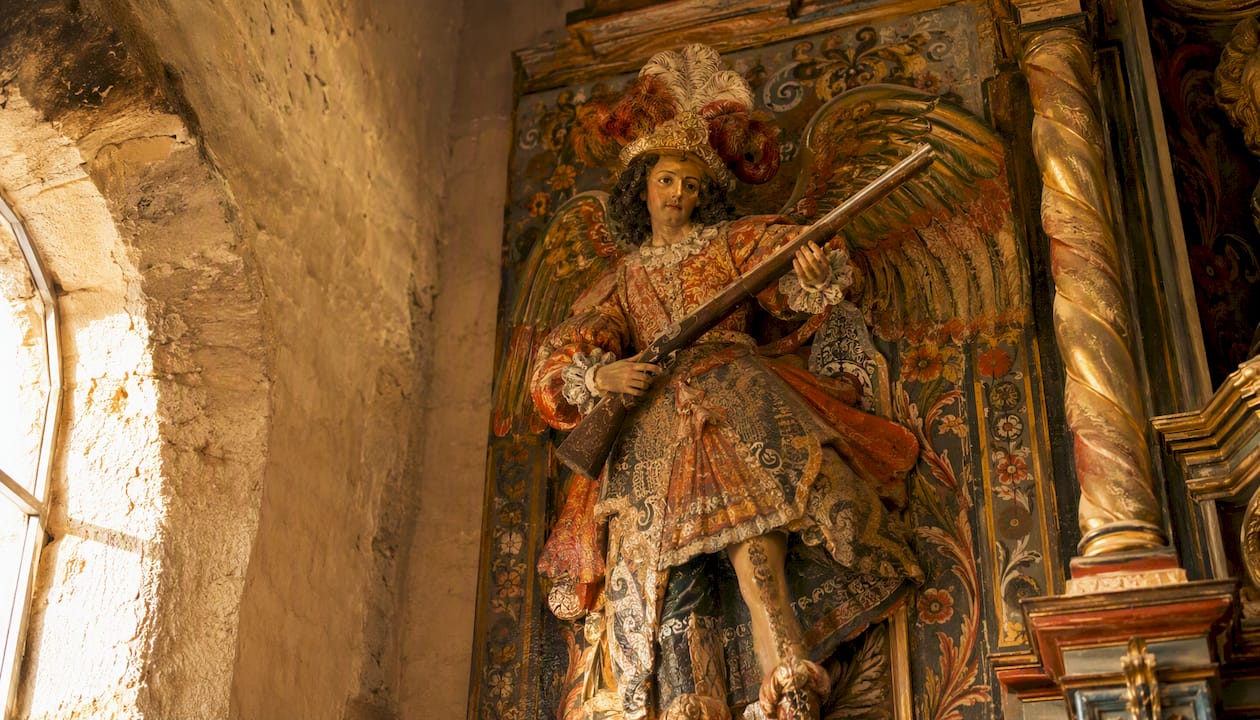
Colonial Latin America (c. 1600–1800 CE). Large-scale paintings of archangels — particularly Gabriel and Michael — became central to church programs in Peru and Bolivia. Smarthistory documents how these images served as comforting group figures and, in the distinctive ángeles arcabuceros tradition, as soldier-angels carrying arquebuses (early firearms). The combination of European iconographic convention with local dress and weaponry produced one of the most visually striking regional variants in the entire history of archangel representation.
Modern and contemporary (c. 1800–present). The 19th century introduced feminine and androgynous archangels in funerary monuments and Pre-Raphaelite painting. Contemporary devotional art ranges from hyper-realistic warrior figures to minimalist graphic treatments. The theological core — named figures with specific attributes — remains the organizing principle even when the visual language shifts dramatically.
| Period | Approximate dates | Diagnostic visual markers |
|---|---|---|
| Early Christian | 300–600 CE | White tunic, pallium, no armor, large wings, inscriptions |
| Byzantine | 600–1453 CE | Loros, scepter, orb, frontal pose, gold ground |
| Medieval Western | 900–1400 CE | Armor, scales, sword, bestial demon underfoot |
| Renaissance | 1400–1600 CE | Contrapposto, idealized anatomy, naturalistic armor |
| Baroque | 1600–1750 CE | Dynamic diagonal, billowing drapery, dramatic lighting |
| Colonial Latin America | 1600–1800 CE | Arquebuses, local dress, large-format church painting |
| Modern/Contemporary | 1800–present | Androgynous or feminine forms, varied media |
Iconographic attributes and how to read them
Attributes are the shorthand artists and patrons agreed on to make archangels legible across languages and literacy levels. Reading them correctly is the core skill for identifying any depiction.
Attribute-to-meaning pairs:
- Sword (drawn or sheathed): divine authority, readiness for battle; primary Michael identifier
- Scales: psychostasy, the weighing of souls at the Last Judgment; almost exclusively Michael
- Armor (Roman or medieval plate): warrior role; Michael, occasionally Uriel
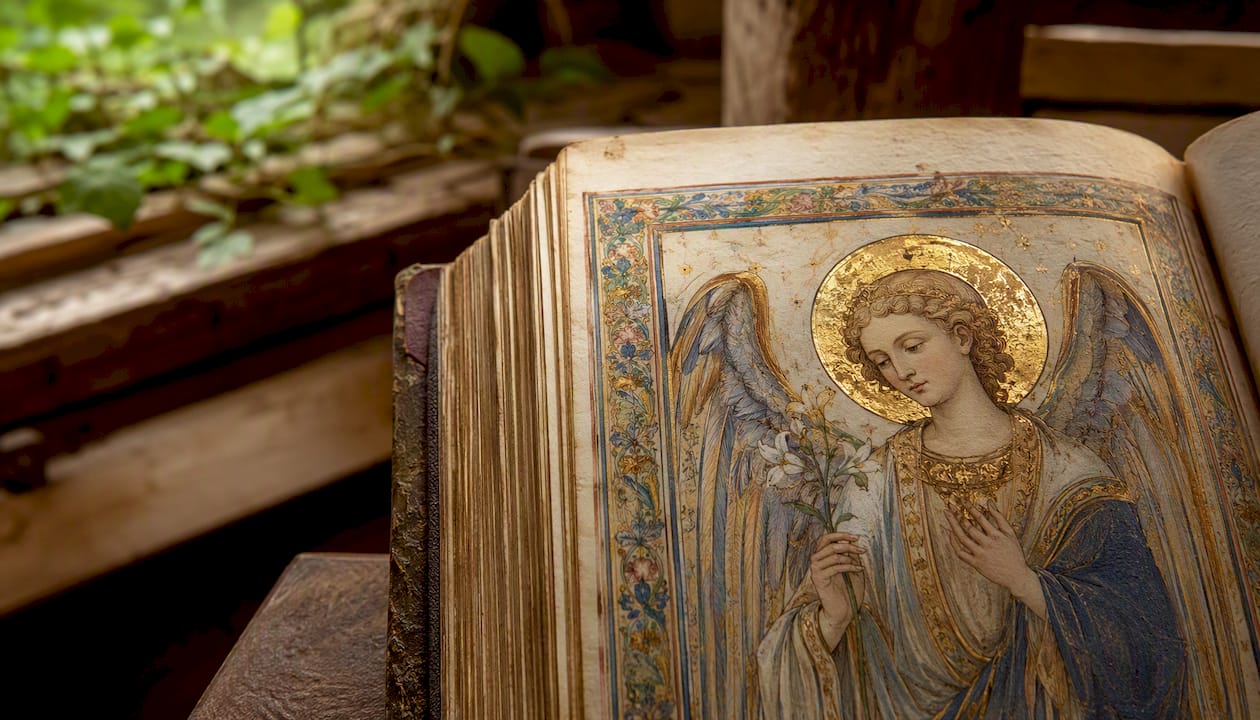
- Lily: purity, the Annunciation message; Gabriel’s most diagnostic attribute in Western art
- Scroll or scepter: divine message or authority; Gabriel, sometimes Michael
- Staff and fish: the journey with Tobias; Raphael’s signature combination
- Trumpet: eschatological announcement; Gabriel in Last Judgment scenes
- Lamp or flame: divine light, wisdom; Uriel’s primary emblem
- Book: divine knowledge or prophecy; Uriel, occasionally Raphael
- Wing type and color: large, symmetrical, feathered wings are standard; peacock-feather eyes appear in some Byzantine and Eastern traditions to signal omniscience
Reading grouped attributes. A winged figure with a sword and a dragon or demon underfoot is almost certainly Michael. A lily combined with a kneeling or standing posture before a seated or startled woman is Gabriel in an Annunciation. A staff with a fish or a young male companion is Raphael in a Tobias scene. Uriel alone with a downward-pointing sword and a flame appears in scenes of the expulsion from Eden in some traditions.
One common misidentification: Michael and St. George look similar at first glance because both appear in armor defeating a dragon. The reliable field identifier is that Michael is winged while George is not, and Michael typically tramples or transfixes the creature rather than lancing it from horseback.
Pro Tip: Check inscriptions first. A titulus (name label) painted directly on the image or on the frame resolves ambiguous attribute readings immediately. When inscriptions are absent, examine the shield or armor surface under magnification: painters occasionally included small reflected details — donor portraits, self-portraits, or heraldic devices — that can confirm attribution and provenance. Late-medieval sculpture sometimes used “feather tights,” plumage covering the angel’s legs and torso instead of drapery, a detail that surprises modern viewers but is a reliable period marker.
Profiles of the four major archangels
Michael: warrior, judge, protector
Michael’s scriptural foundation is broad. He appears in Daniel 10 and 12 as the great prince who stands guard over Israel, in Revelation 12 as the leader of the heavenly army against the dragon, and in Jude 1:9 disputing with the devil over Moses’ body. Artists drew on all three sources. In Last Judgment programs — the tympana of Gothic cathedrals, the altarpieces of Italian churches — Michael holds scales and a sword simultaneously, combining his warrior and judicial roles. The scales carry specific theological weight: medieval images sometimes show a devil pulling on the pan to tip the judgment, a visual reminder of the accuser who bargains for harsher condemnation rather than a literal mechanical process. Medieval artists also constructed the demon beneath Michael’s feet as a composite, bestial figure, deliberately dehumanizing evil to heighten the archangel’s victory.
Armor types shift with period: Roman lorica segmentata in Early Christian mosaics, Gothic plate in 14th-century altarpieces, Renaissance parade armor in 15th-century panel paintings. The wings stay large throughout.
Gabriel: messenger, herald of the Incarnation
Gabriel’s defining scene is the Annunciation (Luke 1:26–38), and the iconographic program for that scene is among the most stable in all of Christian art. Gabriel arrives from the left, carrying a lily or a scepter-scroll. Mary is typically at the right, often interrupted at prayer or reading. The angel’s posture — kneeling, bowing, or standing with one hand raised — signals the formal protocol of a divine embassy. A dove descending from above completes the Trinitarian reading.
Outside the Annunciation, Gabriel appears at the Nativity (announcing to the shepherds), at the Resurrection, and in Islamic-influenced programs as the angel who dictated the Quran to Muhammad, though that last context falls outside Christian iconographic tradition. The Portland Art Museum’s Gabriel entry offers an accessible U.S. collection example for study and citation.
Raphael: guide, healer, companion
Raphael’s primary narrative source is the Book of Tobit (deuterocanonical/apocryphal), where he travels disguised as a human companion named Azariah, helps Tobias retrieve a debt, and heals Tobias’s blind father with a fish’s gall. The scene of Tobias and the Angel — a young man walking with a winged companion who carries or gestures toward a fish — is one of the most frequently painted archangel narratives in Western art, particularly popular in 15th and 16th-century Florence as a patron-saint image for travelers and the young.
Raphael’s attributes in Eastern traditions differ slightly: he may carry a physician’s vessel or an alabaster jar, emphasizing his healing role over the travel narrative. His name means “God heals” in Hebrew, and that etymology shaped how artists across both traditions depicted him.
Uriel: light-bearer, guardian of Eden
Uriel is the least frequently depicted of the four in Western art, partly because he does not appear by name in the canonical Old or New Testament. His authority rests on 2 Esdras (4 Esdras in the Vulgate) and other Second Temple texts, which gave him a more uncertain status in post-Tridentine Catholic iconography. Where he does appear, he carries a flame or lamp (representing divine light and wisdom), sometimes a book, and occasionally a sword pointing downward in his role as guardian of the gates of Eden. Artists working in Anglican, Orthodox, and some pre-Tridentine Catholic traditions depicted him more freely. Recognizing Uriel requires ruling out the other three first: if a winged figure has neither Michael’s scales nor armor, Gabriel’s lily, nor Raphael’s fish, and carries a lamp or downward flame, Uriel is the most likely identification.
What narrative scenes feature archangels?
Archangels appear in a defined set of narrative episodes, each with its own compositional logic.
- The Annunciation: Gabriel and Mary, lily or scepter, dove descending. The most reproduced archangel scene in Western art, appearing in virtually every medium from the 4th century onward.
- The War in Heaven / Defeat of Satan: Michael leading the heavenly host against the dragon (Revelation 12). Typically a dynamic, multi-figure composition; in Baroque versions, Satan falls dramatically downward.
- The Last Judgment / Psychostasy: Michael with scales, weighing souls. Appears on church tympana, altarpieces, and manuscript pages. The devil tugging the scale pan is a recurring detail that functions as a theological argument, not just decoration.
- Tobias and the Angel: Raphael and Tobias walking together, fish prominent. A domestic, intimate scene compared to the cosmic drama of Michael’s battles.
- Guardian and escort scenes: An archangel (often Michael or Raphael) guiding a soul or a living person. Common in funerary art and in devotional images for travelers.
- The Expulsion from Eden: Uriel with a flaming sword at the gate of Paradise (Genesis 3:24, where the angel is unnamed but later identified as Uriel in apocryphal tradition). Less common but iconographically distinctive.
The symbolic readings embedded in these scenes reward close attention. The dragon beneath Michael’s feet is a fallen angel, a corrupted spiritual being, not merely a monster — which is why artists gave it residual human or angelic features in some medieval programs. The Annunciation’s lily is not simply a flower; it signals Mary’s virginal purity and the purity of the divine message Gabriel carries. These layers of meaning are what make archangel imagery so durable as devotional art: every attribute is doing theological work.
How medium and region shaped archangel depictions
The material a work is made in shapes what an artist can do with an archangel’s image, sometimes more than theology does.
Manuscript illumination rewards detail: gold leaf halos, intricate feather patterns, fine inscriptions. The small scale forces attribute clarity — a lily or a fish must be immediately legible in a space the size of a palm. Books of Hours from 15th-century Flanders and France show Gabriel in Annunciation miniatures of extraordinary precision.
Fresco rewards scale and gesture. A wall-sized Michael in a church apse can spread wings across the entire composition, with the demon reduced to a tiny figure underfoot. The Sistine Chapel’s ceiling programs and the apse mosaics of San Vitale in Ravenna demonstrate how fresco and mosaic exploit architectural space in ways no portable panel can match.
Panel painting and canvas allowed the Renaissance and Baroque periods to develop psychological depth: the archangel’s face could carry expression, the armor could reflect light, the drapery could suggest wind and movement.
Sculpture and stained glass each impose their own constraints. Sculpture in the round allows three-dimensional armor detail but limits color. Stained glass prioritizes silhouette and color field over fine attribute detail, which is why inscriptions in glass windows are especially important for identification.
Regional traditions produced some of the most distinctive archangel imagery in the entire history of the subject. Byzantine court-robe conventions traveled east into Russian icon painting, where Michael and Gabriel appear in imperial dress on iconostasis screens to this day. Western European artists standardized the armored Michael from the 12th century onward. In the Spanish Americas, Smarthistory’s essay on defensive saints and angels documents how armored angels were adapted to local visual vocabularies, producing the ángeles arcabuceros tradition of soldier-angels carrying arquebuses — a fusion of European iconographic convention with colonial military culture that is unique to the Andean region.
| Medium | Typical iconographic consequences |
|---|---|
| Manuscript illumination | Fine attribute detail, gold leaf, inscriptions legible at small scale |
| Fresco/mosaic | Large-scale gesture and composition, architectural integration |
| Panel painting/canvas | Psychological expression, material texture, reflected light on armor |
| Sculpture | Three-dimensional armor and drapery detail, limited color |
| Stained glass | Silhouette and color field dominant, inscriptions critical for ID |
Notable works and where to see them
A short list of canonical works gives any researcher a practical starting point.
Piero della Francesca, Saint Michael (c. 1469), National Gallery, London. Part of the Sansepolcro altarpiece, this panel is the textbook example of Renaissance contrapposto applied to an archangel. The armor is painted with the precision of a still life; the figure’s weight shift gives it a presence no Byzantine icon achieves by design. The National Gallery’s curatorial entry is freely accessible and models the kind of close formal analysis useful for teaching.
Guido Reni, Archangel Michael (1635), Santa Maria della Concezione dei Cappuccini, Rome. The defining Baroque Michael: dynamic diagonal, Satan crushed beneath the foot, drapery in full flight. Widely reproduced and the source of countless later devotional images.
Andean ángeles arcabuceros (17th–18th century), various Bolivian and Peruvian collections. The most striking regional variant in archangel art. These large-format paintings show archangels in elaborate courtly dress, carrying arquebuses at military angles. The Museo Nacional de Arte in La Paz holds several significant examples.
Portland Art Museum, Archangel Gabriel. The Portland Art Museum’s Gabriel is the most accessible U.S. collection example for researchers who want to study Gabriel’s iconography in person or cite a North American institutional source.
For digital research, the Index of Medieval Art at Princeton is the authoritative database for medieval archangel imagery, with subject headings that allow systematic searches by attribute and narrative scene. Wikimedia Commons’ Angels in art category aggregates public-domain images useful for visual comparison, though rights and licensing vary and should be checked before reproduction.
How to analyze archangel imagery: a practical methodology
A systematic approach prevents misidentification and produces defensible attributions.
- Gather primary sources and inscriptions first. Read any titulus, cartouche, or dedicatory inscription before interpreting attributes. An inscription overrides visual inference.
- Catalog every visible attribute. List all objects, garments, colors, and figures in the image before assigning an identification. Partial attribute lists lead to partial — and sometimes wrong — identifications.
- Cross-check costume and medium for dating. Roman lorica suggests Early Christian or Renaissance revival; Gothic plate suggests 13th–15th century; arquebuses suggest colonial Latin American context. Medium (fresco, panel, manuscript) narrows the date range further.
- Consult provenance and catalogue records. Museum collection entries often preserve curatorial observations that resolve ambiguous identifications. The Museo del Prado’s entry for Saint Michael the Archangel is a model of this kind of close material reading, noting surface details that a photograph alone would miss.
- Compare to regional databases and subject headings. The Index of Medieval Art’s subject classification system allows systematic comparison across hundreds of works. Cross-referencing a single work against the database’s attribute clusters quickly reveals whether an identification is standard or anomalous.
Key research resources:
- Index of Medieval Art (Princeton): subject headings, attribute clusters, period filters
- Museum catalogue portals (National Gallery, Prado, Met, Portland Art Museum): curatorial notes, provenance, condition reports
- Smarthistory: peer-reviewed essays on regional traditions, including colonial Latin America
- Wikimedia Commons (Angels in art category): public-domain image pool for visual comparison
Pro Tip: Examine reflective surfaces — shields, polished armor, convex mirrors — under high-resolution photography. Painters from the 15th century onward sometimes included small self-portrait reflections or donor portraits in these surfaces, a detail that can clinch attribution or reveal a patron’s identity when documentary evidence is thin.
Why archangel imagery still matters to collectors and congregations
The scholarly study of archangel iconography and the devotional use of archangel imagery are not as separate as they might appear. A congregation that commissions a new Michael for its nave and a curator cataloguing a 15th-century panel are both working with the same visual grammar — the same attributes, the same narrative scenes, the same theological claims rendered in pigment or stone. What changes is the purpose: one is active devotion, the other is historical analysis. But the images themselves carry both functions simultaneously, which is why archangel art has survived every shift in artistic fashion from the catacombs to the present.
Collectors and institutions that preserve this imagery are doing something more than aesthetic curation. They are maintaining a visual theology that has shaped how billions of people have understood divine protection, divine judgment, and divine communication. That is a serious responsibility, and it is one reason why iconographic precision matters: a misidentified Michael is not just an academic error, it is a misreading of a theological argument.
Archangel prints that bring this iconography home
The iconographic tradition surveyed in this guide has inspired Divineprints’ collection of angel and saint prints, each reproduced with attention to the attributes and visual conventions that make these figures immediately recognizable. Whether you are drawn to a warrior Michael, a lily-bearing Gabriel, or the quieter wisdom of Uriel, the prints are available as museum-grade fine art reproductions on archival paper or canvas, in multiple sizes and frame options suited to a home chapel, a parish hallway, or a devotional corner.
For readers interested in the broader narrative scenes covered in this guide, the biblical events collection includes Annunciation and other archangel-centered compositions. Every print ships with the iconographic integrity that makes it useful as both a devotional object and a visually informed piece of wall art. Browse the full collection at Divineprints and find the archangel print that fits your space and your faith.
Sources
The resources below are the primary references cited in this guide and the most useful starting points for deeper research.
- The Iconography of Michael the Archangel at the Feast of Michaelmas
- Piero della Francesca: Saint Michael
- St. Michael in Art
- Archangel Gabriel
- Viceroyalty of Peru
A note on citing museum collection pages: treat a museum catalogue entry as you would a reference book chapter — author (if named), title of the entry, institution name, URL, and access date. For the Index of Medieval Art, cite the subject heading and the database name alongside the URL. These citations are accepted in art-historical scholarship and carry institutional authority that general web sources do not.