

If you want a female Confirmation patron who feels real and not just a name on a certificate, start here: St. Thérèse of Lisieux for her “Little Way” of quiet trust, St. Elizabeth Ann Seton for a relatable American convert and mother, St. Joan of Arc for courage under pressure, or St. Faustina Kowalska if divine mercy speaks to you. Every one of these women lived a real, sometimes messy life before the Church recognized them as saints. That’s the whole point of picking one.
Here’s a quick shortlist to get your prayer and research started:
- St. Maria Goretti — patron of young people facing pressure to compromise their values
- St. Elizabeth Ann Seton — inspiration for converts, mothers, and educators
- St. Thérèse of Lisieux — model of doing small things with great love
- St. Catherine of Siena — patron for anyone unafraid to speak truth to power
- St. Joan of Arc — courage for the young and the doubted
- St. Kateri Tekakwitha — patron of ecology and Native American Catholics
- St. Bernadette Soubirous — model of simple trust and humility
- St. Clare of Assisi — patron of eye trouble and television, oddly enough, but really a model of simplicity
- St. Teresa of Avila — patron for deep thinkers and reformers
- St. Faustina Kowalska — apostle of Divine Mercy
Pray with this list, read a short bio on one or two names that catch your attention, and always confirm the name works with your parish or diocese before you finalize it.
Key Takeaways
Choosing a female Confirmation saint works best when prayer, a short biography, and a matching patronage guide the decision instead of picking a name at random.
| Point | Details |
|---|---|
| Start with prayer | Ask for guidance before researching names, not after you’ve already picked one. |
| Match patronage to your life | Line up a saint’s specialty with a current struggle or future vocation. |
| Confirm parish rules early | Some dioceses require canonized saints or gender-matched names. |
| Keep her present after Confirmation | A short weekly prayer and a visual reminder build a lasting connection. |
| Read before you commit | A one-page biography reveals whether a saint actually resonates with you. |
Table of Contents
- Female Confirmation Saints: Detailed Profiles to Help You Decide
- How Do You Choose a Confirmation Saint?
- What Do Saint Patronages Actually Mean?
- How Do You Keep Your Confirmation Saint Close After the Ceremony?
- Why Visual Reminders Help You Stay Connected to Your Saint
- What Most Guides Get Wrong About Picking a Confirmation Saint
- Sources
Female Confirmation Saints: Detailed Profiles to Help You Decide
Picking a Confirmation saint works best when you know a little about who they actually were, not just their title. Below are ten women the Church holds up as models, each with a life story that still connects with confirmands today.
1. St. Maria Goretti
Maria Goretti was an 11-year-old Italian girl who died in 1902 defending her purity against an attacker, and she forgave him before she died. She’s the patron of young people under pressure to give in to something that goes against their values. If her story resonates, read a short account of her final hours. It’s brief and it sticks with you.
2. St. Elizabeth Ann Seton
Elizabeth Ann Seton was a wealthy New York widow who converted to Catholicism, founded American schools, and became the first native-born American saint. She’s a natural pick for converts, mothers, teachers, or anyone rebuilding life after loss. A short Elizabeth Ann Seton profile or print can keep her story visible long after Confirmation Day.
3. St. Thérèse of Lisieux
Thérèse entered a Carmelite convent at 15 and died at 24, leaving behind a spirituality called the “Little Way,” small acts of love done consistently. She fits anyone who feels ordinary or overlooked but wants their daily life to mean something. Her autobiography, Story of a Soul, is short and worth the read.
4. St. Catherine of Siena
Catherine was a 14th century laywoman who advised popes and challenged corruption in the Church without ever backing down. She suits confirmands who want a patron for boldness, honest speech, or leadership among peers. Franciscan Media’s profiles of influential women saints include her as one of the more assertive models in Church history.
5. St. Joan of Arc
Joan led French troops at 17 after claiming visions instructed her to do so, and she was executed at 19 for it, only to be later declared a saint. She works well for anyone who has been doubted, mocked, or told they’re too young to matter. Look for a short account of her trial. It reads like a courtroom drama because it basically was one.
6. St. Kateri Tekakwitha
Kateri was a Mohawk woman in 17th century New York who converted to Catholicism despite family and community resistance, and she’s now the patron of ecology and Native Americans in the Church. She’s a strong fit for anyone balancing cultural identity with faith. A brief biography reveals how much she gave up to practice her belief openly.

7. St. Bernadette Soubirous
Bernadette was a poor, sickly 14-year-old in Lourdes, France, when she reported visions of the Virgin Mary in 1858, sparking one of the most visited pilgrimage sites in the world. She’s a model for anyone who feels unqualified or unimpressive but ends up carrying something important anyway. Her simple trust, not her eloquence, is what people remember about her.
8. St. Clare of Assisi
Clare left a noble family at 18 to follow Francis of Assisi’s example, founding an order devoted to poverty and simplicity. She’s a good match for confirmands drawn to a stripped-down, less-is-more approach to faith. Her feast day, August 11, is worth marking on a calendar as a small yearly checkpoint.
9. St. Teresa of Avila
Teresa reformed the Carmelite order in 16th century Spain and wrote spiritual classics still read by theologians today. She fits confirmands who like to think deeply, ask hard questions, and aren’t satisfied with surface-level answers. Her writing on prayer, especially Interior Castle, is dense but rewarding if you’re patient with it.
10. St. Faustina Kowalska
Faustina was a 20th century Polish nun who reported visions of Jesus that led to the Divine Mercy devotion practiced worldwide today. She’s a strong choice for anyone drawn to mercy, forgiveness, or a more visual, image-centered prayer life. A St. Faustina print near your prayer space is a simple way to keep her devotion active.
Pro Tip: Don’t pick a saint just because the name sounds nice. Read one paragraph of their life story first. If it makes you want to know more, that’s usually a sign you found the right one.
How Do You Choose a Confirmation Saint?
Prayer plus a little research beats scrolling through a random name list. Choosing a Confirmation saint typically involves prayerful discernment, reading short biographies, and checking your parish or diocesan guidelines before anything is finalized.
Follow these five steps:
- Pray first. Ask God to show you a saint who fits where you are right now, not who you think you should be.
- Read one-page bios. Skim five or six names and notice which stories actually hold your attention.
- Match patronage to your life. Line up a saint’s specialty with a struggle, interest, or vocation you’re facing.
- Talk to your sponsor, parent, or parish. Get a second opinion and confirm your pick fits local rules.
- Finalize your choice with intention. Write down why you picked her, so you remember later.
A few practical notes before you commit:
- Some dioceses require a canonized saint, not a “Blessed” or “Servant of God.”
- Some parishes require the confirmation name to match your gender.
- Rules vary parish to parish, so a quick email or phone call to your parish office saves you from picking a name that later gets rejected.
LifeTeen notes that saints work as mentors precisely because their real, sometimes messy struggles make holiness look achievable, not distant. That’s worth remembering when you’re tempted to pick based on a name you just like the sound of.
What Do Saint Patronages Actually Mean?
A patronage is simply the area of life or group of people a saint is traditionally connected to, usually tied to something from their own biography. Patronages give you a shortcut for narrowing a long list down to a handful of names.
Here’s how some common patronages break down among female saints:
- Students and scholars — St. Catherine of Alexandria, St. Teresa of Avila
- Converts — St. Elizabeth Ann Seton, St. Kateri Tekakwitha
- Mothers and motherhood — St. Anne, St. Monica
- Victims of abuse or violence — St. Maria Goretti
- The sick and suffering — St. Bernadette Soubirous
- Mercy and forgiveness — St. Faustina Kowalska
- Simplicity and poverty — St. Clare of Assisi
- Reform and bold speech — St. Catherine of Siena
USCCB’s saint resources list official patronages and feast days if you want to confirm a match before locking in your decision. The quickest matching tip: pick a saint connected to either what you’re struggling with right now or what you hope to become.
How Do You Keep Your Confirmation Saint Close After the Ceremony?
Confirmation isn’t the finish line with your patron saint, it’s the starting point. A short daily prayer works better than a long one you’ll skip after a week. Try saying a one-line request for her intercession each morning for a month, and celebrate her feast day the way you’d remember a friend’s birthday.
A few habits worth building:
- Keep a small prayer journal noting what you asked your saint to help with.
- Read one paragraph of her biography per week until you’ve finished her story.
- Ask for her intercession in specific prayers, not just vague ones.
- Keep a visual reminder, an image, print, or medal, somewhere you’ll actually see it daily.
Pro Tip: Start with five minutes a week reading her story instead of committing to a daily habit right away. You’ll actually stick with five minutes.
Why Visual Reminders Help You Stay Connected to Your Saint
Guides that walk confirmands through picking a patron consistently recommend keeping a physical image nearby, not just a name in a confirmation booklet. A print in your room or prayer corner turns an abstract choice into something you see every day, which makes praying for her intercession feel less like a chore and more like checking in with someone you actually know.
That’s where Divineprints comes in. Our saint prints are museum-grade, available in multiple sizes and frame options, and designed to hold up as both devotional art and genuinely nice-looking decor, not the kind of flimsy holy card that ends up in a drawer.
- Gift-ready presentation for Confirmation, baptism, or First Communion
- Multiple sizes to fit a dorm wall, a bedside table, or a family prayer space
- Framed and unframed options depending on your budget
Browse the full saint prints collection to find a fitting devotional image for your Confirmation patron, or for someone else’s big day.
What Most Guides Get Wrong About Picking a Confirmation Saint
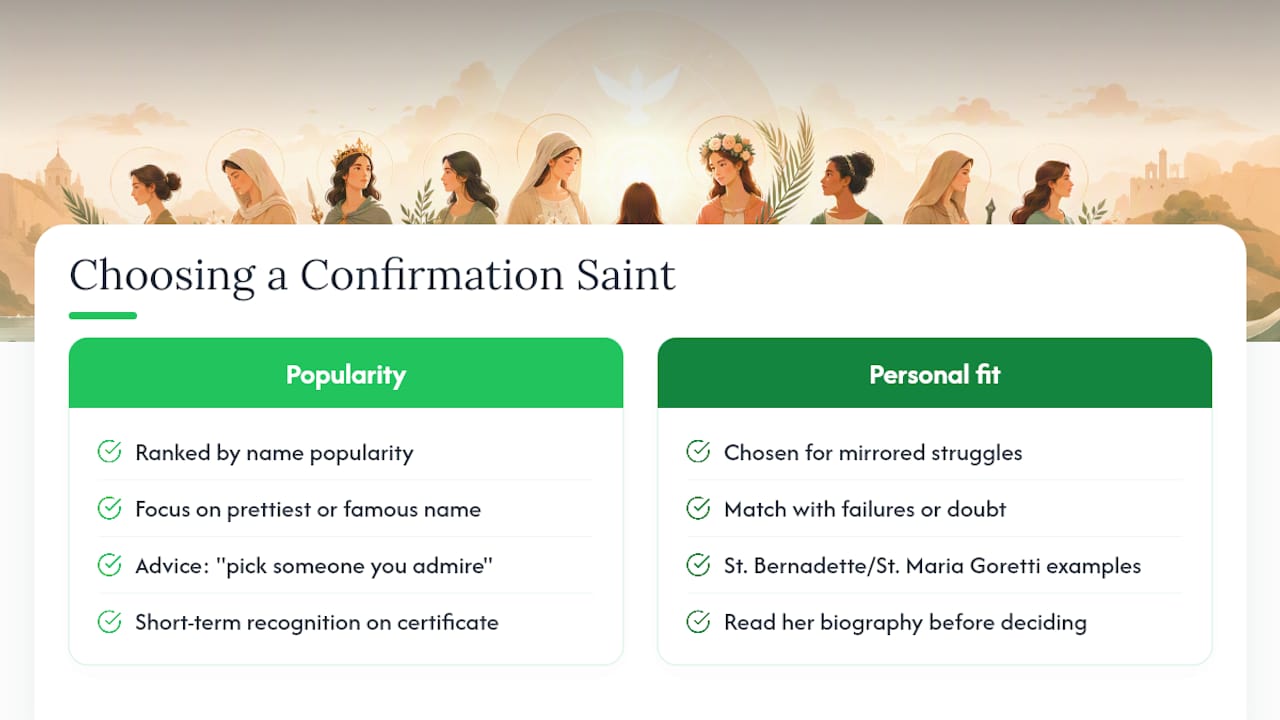
Most lists rank saints by popularity, but popularity isn’t the same as fit. The research behind this piece points somewhere different: the saints who stick with confirmands years later are the ones whose struggles mirrored something the confirmand was actually facing at 13 or 14, not the ones with the prettiest name.
Conventional advice tells you to “pick someone you admire.” That’s too vague to act on. A better standard: pick someone whose failure, doubt, or ordinary life looks uncomfortably similar to yours. St. Bernadette wasn’t impressive. St. Maria Goretti’s story is hard to read. That discomfort is where the connection actually forms.
If you take one thing from this list, take this: read the biography before you decide, and keep an image of her somewhere you’ll actually look. The name on the certificate matters far less than whether you remember her exists six months later.
Sources
- How to Choose a Confirmation Saint (With Saint Suggestions!) - FOCUS
- Biggest and Best List of Confirmation Saints (for Guys and Girls) - LifeTeen
- Sisterhood of Saints: 14 Holy Women | Franciscan Media
- USCCB — saints resources