

Saint Monica, Saint Anne, and the Blessed Virgin Mary are the three figures most commonly called the patron saint of motherhood across Catholic and broader Christian tradition. If you are an expectant mother, Saint Anne or Saint Gerard Majella are the most frequently invoked. For nursing mothers, Our Lady under the title Our Lady of La Leche is the traditional first choice. If you are a parent praying for a child who has drifted from the faith, Saint Monica is the one the Church has pointed to for sixteen centuries.
These are not interchangeable. Each saint earned her or his association with motherhood through a specific life story, and choosing the right one for your situation matters more than picking the most famous name on the list.
Key Takeaways
The most commonly invoked patron saints of motherhood are Saint Monica, Saint Anne, and the Blessed Virgin Mary, each suited to a distinct maternal need, from conversion and perseverance to pregnancy and nursing.
| Point | Details |
|---|---|
| Monica for conversion and perseverance | Invoke Saint Monica when praying for a child or family member who has left the faith. |
| Anne and Gerard for pregnancy | Saint Anne and Saint Gerard Majella are the primary patrons for expectant mothers and safe childbirth. |
| Our Lady for nursing mothers | Our Lady of La Leche is the traditional patron for pregnancy and breastfeeding, with a shrine in St. Augustine, Florida. |
| Match the saint to your situation | Choose based on the saint’s life story and your specific need, not just name recognition. |
| Divineprints saint prints | Divineprints offers museum-grade saint prints as devotional home art and meaningful gifts for mothers. |
Table of Contents
- Who are the main patron saints mothers invoke?
- Detailed profiles of each patron saint of motherhood
- How to choose a patron saint for your situation
- Prayers and novenas for mothers and expectant mothers
- Feast days, shrines, and devotional practices
- Why these saints still matter to modern mothers
- Saint prints for mothers and families from Divineprints
- Sources
Who are the main patron saints mothers invoke?
A quick reference for the eight saints most commonly cited in Catholic devotional tradition, with feast days and primary use:
- Saint Monica (feast: August 27) — Patron of mothers, especially those praying for a child’s conversion or struggling with a difficult family situation. Her persistent prayer for Augustine over seventeen years is the defining story.
- Saint Anne (feast: July 26 in the Latin Church; September 9 in Eastern Orthodox tradition) — Patron of mothers, pregnant women, and grandmothers. Venerated as the mother of the Virgin Mary, she is one of the oldest maternal patronesses in Christian history.
- Blessed Virgin Mary / Our Lady (multiple feast days, including August 15 for the Assumption) — The supreme model of Christian motherhood, invoked under dozens of titles. Our Lady of La Leche is specifically associated with pregnancy and nursing mothers.
- Saint Gianna Beretta Molla (feast: April 28) — Modern patron of mothers, expectant mothers, and unborn children. A 20th-century physician who chose to continue her pregnancy despite serious medical risk to herself.
- Saint Zélie Martin (feast: July 12, shared with her husband Louis) — Patron of working mothers and wives. Mother of five daughters who became nuns, including Saint Thérèse of Lisieux.
- Saint Gerard Majella (feast: October 16) — Patron of expectant mothers and safe childbirth. The most widely invoked male saint in pregnancy-related novenas.
- Saint Zita (feast: April 27) — Patron of domestic workers and household caregivers, sometimes invoked by mothers for strength in daily caregiving.
- Saint Elizabeth (feast: November 5 for Elizabeth of Hungary; January 4 for Elizabeth Ann Seton) — Elizabeth of Hungary is patron of the poor and charitable mothers; Elizabeth Ann Seton is patron of Catholic schools and mothers in the United States.
Pro Tip: If you are unsure where to start, Saint Monica and Saint Anne together cover the widest range of maternal needs. Monica for the interior struggle of parenting; Anne for the physical reality of pregnancy and birth.
Detailed profiles of each patron saint of motherhood
Saint Monica (331–387)
Monica was born in North Africa, married a pagan Roman official named Patricius, and spent decades praying for both her husband’s conversion and, far more famously, her son Augustine’s. Augustine spent his twenties in what Monica considered spiritual ruin: he joined the Manichean sect, fathered a child outside marriage, and moved to Rome partly to escape her. She followed him. He converted at 33. Patricius converted before his death.
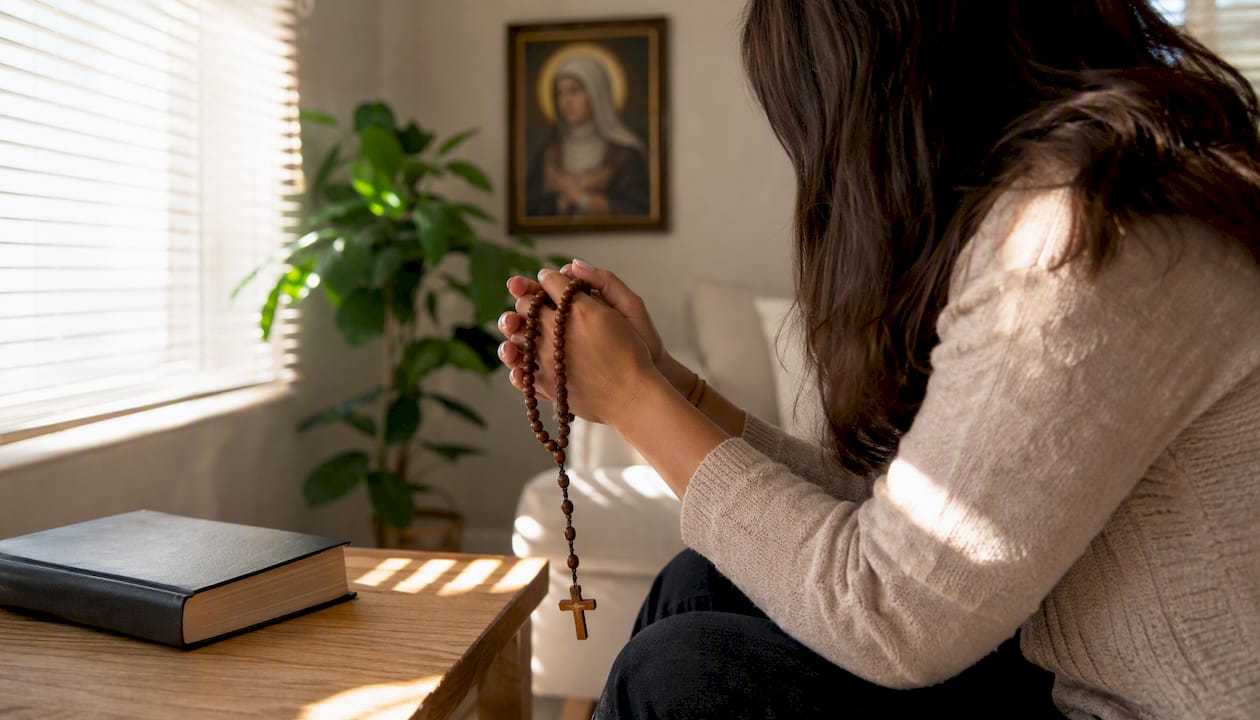
Her patronage of mothers rests entirely on that story of relentless, non-coercive love. She did not force Augustine; she prayed, wept, and waited. Contemporary pastoral writers at US Catholic have called her the “patron saint of doing the best you can,” which is a more honest framing than presenting her as a model of flawless parenting.
Feast day: August 27 Patronage: Mothers, parents of wayward children, victims of abuse, alcoholics Invocation: “Saint Monica, you prayed without ceasing for your son. Intercede for me and for [name], that God’s grace may reach them. Amen.”
Saint Anne
Anne appears in no canonical Gospel. Her story comes from the second-century Protoevangelium of James, which describes her and her husband Joachim as an elderly, childless couple who received an angelic promise of a child. That child was Mary. The New Advent Catholic Encyclopedia traces her veneration back to at least the sixth century in the Eastern Church, with the Latin Church adopting July 26 as her feast day.
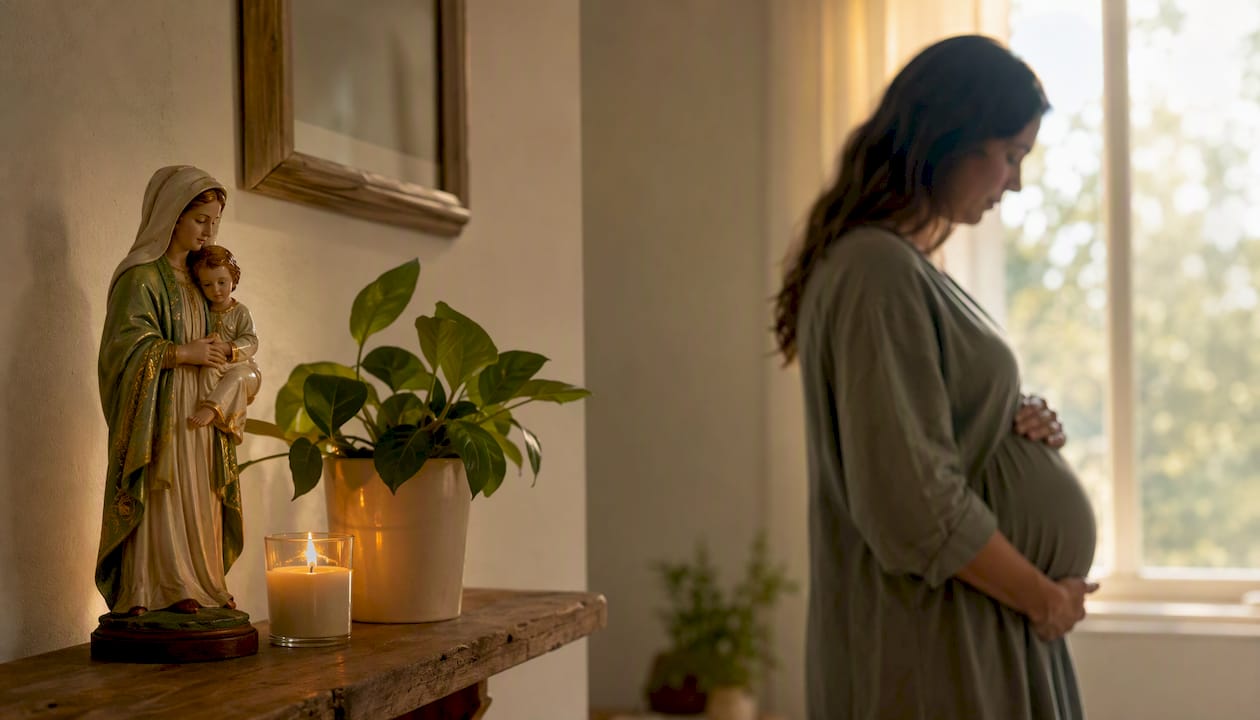
One historically interesting detail: Saint Anne’s patronage expanded in the medieval period through an allegory comparing her womb to a source of hidden treasure, which is why she also became patron of miners in some traditions. That is a long way from motherhood, but it shows how deeply her image of fruitfulness was embedded in popular devotion.
Feast day: July 26 (Latin Church); September 9 (Eastern Orthodox) Patronage: Mothers, pregnant women, grandmothers, childless couples Invocation: “Good Saint Anne, you waited long for the gift of a child. Pray for me in my need and present my petition to your daughter Mary and to her Son. Amen.”
A Saint Anne print can serve as a daily visual reminder of her intercession, particularly for expectant mothers who want a tangible focus for prayer.
Blessed Virgin Mary (Our Lady)
Mary holds a category of her own. She is not simply one patron among many; in Catholic theology she is the Theotokos, the God-bearer, and the supreme model of maternal faith. Her patronage of mothers is expressed through dozens of titles and shrines worldwide.
The most specific maternal title for pregnancy and nursing is Our Lady of La Leche, whose principal American shrine is at Mission Nombre de Dios in St. Augustine, Florida. Franciscan Media documents the shrine’s history as a place where mothers have sought intercession for safe pregnancies and healthy nursing for centuries. The title translates roughly as “Our Lady of the Milk,” and the iconography shows Mary nursing the infant Jesus.
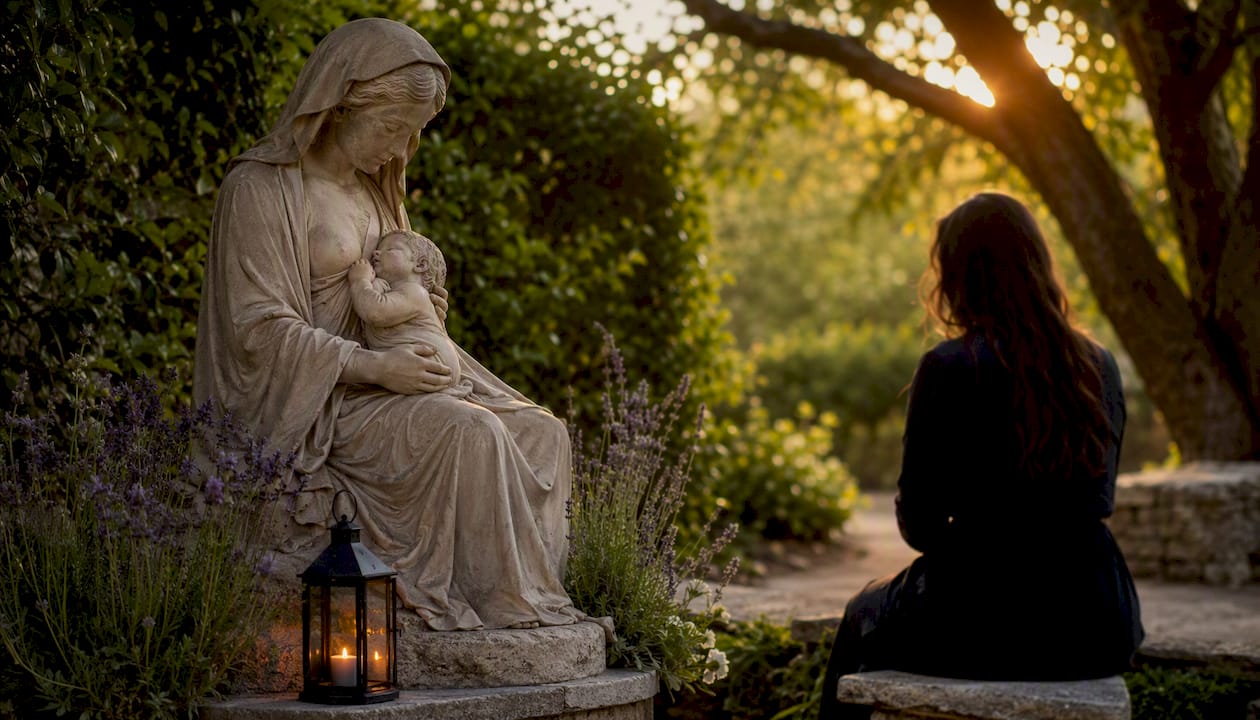
Feast days: Multiple, including January 1 (Mary, Mother of God), March 25 (Annunciation), August 15 (Assumption), December 8 (Immaculate Conception) Patronage: All mothers, pregnant women, nursing mothers, the universal Church Invocation: “Our Lady of La Leche, most tender of mothers, pray for me and for my child. Amen.”
Saint Gianna Beretta Molla (1922–1962)
Gianna was an Italian pediatrician, wife, and mother of four. During her fourth pregnancy in 1961, she was diagnosed with a uterine fibroma. She refused a hysterectomy, which would have ended the pregnancy, and also declined a more radical procedure. She chose the option that preserved the baby’s life at greatest risk to her own. Her daughter Gianna Emanuela was born healthy in April 1962. Gianna Beretta Molla died one week later.
Pope John Paul II canonized her in 2004. Her husband and daughter were present at the canonization. That detail alone separates her story from hagiographic abstraction: her family watched her become a saint.
She is invoked by mothers and expectant mothers facing difficult pregnancies, medical decisions, and fears about childbirth. Physicians also claim her as a patron.
Feast day: April 28 Patronage: Mothers, expectant mothers, physicians, unborn children Invocation: “Saint Gianna, you gave everything for the life of your child. Pray for me in this pregnancy and give me courage to trust God’s plan. Amen.”
Saint Zélie Martin (1831–1877)
Zélie Martin ran a successful lace-making business in Alençon, France, while raising nine children, five of whom survived to adulthood. All five became nuns. The youngest, Thérèse, became one of the most beloved saints of the modern era. Zélie died of breast cancer at 45.
She and her husband Louis were canonized together in 2015, the first married couple canonized simultaneously as a pair. Her feast day is July 12, shared with Louis. She is cited in Catholic365’s list of saints who were mothers as a patron especially relevant to working mothers who balance professional life, grief, and family.
Feast day: July 12 (with Saint Louis Martin) Patronage: Working mothers, wives, families, those grieving the loss of a child Invocation: “Saint Zélie, you balanced work, loss, and love with extraordinary faith. Intercede for working mothers everywhere. Amen.”
Saint Gerard Majella (1726–1755)
Gerard was a Redemptorist lay brother, not a mother, not even a father. He became associated with expectant mothers through a popular story: a woman falsely accused him of fathering her child, and he refused to defend himself. She later recanted. A separate tradition holds that he left a handkerchief at a woman’s home, and when she later went into difficult labor, the handkerchief was brought to her and the birth proceeded safely.
Neither story is formally documented as a verified miracle, but both entered popular devotion and stuck. Today he is among the most widely invoked saints for pregnancy concerns, with novenas available through Catholic.org and numerous parish resources.
Feast day: October 16 Patronage: Expectant mothers, unborn children, safe childbirth, mothers in difficult pregnancies Invocation: “Saint Gerard, powerful intercessor for mothers, pray for me and for the child I carry. Amen.”
Saint Zita (1212–1272)
Zita spent her entire adult life as a domestic servant in Lucca, Italy. She was known for giving away food to the poor, sometimes her employer’s food, and for her deep prayer life woven into ordinary household work. The Nashville Catholic includes her among saints mothers can look to for inspiration, specifically for the unglamorous, repetitive work of household caregiving.
She is not a patron of motherhood in the formal sense, but she is invoked by mothers who find the daily grind of caregiving spiritually invisible. Her life says that hidden, faithful work is seen by God.
Feast day: April 27 Patronage: Domestic workers, housekeepers, household caregivers Invocation: “Saint Zita, you found God in the ordinary. Help me see holiness in the daily work of caring for my family. Amen.”
Saint Elizabeth
Two saints named Elizabeth appear regularly in lists of maternal patronesses.
Elizabeth of Hungary (1207–1231) was a princess who gave away her wealth to the poor after her husband’s death, founding a hospital and caring for the sick until her own death at 24. She is patron of the poor, charitable mothers, and those who serve others sacrificially.
Elizabeth Ann Seton (1774–1821) was the first American-born canonized saint. She was widowed with five children, converted to Catholicism, and founded the first free Catholic school in the United States. Her product page at Divineprints reflects her role as a model for Catholic mothers and educators.
| Saint | Patronage | Why associated with motherhood | Feast day | Typical devotional use |
|---|---|---|---|---|
| Saint Monica | Mothers, parents of wayward children | Prayed 17 years for son Augustine’s conversion | August 27 | Conversion, perseverance in prayer |
| Saint Anne | Mothers, pregnant women, grandmothers | Mother of the Virgin Mary | July 26 (Latin) | Pregnancy, fertility, family |
| Our Lady (Mary) | All mothers, nursing mothers | Mother of Jesus; Our Lady of La Leche title | Multiple | Pregnancy, nursing, daily mothering |
| Saint Gianna | Expectant mothers, unborn children | Chose to continue pregnancy at risk to her life | April 28 | Difficult pregnancies, medical decisions |
| Saint Zélie Martin | Working mothers, wives | Raised five daughters who became nuns while running a business | July 12 | Working mothers, family life |
| Saint Gerard Majella | Expectant mothers, safe childbirth | Popular tradition of intercession for pregnant women | October 16 | Pregnancy novenas, labor |
| Saint Zita | Household caregivers | Lifelong faithful domestic service | April 27 | Daily caregiving, household work |
| Elizabeth of Hungary | Charitable mothers, the poor | Sacrificial service after widowhood | November 5 | Service, generosity |
| Elizabeth Ann Seton | Catholic mothers, educators | Widowed mother who founded Catholic education in America | January 4 | Mothers, teachers, converts |
How to choose a patron saint for your situation
Pastoral writers consistently recommend one principle: match the saint’s story to your lived reality, not your aspirational self. You do not need to emulate a saint’s entire life. You need a companion whose experience touches yours.
Selection criteria to weigh:
- Your specific need. Pregnancy? Choose Anne, Gerard, or Gianna. Nursing? Our Lady of La Leche. A child who has left the faith? Monica. Daily household exhaustion? Zita. Working while raising children? Zélie.
- Cultural or ancestral devotion. If your family has a long history of devotion to a particular saint, that connection is worth honoring. Patronage is often passed through families.
- Personal resonance. Read a short biography. Does this person’s struggle feel familiar? That recognition is often how a devotion begins.
- Pastoral guidance. For formal questions about patronage, a parish priest or diocesan resource is the right place to ask. Feast-day dates should be confirmed against authoritative liturgical calendars, not informal lists.
A short checklist for adopting a patron saint:
- Read a reliable biography of the saint (New Advent, Franciscan Media, and shrine pages are solid starting points).
- Spend a few days in prayerful reflection, asking whether this saint’s story speaks to your situation.
- Add a short invocation or prayer to your daily routine, even one sentence.
- Mark the feast day on your calendar and observe it in some way, whether at Mass, a family meal, or a quiet prayer.
- If you want a tangible focus for prayer at home, consider a saint print or image for your prayer space.
The patron saint gift alternatives guide at Divineprints is a practical resource if you are choosing a saint as a gift for a mother or expectant mother.
Prayers and novenas for mothers and expectant mothers
Short, ready-to-use invocations for the most commonly invoked saints:
- Saint Monica: “Saint Monica, mother of Augustine, pray for me and for [name]. Give me your patience and your faith that God hears every prayer. Amen.”
- Saint Anne: “Holy Saint Anne, mother of Mary, grandmother of Jesus, intercede for me in my pregnancy and present my child to God before birth. Amen.”
- Our Lady of La Leche: “Our Lady of La Leche, pray for me and for my child. Cover us with your maternal care. Amen.”
- Saint Gianna Beretta Molla: “Saint Gianna, you trusted God with your life and your child’s life. Pray for me in this pregnancy and give me courage. Amen.”
- Saint Gerard Majella: “Saint Gerard, patron of expectant mothers, intercede for me and for the safe birth of my child. Amen.”
For full novena texts, the most authoritative sources are shrine pages and established Catholic publishers. The National Shrine of the Immaculate Conception maintains resources for Marian novenas. Catholic.org hosts novena texts for Saint Gerard. Franciscan Media publishes devotional guides tied to Our Lady of La Leche.
Pro Tip: If a nine-day novena feels unmanageable during pregnancy or postpartum recovery, shorten it. Pray one prayer in the morning and one at night. Many parish communities also organize novena groups around feast days, which adds communal support alongside the private prayer. The Franciscan Media guide on Our Lady of La Leche suggests coordinating novena intentions with practical parish support like meal trains or prayer groups, making the devotion sustainable rather than another obligation.
Feast days, shrines, and devotional practices
A few notes on denominational variation: in the Eastern Orthodox tradition, Saint Anne’s feast is September 9, and the collective feast of the Holy Ancestors of God (which includes Anne and Joachim) falls on the Sunday before Christmas. Anglican and Episcopal churches observe some of these saints on the same dates as the Latin Church; others appear in their own liturgical calendars with slight variations. Protestant traditions generally do not formally observe feast days or invoke saints as intercessors, though many Protestant Christians find the biographical stories of these women spiritually instructive.
The most reliable source for confirming feast days in the Latin Church is the Roman Martyrology or a diocesan liturgical calendar. For Eastern dates, the Orthodox Church in America’s calendar is a trustworthy reference.
Why these saints still matter to modern mothers
There is a tendency to present saints as models of impossible virtue, which makes them useless. Saint Monica is more interesting than that. She was a mother who got things wrong, who was reportedly difficult in her early marriage, who followed her adult son across the Mediterranean because she could not let go. She is not a model of serene detachment. She is a model of love that refuses to quit.
That is why pastoral writers have started calling her the patron saint of doing the best you can. It is a more honest description than “perfect mother.” And it is more useful. A mother in 2026 does not need a saint who had everything figured out. She needs one who kept going anyway.
The same logic applies to Zélie Martin, who ran a business while grieving four children who died in infancy, and to Gianna Beretta Molla, who was a working physician making an impossible medical decision. These are not distant medieval figures. Their struggles are recognizable.
What I find most worth saying, after looking at all of these lives together, is this: the saints associated with motherhood are not united by perfection. They are united by persistence. Monica prayed for seventeen years. Anne waited decades for a child. Gianna made one irreversible choice. Zélie kept working through grief. The devotion these saints invite is not admiration from a distance. It is companionship in the actual difficulty of raising children and keeping faith at the same time.
Saint prints for mothers and families from Divineprints
For mothers who want a tangible focus for daily prayer, a saint print placed in a bedroom, nursery, or home prayer corner does something a phone screen cannot: it stays. It is there when you walk past at 3 AM with a newborn, and it is there on an ordinary Tuesday.

Divineprints offers a growing collection of saint prints featuring many of the saints covered here, printed on museum-grade fine art paper and canvas in multiple sizes and frame options. A Saint Anne print makes a meaningful gift for an expectant mother; the collection also includes options suitable for Confirmation, baptism, and First Communion. Orders ship worldwide. Browse the saints collection and find the print that fits your prayer space or the mother you want to honor.
Sources
- St. Monica — University of Notre Dame (Faith ND)
- Saint Anne — New Advent Catholic Encyclopedia
- Baby wanted: the shrine of Our Lady of La Leche — Franciscan Media
- St. Monica: The Patron Saint of Mothers — National Shrine of the Immaculate Conception
This article provides general devotional and historical information. For questions about formal patronage, liturgical feast-day observance, or personal spiritual direction, consult your parish priest or a qualified pastoral minister.