

Nativity art presents the birth of Christ as both a historical scene and a visual theology, a deliberate blend of narrative detail and symbolic sign language built to teach the Incarnation. The manger, the star, the ox and ass, and the ruined architecture behind Mary aren’t decoration. Every element carries doctrine, and several quietly point forward to the crucifixion. Eastern icons and Western paintings dress this same theology in different clothes, which is exactly what makes learning to read either tradition so rewarding.
TL;DR:
- Most Nativity scenes incorporate symbols from apocryphal sources, such as the ox, ass, and midwives, which are not directly mentioned in the Gospel texts but have theological significance.
- Orthodox Nativity icons compress multiple moments into one image to convey a unified theological message, depicting events out of chronological order to explore deeper spiritual truths.
- Renaissance artists localized the Nativity inside contemporary landscapes and architecture to connect Christ’s birth with the viewer’s present, often using ruins to symbolize the transition from old to new.
- The scene’s symbolic elements, like the manger as a foreshadowing of the tomb and the star indicating divine presence, carry layered meanings that go beyond their straightforward narrative roles.
- Nativity art functions as a devotional image meant for year-round reflection, with placement choices and regional styles reflecting theological emphasis and cultural context.
Table of Contents
- The History of Nativity Art From Early Christianity to Today
- What Do the Symbols in a Nativity Scene Mean?
- How Do Orthodox Icons Show the Theology of the Nativity?
- Why Did Renaissance Artists Localize the Nativity Scene?
- What Are the Common Settings and Regional Styles of Nativity Art?
- How Do You Read a Nativity Painting or Icon?
- Which Nativity Artworks Should You Know?
- How Do Protestant and Other Denominations Depict the Nativity?
- What Do the Angels, Midwives, and Other Uncommon Figures Mean?
- What Role Has Nativity Art Played in Worship and Devotion?
- What Misconceptions About Nativity Symbolism Should You Watch For?
- A Publisher’s View on Living With Nativity Art at Home
- Sources
- FAQ
The History of Nativity Art From Early Christianity to Today
The Nativity has been a subject of Christian art since at least the 4th century, showing up first on sarcophagi and catacomb walls before spreading into nearly every medium Christian artists have touched: mosaics, panel painting, manuscript illumination, icons, sculpture, and eventually oil on canvas. Those earliest depictions were sparse. A child in a manger, an animal or two, sometimes Mary alone. The theological program hadn’t been standardized yet.
That changed with the Byzantine world. Between roughly the 6th and 9th centuries, Eastern iconographers settled on a compositional formula that would barely shift for over a millennium: the cave, the mandorla-shaped mountain, the reclining Christ child, midwives bathing him, shepherds, and Magi approaching from opposite sides. This wasn’t artistic conservatism. It was theology locked into a repeatable visual grammar, meant to teach the same truths across centuries and languages.
Medieval Western art absorbed much of that Byzantine structure into narrative cycles depicting the Life of Christ and the Life of the Virgin, often as part of larger altarpieces or fresco programs meant to walk illiterate congregations through the Gospel story panel by panel.
The Renaissance changed the visual language again. Painters like Piero della Francesca and Sandro Botticelli began setting the Nativity inside contemporary Italian landscapes and architecture, a practice historians trace through 15th-century Italian masters who wanted the birth of Christ to feel present, not distant. Ruins replaced the Byzantine cave. Shepherds started looking like local peasants. Patrons occasionally inserted their own likenesses into the crowd.
From there, the story branches rather than progresses in a straight line:
- Baroque painters like Caravaggio added dramatic chiaroscuro, using darkness and a single light source to isolate the Christ child as the scene’s literal and theological light.
- Folk and regional traditions, especially in Latin America and Eastern Europe, adapted the scene using local materials, dress, and landscape.
- Modern and abstract artists have continued reinterpreting the Nativity, sometimes stripping it to a few symbolic shapes, sometimes relocating it into contemporary settings to make a political or social point.
- Popular culture, from greeting cards to animated specials, has flattened some of this symbolism into shorthand, which is part of why relearning the original visual grammar matters.
Nativity iconography never really stopped developing. It just kept absorbing the visual habits of whatever era was painting it.
What Do the Symbols in a Nativity Scene Mean?
Nativity symbolism works on at least two registers at once: a plain narrative level (this is what happened) and a theological level (this is what it means). Reading only the first misses most of the point.
The manger and the cave. A feeding trough for animals, set inside a cave or ramshackle stable, signals radical humility. God enters the world at its lowest social rung, not a palace. Pope Francis, in his 2019 apostolic letter, describes the nativity scene as a living Gospel that narrates the mystery of the Incarnation through exactly these humble, deliberately chosen details. Many artists and theologians also read the manger as a foreshadowing of the tomb: the same shape, the same stone or wood, the same act of laying a body down.
Mary’s posture and dress. In most icons, Mary wears a deep red or purple garment marked with three stars, one on each shoulder and one on her forehead, symbolizing her virginity before, during, and after Christ’s birth. Her posture varies by tradition. Eastern icons often show her reclining, exhausted from labor and fully human; Western Renaissance panels increasingly show her kneeling in adoration, emphasizing her role as the first worshiper of her own son.
Joseph. Frequently placed off to the side, seated, sometimes turned away in thought. That physical distance isn’t accidental. It visually reinforces his non-biological relationship to the child while still affirming his legal and protective role.
The Christ child. Nearly always the smallest figure and the brightest. Artists use radiance, gold leaf, or a mandorla to signal divinity inside apparent helplessness. Swaddling clothes bind him tightly, another detail some traditions link to burial wrappings.
The Star of Bethlehem. A cosmic sign pointing straight down at the exact location, collapsing the distance between heaven’s order and one particular place on earth.
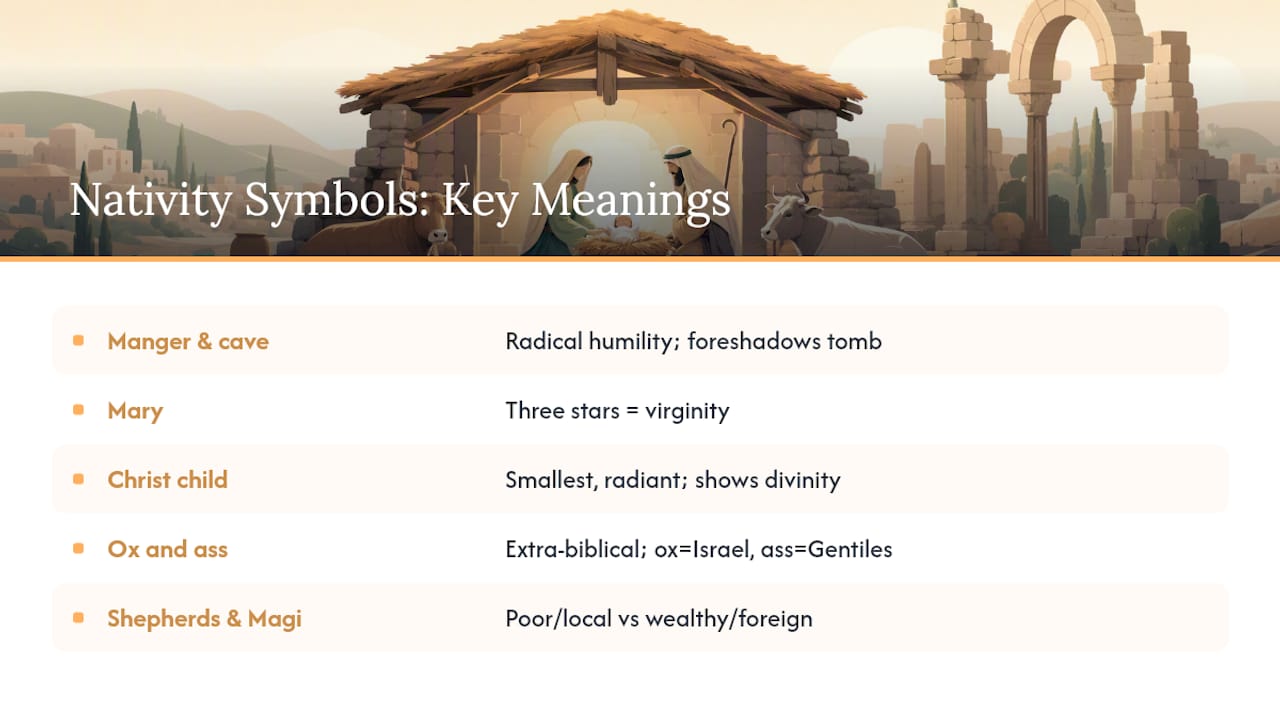
Ox and ass. Not in the Gospel text itself, but drawn from Isaiah and early apocryphal writing. One widely used reading treats the ox as a stand-in for Israel and the ass for the Gentile nations, both recognizing what human rulers missed.
Shepherds and Magi. Shepherds represent the poor and the local; Magi represent the wealthy and the foreign. Together they claim that the birth matters to every social class and every nation, not just one audience.
Quick reference: Of the figures most viewers assume are biblical, the ox, the ass, and the midwives all come from extra-biblical sources like the Protoevangelium of James and Isaiah, not the Gospel narratives themselves.
How Do Orthodox Icons Show the Theology of the Nativity?
Orthodox iconographers describe the Nativity icon as theology rendered in color, not a snapshot of a historical moment. That distinction changes everything about how you’re supposed to look at one.
The icon deliberately breaks chronology to preserve theological hierarchy. Mary, the midwives bathing the infant, Joseph’s private doubt, and the Magi’s arrival can all appear in a single frame even though they happened at different times, because the icon isn’t recording a sequence of events. It’s teaching a single, unified truth about who this child is.
That single insight from Orthodox iconographic tradition explains why Orthodox Nativity icons look so unlike a photograph or even a Renaissance painting. They’re not trying to capture one instant. They’re compressing an entire theological argument into one visual field.
The compositional logic usually runs top to bottom and reads as a movement from heaven into earth:
- A star at the very top sends a single ray down into a dark cave, uniting cosmic order with a specific place, a device the Orthodox Arts Journal describes as visually unifying heaven and earth in one continuous image.
- The cave itself, often rendered as a black void rather than a warm shelter, doubles as a symbol of Hades and death, tying the birth to the eventual resurrection.
- Christ lies swaddled in a manger shaped deliberately like a stone sarcophagus, making the tomb connection explicit rather than incidental.
- Midwives bathe the newborn in a basin at the icon’s base, an echo of baptism that most Western Nativity paintings simply omit.
- Off to one side, a small, easily missed scene shows Joseph being tempted by a devil figure disguised as an old shepherd, questioning how a virgin could give birth. This detail isn’t in the Gospels. It comes from apocryphal tradition and represents human doubt confronting divine mystery.
Icons aren’t meant to be decoded once and set aside. Orthodox devotional practice treats the icon as a window for contemplation, something you return to repeatedly, letting each viewing surface a different layer of the arrangement. That’s a fundamentally different relationship to the image than admiring a Renaissance panel for its technical skill.
Why Did Renaissance Artists Localize the Nativity Scene?
Renaissance painters made a specific, deliberate choice: instead of the timeless Byzantine cave, they set the Nativity inside recognizably contemporary landscapes and architecture. Piero della Francesca and Botticelli both worked this way, a pattern documented among 15th-century Italian masters who wanted biblical history to feel like it was happening in the viewer’s own world, not a remote, abstracted past.
That choice did real theological work. A Tuscan hillside standing in for Bethlehem told a 15th-century Florentine congregation something specific: this event isn’t sealed off in ancient history. It’s still breaking into the present. Renaissance artists used local visual cues precisely to link Christ’s birth to their own moment, including, in some cases, contemporary ideas about cultural and civic renewal.
Ruins became one of the era’s favorite devices, and they carry more weight than casual viewers usually notice.
- A crumbling classical building often stands for the old pagan order or the Old Covenant, now giving way to something new.
- Broken columns and cracked stone suggest decay being interrupted, even reversed, by the child born among them.
- Some art historians read the ruin as a visual echo of the Roman Empire specifically, birth arriving inside the wreckage of worldly power.
- The contrast between decayed architecture and a glowing, newborn child sharpens the sense of rebirth the whole composition is arguing for.
Renaissance Adoration scenes also loosened up emotionally compared to the more formal, hierarchical Byzantine model. Mary kneels rather than reclines. Shepherds show visible awe or confusion. Angels sometimes gather in casual, almost conversational clusters instead of rigid rows. The Metropolitan Museum’s analysis of a Lorenzo Monaco Nativity points to exactly this kind of shift, where composition starts carrying individual human reaction rather than pure symbolic hierarchy. The theology didn’t change. The emotional temperature did.
What Are the Common Settings and Regional Styles of Nativity Art?
Not every Nativity scene uses a cave. The setting itself is a choice, and it signals something about which tradition you’re looking at.
- The cave dominates Eastern Orthodox icons, doubling as the Hades/tomb symbol described earlier.
- The wooden stable became the dominant Western convention, especially after Saint Francis of Assisi popularized live nativity reenactments in the 13th century, favoring a more rustic, relatable structure over a cave.
- Urban or domestic settings appear in some Northern European painting, where the Holy Family shelters in a ruined city building rather than a rural structure, reinforcing the “no room” detail from Luke’s Gospel.
- Open-air or landscape settings without walls at all, common in Italian Renaissance work, use the surrounding countryside itself as the shelter.
Regional folk traditions push the variation further. Latin American nacimientos often include local flora, indigenous dress on the shepherds, and sometimes entire miniature villages built around the manger. Eastern European folk Nativity art frequently incorporates carved wood, bright embroidered textiles, and animals specific to the region rather than the generic ox and ass. Some Native American Christian communities have produced Nativity art using traditional materials, clothing, and even architectural forms native to their own cultures, reframing the same theological event in an entirely different visual vocabulary.
Modern and abstract reinterpretations take this even further. Some contemporary artists strip the scene down to a few geometric shapes and a single light source, pushing the composition toward pure contemplation. Others deliberately relocate the Nativity into a refugee camp, an urban alley, or a war zone, using the birth narrative to make an explicit statement about displacement or poverty. None of this is a departure from the tradition so much as its continuation. Every century has restaged the Nativity in its own visual language.
How Do You Read a Nativity Painting or Icon?
Reading a Nativity artwork well starts with the same question every time: what is this composition asking you to look at first?
- Find the focal point. Radiance, gold leaf, a converging gaze from every other figure, and central placement almost always point to the Christ child. If your eye lands somewhere else first, ask why the artist wanted it that way.
- Watch gestures and gaze, not just position. A shepherd’s raised hand, a Magus removing his crown, Mary’s eyes cast down rather than at the viewer. These small choices carry theological weight about humility, recognition, and worship.
- Look for scale distortions. Medieval and Byzantine art often makes theologically important figures larger regardless of actual physical distance. Size signals importance, not realism.
- Check for extra-biblical additions. Midwives, a doubting Joseph confronted by a devil figure, ruined architecture, a visible tomb-shaped manger. These details tie back to apocryphal texts or theological tradition rather than the Gospel accounts themselves.
- Ask about date, patron, and region before assuming an oddity is a mistake. A donor’s face inserted into the crowd, unusual local dress, or a strange animal often reflects patronage or regional custom rather than artistic error.
Orthodox tradition offers one more specific technique worth borrowing even for Western art: read from the center outward. Identify the theologically central figure first, then follow the ray of light or the direction of everyone’s gaze to see how the composition moves the eye from heaven down to earth and back again, a method the Orthodox Arts Journal uses to unpack the icon’s full theological argument.
Pro Tip: Before you leave a museum gallery or a church, try writing one sentence describing what the artist wanted you to feel first, and one sentence describing the detail that took you longest to notice. That gap between first impression and slow discovery is usually where the real theological content of a Nativity scene is hiding.
Which Nativity Artworks Should You Know?
A short list of works, spanning several centuries and traditions, gives you real reference points for everything covered above.
- The Nativity icon tradition (Byzantine, 6th to 9th century onward). Not a single work but a codified type, found across Orthodox churches and monasteries, that established the cave, mandorla, midwives, and doubting Joseph as a fixed program still used today, as explained in GOARCH’s icon commentary.
- Duccio di Buoninsegna, Maestà Nativity panel (early 14th century). A key transitional work bridging Byzantine gold-ground formality with the beginnings of Italian narrative naturalism.
- Giotto, Nativity fresco, Scrovegni Chapel (early 14th century). Giotto’s figures show visible emotion and weight, a turning point toward the human warmth that would define Renaissance treatment of the scene.
- Piero della Francesca, The Nativity (mid 15th century). Sets the Holy Family against a distinctly Italian landscape, exemplifying the localization strategy Renaissance painters favored.
- Sandro Botticelli, Mystic Nativity (late 15th century). Combines domestic tenderness with an unusual, almost apocalyptic band of angels above, blending devotion with theological commentary on the era’s turmoil.
- Lorenzo Monaco, Nativity panel. A useful case study in emotional shift within Western Adoration scenes, discussed in the Metropolitan Museum’s collection notes.
- Caravaggio, Adoration of the Shepherds (early 17th century). Strips away idealized beauty in favor of dramatic light and rough, working-class realism among the shepherds.
- Modern devotional reinterpretations. Contemporary artists continue producing Nativity imagery for home and parish use, often distilling centuries of symbolism into simplified, warm compositions, an approach reflected in pieces like Divine Prints’ abstract-style Nativity print.
How Do Protestant and Other Denominations Depict the Nativity?
Protestant traditions generally kept the Nativity’s core narrative elements while stripping away much of the symbolic density that Catholic and Orthodox art layered on for centuries. Post-Reformation art, especially in northern Europe, tended to favor plainer compositions, less gold leaf, fewer apocryphal figures like the doubting Joseph scene, and a stronger emphasis on domestic, human warmth over doctrinal signaling.
That doesn’t mean Protestant Nativity art abandoned meaning. It shifted emphasis. Many Protestant depictions foreground Scripture’s own details, shepherds, the announcing angel, the manger, while downplaying elements drawn from apocryphal texts or later Marian devotion, such as the crowned Theotokos imagery common in Orthodox and Catholic work.
Some evangelical and nondenominational communities today favor a stripped-down, almost documentary style: a young couple, a dim stable, a plain feeding trough, deliberately avoiding halos or radiant light effects that might feel closer to icon veneration than straightforward biblical illustration. Other Protestant traditions, particularly high-church Anglican and Lutheran communities, retain much of the symbolic vocabulary shared with Catholic art, including ruin symbolism and hierarchical composition.
The variation says something real about theology. How much symbolic weight a tradition assigns to Mary, to sacred objects, and to visual mediation of the divine shows up directly in how its artists choose to paint a manger scene.
What Do the Angels, Midwives, and Other Uncommon Figures Mean?
Several recurring Nativity figures never appear in Matthew or Luke’s birth narratives at all, which surprises a lot of viewers once they notice it.
The midwives bathing the infant Christ come from the Protoevangelium of James, an early apocryphal text. Their presence, especially prominent in Orthodox icons, adds a note of physical, embodied humanity to the scene and creates a visual parallel to baptism that Western art largely dropped.
The devil-shepherd tempting Joseph, tucked into a corner of many Orthodox icons, dramatizes Joseph’s private crisis of faith over Mary’s pregnancy. It’s a small scene, but it’s doing real theological work: even the child’s earthly guardian had to wrestle with doubt before accepting the mystery.
Angels function differently across traditions. In Byzantine icons, they often appear stacked in a formal register above the cave, more architectural than active. In Renaissance and Baroque painting, angels grow more animated, sometimes playful, occasionally singing or gesturing directly at the viewer, pulling the audience into participation rather than pure observation.
Ox and ass, already discussed as prophetic stand-ins for Israel and the Gentiles, technically qualify as apocryphal additions too, since neither animal is named in the Gospel accounts.
None of these figures are errors or embellishments to dismiss. They represent centuries of theological reflection working through visual storytelling, filling narrative gaps the Gospels left open.
What Role Has Nativity Art Played in Worship and Devotion?
Nativity imagery has functioned as devotional practice, not just decoration, since at least the medieval period. Icons in Orthodox worship aren’t admired the way a painting hangs in a gallery. They’re venerated, kissed, incensed, and used as focal points for prayer during liturgical seasons tied to Christ’s birth.
Saint Francis of Assisi’s 13th-century live Nativity reenactment in Greccio helped popularize the crèche tradition across the Western church, turning static imagery into something communities physically built and gathered around each Advent. Pope Francis’s own reflection on this practice describes the nativity scene as inviting contemplation of the Incarnation in a way that engages the whole family, not just individual private prayer.
Home devotional display has followed a similar path. Families setting up a manger scene each December, whether a full figurine set or a single framed print, are participating in a much older habit of using physical, visual reminders to keep a theological event present in ordinary domestic life. Many icons and medieval panels were also composed to echo specific liturgical hymns, connecting the visual image directly to the words sung or chanted during Christmas services, reinforcing the same message through two senses at once.
That dual function, prayer aid and teaching tool, is why Nativity art never fully settled into being just history painting. It stayed devotional even as its style kept changing.
What Misconceptions About Nativity Symbolism Should You Watch For?
The biggest misreading is treating a Nativity scene as a straightforward historical snapshot rather than a theological composition. Once you know icons compress multiple moments into one frame on purpose, details that look like continuity errors start making sense.
A second common mistake: assuming every figure in the scene comes straight from Matthew or Luke. The ox, the ass, and the midwives have no Gospel citation. They come from Isaiah’s prophetic imagery and apocryphal texts like the Protoevangelium of James, later absorbed into standard iconography.
People also frequently assume the Magi and shepherds arrived together. Most artists compress the timeline for compositional or theological reasons, not because the events happened simultaneously.
Another frequent confusion involves Mary’s position relative to Joseph and the manger. There’s no fixed rule placing her strictly on the left or right; it varies by period, region, and individual composition, often driven by where the artist wanted the viewer’s eye to land first rather than any symbolic left/right convention.
Finally, some viewers dismiss ruin symbolism, radiant light effects, or the manger-as-tomb echo as accidental or purely decorative. They’re not. Art historians point out that Nativity scenes are frequently paired with the crucifixion precisely because artists wanted birth and death read as one continuous act of salvation, not two separate stories.
A Publisher’s View on Living With Nativity Art at Home
Most people encounter Nativity symbolism for about six weeks a year and then pack it away. That’s a missed opportunity. The theology behind the manger, the star, and the ox and ass doesn’t expire after Epiphany. It’s a compact statement about humility, incarnation, and sacrifice that holds up as a year-round devotional image, not just a seasonal decoration.
At Divineprints, the goal with Nativity and other biblical event prints is to give that theology a permanent place in a room rather than a closet. A smaller framed print works well in a hallway or prayer corner where you pass it daily. A larger canvas earns a spot above a mantel or in a family room, somewhere it can anchor conversation during Advent and beyond. Material matters too: a museum-quality print on matte paper reads warmer and more intimate for a bedroom, while canvas holds up better in higher-traffic living spaces.
Choosing a Nativity print for a Confirmation or baptism gift works the same way a good icon works: it gives someone a fixed visual point to return to long after the occasion has passed.
Sources
For readers who want to go directly to primary material, a few sources anchor most of the claims above. Pope Francis’s Admirabile signum remains the clearest Catholic reflection on the crèche’s purpose. GOARCH and the Orthodox Arts Journal offer the deepest treatment of icon theology and symbolism. Museum essays from institutions like the Metropolitan Museum, alongside the broader historical overview on Wikipedia, round out the art-historical picture.
- Admirabile signum — Apostolic Letter (Pope Francis)
- Icon of the Nativity — GOARCH
- How Renaissance artists captured the Nativity — Aleteia
FAQ
What Does the Nativity Symbolize?
The Nativity symbolizes the Incarnation, God taking on human flesh and entering the world through humility rather than power. Elements like the manger, the cave, and the ruined architecture reinforce that theme, and many artists deliberately echo crucifixion imagery to link Christ’s birth and death as one salvific story.
What Are Some of the Most Beautiful Nativity Paintings?
Widely cited examples include works by renowned artists such as Piero della Francesca, Botticelli, Giotto, and Caravaggio. Byzantine Nativity icons are also frequently praised for their theological depth, described in Orthodox sources as theology rendered in color.
Was There a Dog at Jesus’ Birth?
No canonical or widely used apocryphal source includes a dog at the Nativity. Standard iconography instead features the ox and ass, drawn from Isaiah and early apocryphal texts, representing Israel and the Gentile nations.
Is Mary on the Left or Right in the Nativity?
There’s no fixed rule. Mary’s placement relative to Joseph and the manger varies by period, region, and individual artist, usually driven by compositional balance rather than a symbolic left/right convention.