

The saints most commonly invoked by soldiers are St. Michael, St. George, St. Maurice, St. Sebastian, St. Ignatius of Loyola, Joan of Arc, and St. Barbara. Each holds a different corner of military patronage, from artillery to airborne units, and Christian tradition has varied in assigning patronage. This guide covers their stories, which branches favor which saint, common prayers, feast days, and simple ways to keep their memory close during service.
TL;DR:
- St. Michael is widely invoked for protection and spiritual combat, with his feast on September 29 marking him as the most recognized military icon.
- St. George, honored on April 23, symbolizes chivalry and bravery, especially in medieval and cavalry traditions, with legends shaping his patronage.
- St. Maurice, linked to infantry units, gained prominence through his leadership of the Theban Legion, martyred for refusing pagan worship.
- St. Sebastian represents endurance and steadfastness under attack, making him popular among soldiers facing combat dangers, with a feast day on January 20.
- Patron saints’ feast days serve as focal points for prayer and ceremonies, often aligned with branch traditions or unit histories, emphasizing faith in everyday military life.
Table of Contents
- The Patron Saint of Soldiers: Nine Names Every Service Member Should Know
- Which Saint Matches Which Branch or Role
- Why These Saints Became Patrons in the First Place
- Prayers and Devotional Practices Soldiers Actually Use
- Feast Days Worth Marking on the Calendar
- Devotional Art, Medals, and How Service Members Use Them
- A Reflection on Faith, Memory, and Military Life
- Bring a Patron’s Presence Into Your Prayer Space
- Sources
The Patron Saint of Soldiers: Nine Names Every Service Member Should Know
No single figure holds exclusive claim to the title “patron saint of soldiers.” Franciscan Media’s roundup lists Joan of Arc, George, Hadrian, Ignatius, Sebastian, Demetrius, Martin of Tours, and Maurice all under that heading, and the variation is a feature of the tradition, not a flaw in it. Different armies, orders, and eras leaned on different soldier-saints depending on what they needed: protection before a charge, courage under torture, or a model for leaving violence behind.
- St. Michael the Archangel. Not a human soldier but the commander of the heavenly host, invoked for protection and spiritual combat. His feast is commonly observed on September 29, and his image, sword raised over a defeated devil, remains the most recognized military icon in Christian art.
- St. George. A Roman soldier martyred for his faith around 303 AD, later folded into legend as the dragon-slaying knight. Medieval armies adopted him as a symbol of chivalric courage; his feast is April 23.
- St. Maurice. Leader of the legendary Theban Legion, a unit of Christian soldiers martyred for refusing to worship pagan gods. Notre Dame’s Faith database credits him as a patron of infantrymen specifically, with a feast on September 22.
- St. Sebastian. A Roman soldier and martyr, tradition holds he survived an execution by arrows before ultimately dying for his faith. His steadfastness under attack made him a natural patron for those facing combat; feast day January 20.
- St. Ignatius of Loyola. Wounded by a cannonball as a young soldier, he converted during a long recovery and later founded the Jesuits. National Catholic Register traces his patronage directly to that battlefield injury; feast July 31.
- St. Joan of Arc. A teenage peasant who led French troops during the Hundred Years’ War, claiming divine visions guided her strategy. Burned at the stake and later canonized, her feast is May 30.
- St. Barbara. A young martyr whose father reportedly struck her down with a sword, after which lightning killed him, an association that made her patron of anyone working with explosives. Feast December 4.
- St. Demetrius. A Roman soldier and martyr from Thessaloniki, venerated heavily in Eastern Orthodox military tradition as a warrior-saint and protector of the city.
- St. Martin of Tours. A Roman cavalry officer who left military service over a conscience objection to violence, later becoming a bishop known for charity. His feast is November 11.
Which Saint Matches Which Branch or Role
Soldiers and units have long matched their patron to the job at hand, and the pairings usually trace back to a legend, a piece of history, or a modern tradition that stuck.
- Infantry. St. Maurice holds a strong claim here, rooted in his command of the Theban Legion and its refusal to compromise under orders.
- Artillery. St. Barbara’s association with lightning and sudden violent death made her the natural fit for gunners handling explosives, a tradition still honored at artillery branch ceremonies.
- Airborne and paratroopers. St. Michael’s link to jump units developed during World War II, when French parachutist traditions adopted him as protector, a practice that spread and stuck across airborne culture.
- Cavalry and armor. St. George’s knightly legend, the mounted warrior facing down a monster, traditionally associates him with cavalry and armored units.
- Navy and maritime service. Several coastal and seafaring traditions lean on saints tied to storms and safe passage, though naval patronage varies more by nation than the other branches.
- Unit-specific patronage. Many individual regiments and chapels adopt a saint based on their own founding story rather than branch-wide convention, which is why you’ll find a St. Sebastian medal in one unit and a St. Demetrius icon in another.
Observances differ by country and denomination. A unit’s commemorative jump on a feast day or a special Mass tied to a patron’s anniversary is common, but it is a local tradition rather than a fixed rule across every army.
Why These Saints Became Patrons in the First Place
Patronage among soldier-saints tends to follow one of a few recurring patterns, and knowing which pattern applies to a given saint tells you whether the connection rests on documented history, later legend, or a devotional tradition that grew up centuries after the fact.
- Soldier-martyrs who refused to renounce their faith. Maurice and his Theban Legion, along with Sebastian, fall here: real military service followed by execution for religious conviction.
- Leader-of-legion stories that grew into legend. George’s historical martyrdom is thin on detail, but centuries of storytelling turned him into the dragon-slaying knight patron.
- Soldier-to-saint conversions. Ignatius is the clearest case: a battlefield wound triggered a spiritual awakening that ended his military career and started a religious order.
- Conscience-driven departures. Martin of Tours walked away from the Roman army over moral objections to violence, a narrative that resonates with soldiers wrestling with the ethics of combat.
Medieval knighthood and, later, twentieth-century military culture amplified several of these figures well beyond their original context. Chaplaincy commentary on military virtues frames these saints as models of courage and fidelity rather than guarantees of safety, a distinction worth holding onto before assuming any patronage functions like a lucky charm.
Prayers and Devotional Practices Soldiers Actually Use
There is no single official “soldier’s prayer” in Catholic tradition. What comes closest is the Prayer to St. Michael, recited widely for protection and used informally by service members before deployment or difficult duty. Its short, direct language, asking Michael to “defend us in battle,” makes it easy to memorize and repeat under pressure.
Pro Tip: Keep a laminated card with the Prayer to St. Michael in your gear. It takes seconds to read and works even when you have no time or privacy for longer devotion.
- Many Catholics in uniform draw on the Spiritual Exercises of St. Ignatius, a structured method of daily reflection built around discernment rather than combat specifically.
- A pocket prayer card or small medal blessed by a chaplain is the most portable devotional option available.
- Requesting a chaplain-led Mass on a patron’s feast day is common practice in units with a strong Catholic presence, often arranged through Catholic Funeral Services Singapore | Indian Life Memorial providers who support military families.
- Keeping a small saint image in personal quarters, even a locker or bunk, gives a quiet visual anchor for prayer.
Feast Days Worth Marking on the Calendar
Each patron carries a fixed date on the liturgical calendar, and observing it can be as simple as a private prayer or as formal as a unit ceremony.
- January 20 — St. Sebastian: a quiet prayer for endurance under pressure.
- April 23 — St. George: fitting for cavalry and armor units to mark with a small ceremony.
- May 30 — St. Joan of Arc: a moment to reflect on courage under impossible odds.
- July 31 — St. Ignatius: a good day to sit with the Spiritual Exercises, even briefly.
- September 22 — St. Maurice: traditionally honored by infantry with a feast-day Mass.
- September 29 — St. Michael: the most widely marked date across denominations, often with special prayers.
- November 11 — St. Martin of Tours: a date that already overlaps with Veterans Day observances in the United States.
- December 4 — St. Barbara: artillery units frequently hold a formal dinner or ball on this date.
Denominational calendars vary, and Eastern Orthodox dates for figures like Demetrius often differ from the Western dates listed above. Check with a unit or parish chaplain before planning an official observance.
Devotional Art, Medals, and How Service Members Use Them
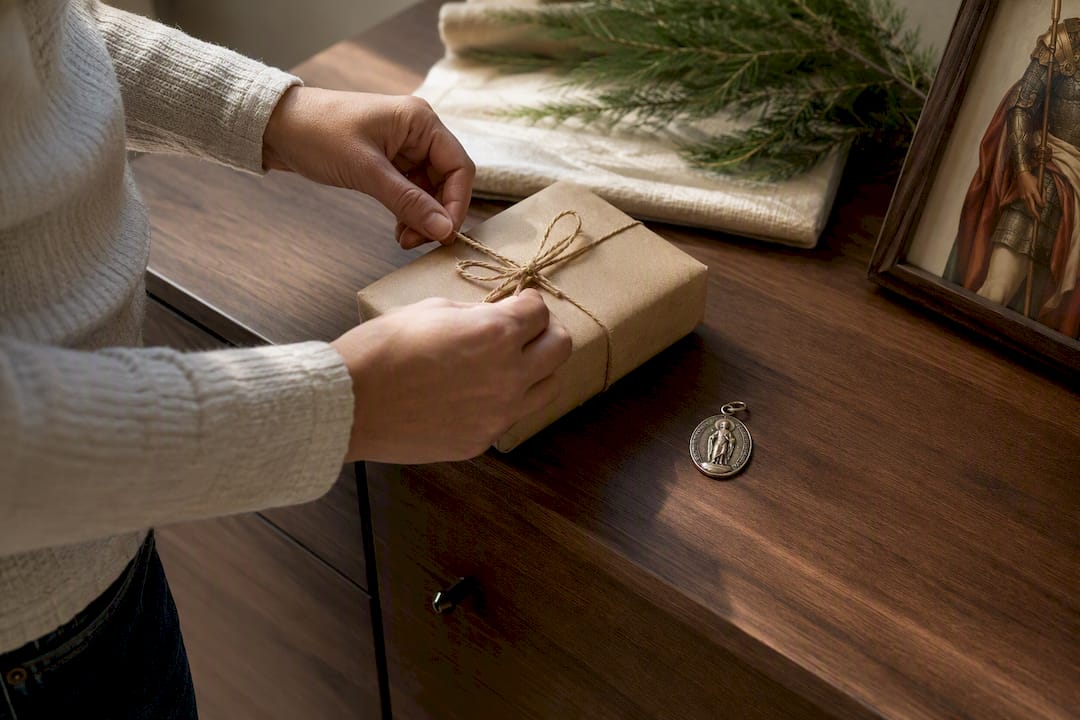
Physical reminders matter in military life, where space is limited and time for formal prayer even more so. A medal clipped to dog tags, a holy card tucked into a wallet, or a small framed print on a wall at home all serve the same purpose: keeping a patron’s memory present without requiring a chapel or a quiet hour.
- Pocket medals travel well and hold up to field conditions better than paper.
- Holy cards fit inside a Bible, a journal, or a helmet band.
- A framed print works best in a home, office, or shared prayer space rather than field gear.
Pro Tip: If you’re placing an image in a shared barracks or common area, ask before hanging it. A respectful choice, a single saint rather than a busy devotional scene, tends to fit better in mixed-faith environments.
Deployment send-offs, promotions, and memorials are natural occasions for gifting a saint image, and a well-chosen print can outlast almost any other keepsake on that list.
A Reflection on Faith, Memory, and Military Life
Saint images do real work in military life, not as protection guarantees but as anchors for memory and prayer when time and privacy run short. A small print of St. Michael on a nightstand or a medal of St. Barbara worn under a uniform carries the same purpose the earliest soldier-martyrs understood: faith held onto in circumstances that test it daily.
These images are aids to devotion, not substitutes for a chaplain’s counsel or a soldier’s own conscience. Treat them that way and they hold their proper place.
— Griffin
Bring a Patron’s Presence Into Your Prayer Space
There are ways to keep a chosen patron visibly present at home, in a dorm room, or at a parish, without hunting through generic religious retailers for something that actually looks worth hanging. The Saint Prints collection offers museum-grade prints and canvases sized for a nightstand, a hallway, or a chapel wall, framed or unframed, made to order rather than pulled from a mass-produced stock bin.

If you’re marking a deployment, a promotion, or a feast day, a framed Sacred Heart of Jesus print or a piece from the saints collection makes a gift that holds meaning years after the occasion passes. Browse the collection, pick a size and frame that fits the space you have in mind, and place an order today.
Sources
- Saint Maurice and companions | University of Notre Dame (Faith)
- Were any soldiers saints? | Franciscan Media
- Prayer to St. Michael | Saint Michael USA
- How St. Ignatius of Loyola became the patron saint of soldiers | National Catholic Register