

The empty tomb painting is defined as Christian artwork depicting the moment of Christ’s resurrection through the absence of his body and the reactions of the first witnesses. This motif appears across centuries of Western and Eastern Christian art, rooted directly in the four Gospels: Matthew 28, Mark 16, Luke 24, and John 20. Landmark works like Giovanni Francesco Romanelli’s 1641 painting and Piero della Francesca’s 1463 fresco established the visual vocabulary still used today. These resurrection paintings do more than record a biblical event. They function as devotional objects, pulling viewers into the story and inviting personal prayer and reflection.
What is the historical evolution of the empty tomb painting?
The earliest Christian depictions of the empty tomb were symbolic rather than narrative. Medieval artists working in tempera and gold leaf kept figures flat and stylized, prioritizing spiritual meaning over physical realism. The symbolic simplicity of early art gave way to humanistic realism as the Renaissance took hold across Europe.
Piero della Francesca’s 1463 fresco, measuring 225 x 200 cm, marks a turning point. He applied geometric perspective and anatomical precision to the resurrection scene, placing a risen Christ at the center with sleeping soldiers below. The composition uses a vanishing point to draw the viewer’s eye directly to Christ’s figure, a technique that made the theological claim feel physically present. This was not decoration. It was argument in paint.
Giovanni Francesco Romanelli’s 1641 painting, measuring 47.0 x 38.0 cm, brought Baroque drama to the same subject. Romanelli used deep shadow, dynamic figure poses, and concentrated light to heighten emotional tension. Alexander Ivanov’s later work continued this tradition of psychological depth, focusing on the human response to the empty site rather than the risen Christ himself.
The table below outlines the key shifts across artistic periods:
| Period | Style | Key Characteristics |
|---|---|---|
| Early Medieval | Symbolic | Flat figures, gold leaf, minimal narrative detail |
| Byzantine | Iconic | Formal composition, spiritual hierarchy, limited realism |
| Renaissance | Humanistic | Geometric perspective, anatomical accuracy, narrative depth |
| Baroque | Dramatic | High contrast, emotional figures, theatrical lighting |
| Modern | Varied | Photorealism, abstraction, or devotional simplicity |
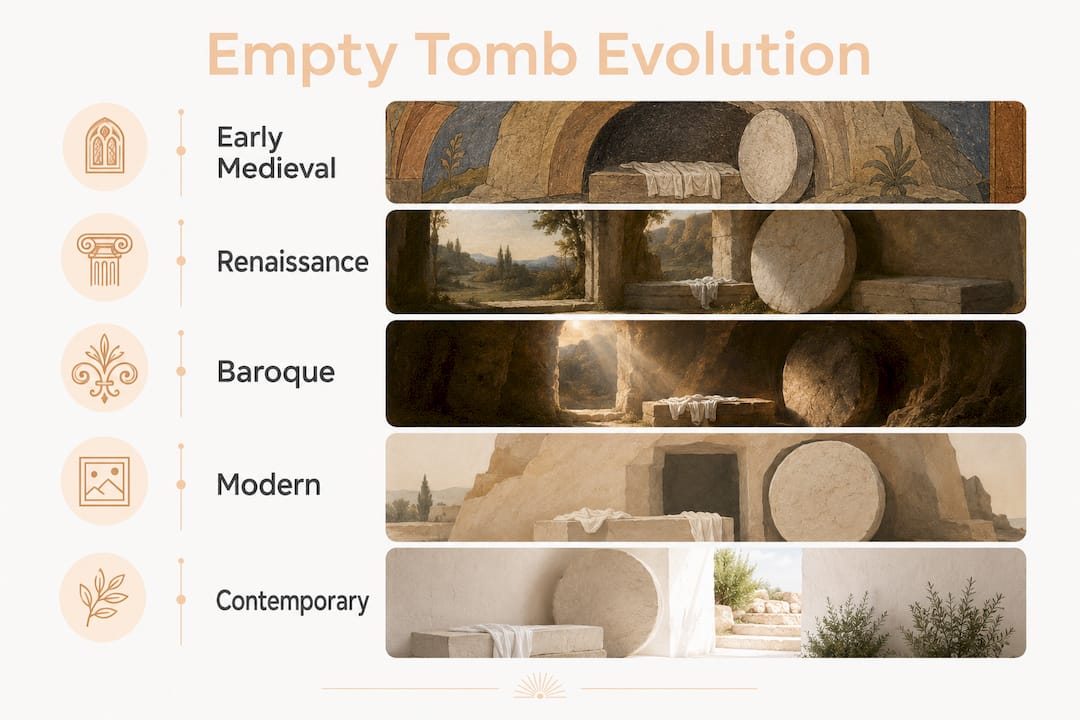
Three artists anchor the historical tomb paintings tradition most firmly: della Francesca for Renaissance structure, Romanelli for Baroque emotion, and Ivanov for psychological realism. Each reflects the theological priorities of his era.
What theological meanings does empty tomb artwork convey?
The empty tomb carries a specific theological weight that differs from a resurrection scene showing the risen Christ. The empty site itself forces the viewer to reckon with absence as evidence. No body means resurrection. The art makes that logic visible.
Biblical accounts from all four Gospels anchor the iconography. John 20 provides the scene of Mary Magdalene encountering the risen Christ, with the famous line “Do not cling to me” offering artists a charged moment of transition between grief and recognition. Artists have returned to this scene repeatedly because it holds both human emotion and divine mystery in a single exchange.
Key symbolic elements appear across most empty tomb compositions:
- The empty sarcophagus or burial cloth: Signals the physical reality of resurrection without showing the risen body.
- Angel figures: Represent divine announcement; their posture and gesture direct the viewer’s attention and emotional response.
- The Three Marys or apostles Peter and John: Ground the scene in human witness, making the viewer feel like one of the first to arrive.
- Light sources: Often positioned to suggest divine presence entering the physical world.
The theological function of these images is to move the viewer from observer to participant. Scholars of Christian iconography describe this as the artwork’s contemplative purpose: it does not simply document history but invites the viewer to stand among the witnesses.
Pro Tip: When using empty tomb artwork in a prayer space, choose a composition that includes human witnesses rather than a purely symbolic empty tomb. The presence of figures like Mary Magdalene or the apostles gives the viewer a point of identification, deepening the meditative experience.
How do artistic styles and techniques shape these paintings?
Composition is the primary tool artists use to control how a viewer experiences a resurrection painting. Piero della Francesca placed Christ on a raised platform above sleeping soldiers, creating a vertical hierarchy that reads as spiritual ascent. The geometric precision of his composition communicates order and divine authority without a single word.
Romanelli took the opposite approach. His Baroque compositions crowd the frame with figures in motion, using sharp light and shadow to create urgency. Where della Francesca’s work invites calm contemplation, Romanelli’s demands emotional engagement. Both are valid devotional strategies. The difference lies in what kind of prayer the artist wants to prompt.
Color choices carry theological meaning as well. Artists frequently render Christ in cool whites or luminous gold to signal his divine nature, while surrounding figures appear in warmer, earthier tones. This contrast between cold-white for Christ and emotional figures in warm color is a documented compositional technique in major empty tomb works.
“Religious artworks of the empty tomb transcend depiction to achieve a solemn, meditative atmosphere balancing human grief and divine glory. The best of these paintings hold both realities at once, refusing to let the viewer settle into either pure sorrow or pure triumph.”
The three main categories of empty tomb imagery each serve a different devotional function. Narrative scenes with witnesses suit personal prayer and identification. Angel-focused theological scenes emphasize divine announcement and authority. Triumphant resurrection portrayals shift focus to Christ’s victory and are better suited to communal worship settings. Knowing which category a painting belongs to helps collectors and enthusiasts choose work that fits their intended use.
What should collectors know when acquiring empty tomb art?
Collectors face a clear choice between archival prints and hand-painted oil reproductions. Archival prints on acid-free luster paper resist yellowing and fading over time, maintaining color accuracy for decades. They typically include a one-inch white border that protects the image during framing. This makes them the practical choice for most buyers.
Hand-painted oil reproductions offer a different value. The texture of brushwork, the depth of layered paint, and the physical presence of a canvas all contribute to the devotional experience in ways a print cannot replicate. The tradeoff is cost and variability. Quality depends entirely on the skill of the artist commissioned to produce the work. Buyers should request samples or portfolio evidence before committing to a custom oil reproduction.
Pro Tip: Before purchasing any reproduction, confirm that the seller specifies acid-free materials and offers professional framing options. These two details separate quality reproductions from pieces that will degrade within a few years.
Material and sizing considerations matter for both display and longevity:
- Acid-free paper or canvas: Prevents chemical degradation that causes yellowing.
- Archival inks: Maintain color fidelity across decades of display.
- Custom sizing: Hand-painted reproductions can match the dimensions of historical originals or be scaled for specific wall spaces.
- Framing: UV-protective glass extends the life of both prints and paintings displayed in sunlit rooms.
The devotional purpose of the artwork should guide every acquisition decision. A piece intended for a prayer corner calls for a different scale and tone than one chosen for a church narthex or a living room wall. Matching the artwork’s emotional register to its setting is as important as material quality. Collectors who treat these as purely aesthetic objects often end up with pieces that feel out of place in devotional contexts.
For collectors building a broader Christian art collection, pairing empty tomb imagery with related biblical event prints creates a coherent visual narrative across a home or worship space.
Key Takeaways
The empty tomb painting is the most theologically concentrated motif in Christian art, combining witness, absence, and divine announcement into a single visual moment.
| Point | Details |
|---|---|
| Three iconographic categories | Empty tomb art divides into narrative witness scenes, angel-focused theological scenes, and triumphant resurrection portrayals. |
| Historical milestones | Della Francesca’s 1463 fresco and Romanelli’s 1641 painting define the Renaissance and Baroque approaches respectively. |
| Theological symbolism | The empty sarcophagus, discarded shroud, and angel figures each carry specific meaning rooted in the four Gospels. |
| Collector priorities | Archival prints on acid-free paper offer longevity; hand-painted oils require verified artist skill and custom commissioning. |
| Devotional matching | The composition style and emotional register of a piece should match its intended setting and prayer purpose. |
Why the empty tomb still stops me cold
I have spent years studying Christian iconography, and the empty tomb remains the motif that consistently surprises me. Most sacred art gives you something to look at: a saint’s face, a miracle in progress, Christ in glory. The empty tomb gives you nothing. That absence is the entire point, and pulling it off in paint is genuinely hard.
What I find underappreciated is how much the witness figures carry the theological weight. When Romanelli painted Peter and John at the tomb, he was not illustrating a story. He was creating a mirror. The apostles’ confusion and awe are the viewer’s confusion and awe. The best empty tomb compositions work because they refuse to explain the resurrection. They simply show people encountering evidence they cannot fully process.
The shift from medieval symbolic depictions to Renaissance realism also changed what these paintings ask of the viewer. A gold-leaf Byzantine icon keeps you at a reverent distance. Della Francesca’s fresco puts you in the scene. Both are legitimate devotional strategies, but they produce very different kinds of prayer. Collectors who understand this distinction make better choices, and they end up with artwork that actually functions in their spiritual lives rather than just hanging on a wall.
If you are building a devotional space, I would encourage you to look at biblical event prints that include witness figures. The empty tomb without witnesses is a historical document. With witnesses, it becomes an invitation.
— Griffin
Resurrection art worth living with, from Divineprints
Divineprints offers a curated selection of Christian art pieces centered on biblical events, including resurrection and Gospel-inspired imagery printed on archival-grade materials. Each piece is designed to serve both as home decor and as a devotional anchor for daily life.

For collectors seeking a devotional centerpiece, the Sacred Heart of Jesus reproduction exemplifies the quality and spiritual depth Divineprints brings to Christian wall art. Prints are available in multiple sizes, produced on acid-free paper with archival inks, and ready to frame. Whether you are furnishing a prayer room, a family living space, or a parish setting, Divineprints provides artwork that holds its meaning over time.
FAQ
What is the empty tomb painting in Christian art?
The empty tomb painting is a category of Christian iconography depicting the moment after Christ’s resurrection, focusing on the empty burial site and the reactions of witnesses such as Mary Magdalene, the Three Marys, and the apostles Peter and John. It is rooted in accounts from Matthew 28, Mark 16, Luke 24, and John 20.
How does empty tomb art differ from resurrection paintings?
Empty tomb scenes focus on witnesses encountering the vacant tomb, emphasizing human response and contemplation. Resurrection paintings typically depict the triumphant risen Christ himself, making them more celebratory and less meditative in tone.
What are the most historically significant empty tomb paintings?
Piero della Francesca’s 1463 fresco (225 x 200 cm) and Giovanni Francesco Romanelli’s 1641 painting (47.0 x 38.0 cm) are among the most studied works in this tradition, representing Renaissance geometric precision and Baroque emotional drama respectively.
What materials should I look for in a quality empty tomb art print?
Acid-free luster paper with archival inks and a one-inch white border are the standard markers of a quality archival print. These materials prevent yellowing and maintain color accuracy over decades of display.
How do I choose the right empty tomb artwork for a devotional space?
Match the composition style to the intended use. Narrative scenes with witness figures suit personal prayer and meditation. Angel-focused theological compositions work well in formal worship settings. Triumphant resurrection portrayals are best suited to communal or celebratory contexts.