

The best narthex decor does two things at once: it welcomes people warmly and it turns their attention toward worship. In practice that means a clean, uncluttered entry, good lighting, a few well-chosen sacred images placed with care, and seasonal touches that follow the church year. A single strong piece of devotional art, such as a saint or Christ image printed at a size the room can carry, does more than a dozen small decorations competing for attention.
The narthex is the entrance area just inside the front doors. Some parishes call it the vestibule, the gathering space or the lobby. Below is how to decide what belongs there, where to hang it and how to keep it welcoming in every season.
TL;DR
- The narthex is a threshold between the street and the sanctuary, so decor should be simple, clean and orienting, never cluttered.
- Sacred art, banners and parish displays all suit this space, but one or two focal images beat many small ones.
- Follow the liturgical seasons with wreaths, fabric and a rotating centerpiece, and keep secular decorations out.
- Leave clear pathways for wheelchairs, walkers, strollers and processions before adding any furniture or decor.
- Museum-grade saint, Jesus, angel and biblical prints from Divine Prints are made to order with a lifetime warranty against defects or fading.
Table of Contents
- What the narthex is for
- Start with the walls: sacred art as the focal point
- Seasonal decor that follows the church year
- Make the decor do hospitality work
- Match the decor to your parish’s character
- Plan for traffic, accessibility and safety
- Bring the art to your narthex
- FAQ
- Sources
What the narthex is for
Decor choices get easier once you know the job of the room. A Catholic liturgical-environment guide describes the narthex as the area directly inside the front doors, a transition from the secular to the sacred where people leave behind ordinary cares. It should look inviting and well kept, never dingy or cluttered, with a simple beauty that turns hearts toward God.
The room is also busy. The Lutheran Altar Guild and Sacristy Handbook notes that the narthex is where processions form, wedding receiving lines gather and Palm Sunday begins. It also says the space should be kept clean and uncluttered at all times, and that sculpture, wall hangings and paintings may reflect the day or season of the church year. Catholic Review adds that this is where baptisms, funerals and weddings begin and where the faithful greet one another before and after Mass.
The Eastern tradition describes the same room in practical terms. An Orthodox Arts Journal essay says the narthex is where people “land”: eyes adjust, families regroup, coats come off, and lighting is generally dimmer so people quiet down before entering the nave.
So narthex decor has three jobs:
- Welcome. A visitor should feel expected within seconds.
- Orient. The room should point toward the worship space and the life of the parish.
- Stay out of the way. Processions, wheelchairs, strollers and greeters all need to move through.
Start with the walls: sacred art as the focal point
Walls cost nothing in floor space, which is why art is the most efficient narthex decor in a small or busy entry. The Catholic guide above calls the narthex a good place for flags, banners, displays and sacred art. A church-design guide hosted by an Austin firm says the narthex should give a clear visual focus on the worship space, using organization, materials, lighting, artwork and signage to convey a sense of the spiritual.
A real parish example shows how far a few pieces can go. The Parish of St Ann in Charlotte describes a narthex with terrazzo floors, green walls and arches, anchored by three major artworks: a Divine Mercy image, a Russian icon of the Presentation of Mary and a statue of the Infant Jesus of Prague. Three pieces, each with a clear devotional meaning, carry the whole room.
Choose subjects that fit your parish
The subject is the first decision. These are the families of imagery that suit an entry:
- Your patron saint. A print of the saint your parish is named for tells every visitor whose house they have entered. It also gives children a face to connect with the name on the sign.
- Christ images. The Sacred Heart, Divine Mercy or the Good Shepherd speak a welcome before anyone says a word. Our Jesus prints cover these themes.
- Saints tied to a ministry. A saint for the St. Vincent de Paul society, the youth group, the choir or the school gives each group a visible home.
- Angels. Guardian angel and archangel images suit family-heavy parishes and the corridor to the nursery or cry room. See the angel prints.
- Biblical scenes. A scene such as the Transfiguration or the Road to Emmaus gives a gathering space a sense of story. Browse biblical event prints for options.
For saints, the saint prints collection is the place to start, especially if you are looking for a patron or a saint tied to a specific ministry.
Hang fewer pieces, and hang them well
Restraint is part of reverence. The Diocese of Venice (Florida) building guidelines say that sacred objects and images should not be multiplied in the same space. That guidance is written about worship areas, but it is a good test for the narthex too. Ask whether each piece has room to be seen and a reason to be there.
A simple working method:
- Pick the focal wall. This is usually the wall a visitor faces after the doors close, or the wall beside the guest book or greeter table.
- Hang one large piece or a balanced pair. Aim for the center of the artwork at roughly eye level, which most designers put around 57 inches from the floor. Our entryway guide on the two-thirds rule explains how to size art against the wall or furniture below it.
- Leave breathing room. Blank wall around an image makes it read as intentional.
- Light it. A warm-white picture light or nearby lamp keeps the piece from disappearing in a dimmer entry.
- Keep notices separate. Put bulletin boards and flyers on their own wall, so the devotional image is not buried in announcements.
A worked example: a narthex has a 10-foot wall between the entry doors and the nave doors, with a guest-book table in the middle. Hang one large saint print centered above the table, and move the event flyers to a board on the side wall near the restrooms. The result is one quiet focal point, and visitors still find the information they need.
Frames, canvas and paper
Narthex doors open and close all day, and the room swings with the weather and the crowd. Durable materials matter. Our prints are made to order on museum-quality matte fine art paper or on canvas, in multiple sizes and frame types. They come with a lifetime warranty against defects or fading, and shipping is free worldwide. Matte paper also helps in a narthex, where overhead and window light can create glare on glossy surfaces. If the wall will carry a large image, the canvas option suits the scale.
Seasonal decor that follows the church year
The narthex is the easiest room in the building to change with the seasons, because it is where people arrive and where seasonal customs often begin.
Advent. The Catholic guide allows the Advent wreath in the narthex where it is visible without interfering with the liturgy. It also says the narthex can be the best place for Christmas trees, with no blinking or flashing lights and no ornaments (see the liturgical-environment guide). Families who want to carry Advent home can find ideas in our guide to Advent home decor.

Easter. The same guide calls for lavish, elegant decor in white and gold, without secular decorations such as bunnies or pastel eggs. A white runner on the welcome table and a print of the Resurrection or the Holy Women at the Tomb set the tone.
Ordinary Time and feast days. A rotating saint print can mark a feast day, a patronal feast or All Saints. Placing it on an easel or hanging a lighter frame near the guest table makes it easy to swap.
Fall. Subsplash’s guide to fall lobby decor suggests wreaths of dried leaves, pinecones or wheat just inside the doors, and faux leaf garlands in reds, golds and burnt oranges along tables and windowsills. If doors stay open, secure and weatherproof anything that hangs outside.
A seasonal fabric runner in the liturgical color (purple for Advent and Lent, white for Easter and Christmas, green for Ordinary Time) is the cheapest way to signal the church year on a table. Keep the centerpiece simple: a cross, a bowl of natural elements or a single vase of flowers.
For more budget-friendly ideas on color, focal art and do-it-yourself touches, see our church decor ideas.
Make the decor do hospitality work
The Gospel Coalition quotes a church leader who calls the narthex the space between the secular and the sacred, where the community greets one another and offers hospitality in the spirit of 1 Peter 4:9. Decor should serve that.
The Episcopal Diocese of Georgia’s hospitality checklist is concrete. It recommends that the narthex have well-made visitor brochures, the current newsletter and attractive bulletin boards reflecting the congregation’s life and ministries. It also calls for good lighting and paint, tissues in cold and allergy season, and clearly marked, clean, well-stocked restrooms.
A parish newsletter from Saint Anthony’s gives a picture worth copying: a clean, spacious entry with a spray of flowers, a classic icon, a warm wooden table with the guest book and greeters with bulletins and smiles. Notice that the icon is one piece and the table is one table.
Practical elements that pair well with art:
- A greeter table with the guest book, bulletins and name tags, set to one side of the traffic path.
- A bulletin board that is current. Pull down expired flyers every week. Outdated notices are a form of clutter.
- A prayer intentions station or a small table with a candle and a card for prayer requests.
- Natural elements such as a peace lily or seasonal branches. Real greenery softens a hard-surfaced entry.
- Warm lighting. Floor lamps, table lamps or sconces in warm white are kinder than harsh overhead fluorescents, and they suit the quieter mood the Orthodox essay describes.
A prayer-corner approach also works in a narthex niche. If your entry has a nook, our prayer corner ideas for small spaces show how an image, a candle and a seat create a place to pause.
Match the decor to your parish’s character
There is no single formula. The Austin church-design firm notes that the narthex should reflect the essential character of the community. A traditional church might lean on stained glass and traditional details, while a contemporary one might prefer an open, flexible space with member photos and activity displays.
That gives you a simple way to choose:
| If your church is… | Lean toward… | Art suggestion |
|---|---|---|
| Traditional, with stained glass and wood | Framed saint or Christ images, a wooden table, brass or candle accents | A classic saint portrait in a dark or gold-toned frame |
| Contemporary, open and bright | Light frames, canvas, a photo wall of parish life | A watercolor-style biblical scene on canvas |
| Family-centered, with a school or large youth program | Patron saints of the young, guardian angels, a children’s display | A guardian angel print near the nursery hallway |
| Small, with a narrow entry | One strong wall piece, minimal furniture | A single large print above a slim table |
Plan for traffic, accessibility and safety
Before adding any decor, walk the room as a wheelchair user, a parent with a stroller and a pallbearer team would. Narthex layout is a practical and moral matter.
The U.S. bishops’ document Built of Living Stones, quoted in the Diocese of Venice guidelines, states that all forms of the liturgy must be completely accessible to persons with disabilities. It says ramps, elevators, Braille signs and special sound systems should be provided, and that staircases should have at least one railing. It adds that new construction and renovation must integrate liturgical demands with current laws, codes and ordinances for persons with disabilities. The same guidelines say the entrance should be large enough to accommodate reception of the body during funerals, and that restrooms should accommodate a wheelchair or walker.
The Unitarian Universalist Association’s facilities guide adds that congregations should provide signs to restrooms and a crying room, and adaptive devices for people with vision or hearing loss. It also asks a useful question: what general message does your entryway decoration convey?
Translate that into a short checklist:
- Keep a clear path from the doors to the nave and to the restrooms. If a table or display narrows it, move the table.
- Hang art above the reach zone. Wall pieces in a high-traffic corridor should sit flat and secure, with no sharp frame corners at child height.
- Anchor everything heavy. Large frames, easels and banners should be secured, particularly where doors swing or crowds press.
- Mount lighting safely. Use lamps with cords out of the walking path, or wall sconces.
- Mark the essentials. Restrooms, nursery and accessible entrances need signs that can be read from across the room.
- Check with your local requirements. New work in a church building may be subject to local codes and the ADA, so talk to your building committee or a licensed contractor before changing layouts or adding fixed elements.
Wall art is a friendly choice here because it takes up no floor space. That makes it an easy way to add beauty without making a tight entry tighter.
Bring the art to your narthex
If you are ready to put sacred art in your entry, we make saint prints, Jesus prints, angel prints and biblical event prints for parishes, ministries and families. Each piece is made to order on museum-quality matte fine art paper or canvas, in multiple sizes and frame types. Our prints come with a lifetime warranty against defects or fading, and free worldwide shipping. They are designed for easy installation at home or in church. Start with your patron saint or the image you want a visitor to see first, and choose a size that fits your focal wall.
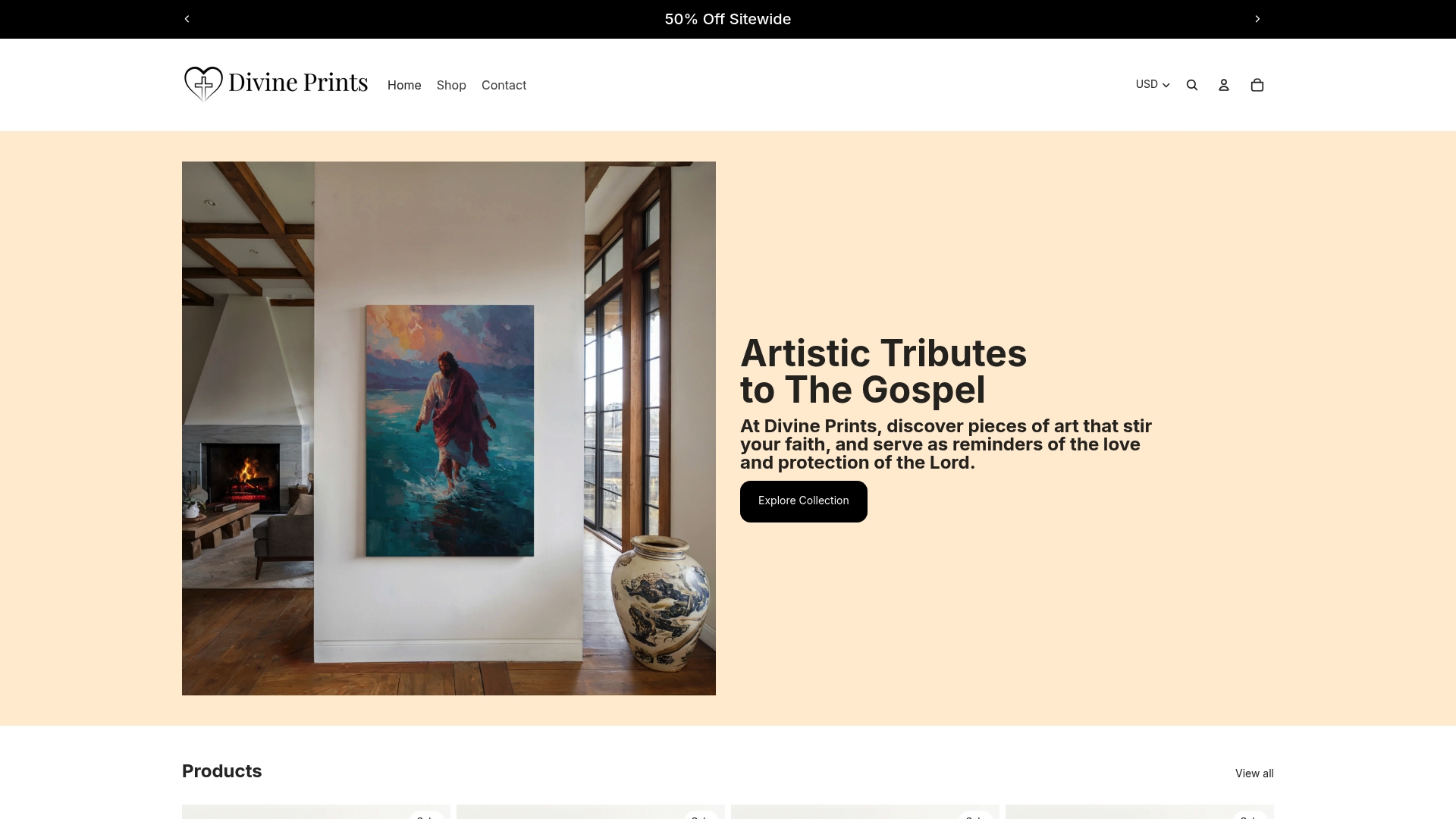
You can see the full range at Divine Prints.
Our view: one image, chosen with care
We build Divine Prints around a simple belief: a faithful image on a wall is a quiet form of catechesis. In a narthex, where people spend a minute or two crossing from the parking lot to the pew, that image has a lot of work to do.
That is why we focus on saints. A saint is a person, a witness, a patron and a friend. When a parish hangs the portrait of its patron in the entry, it says to every newcomer: this is who we are and who prays for us. We design our saint prints so they can be devotional reminders as much as decor.
We also make our prints to last. Narthex walls see doors, crowds, sunlight and years, which is why we print on museum-quality matte fine art paper or durable canvas and stand behind each piece with a lifetime warranty against defects or fading.
Our advice to any parish is to start small. Choose one piece, give it the best wall, and let it do its work before you add more.
Griffin
FAQ
What is the difference between a narthex and a lobby?
They describe the same entrance area. “Narthex” is the traditional church word for the space just inside the front doors, while “lobby,” “vestibule” and “gathering space” are common modern names. Whatever you call it, its purpose is the same: to welcome people and prepare them to enter the worship space.
What kind of art belongs in a Catholic narthex?
Sacred art such as images of Christ, Mary, the saints and angels, along with banners and parish displays, suits the narthex according to a Catholic liturgical-environment guide. Many parishes choose their patron saint as the focal piece. Keep notices and flyers on a separate board so the devotional image stays clear.
How much art is too much for a narthex?
If the entry feels crowded or people have to slow down to get around displays, you have too much. Diocesan guidance says sacred images should not be multiplied in the same space, so aim for one or two focal pieces with open wall around them.
How should we decorate the narthex for Advent and Easter?
For Advent, a wreath and a purple runner or ribbon work well, and a Christmas tree can sit in the narthex without flashing lights or ornaments, per the Catholic guide. For Easter, use white and gold and leave out secular decorations such as bunnies and pastel eggs. A seasonal print on an easel makes the change simple.
How do we make a small narthex feel welcoming?
Use the walls. Hang one strong piece of art, add warm lighting, keep a single greeter table and clear the floor of anything that blocks the path. Our guide to entryway wall art explains how to size a piece for a limited wall.
Sources
- Ministry for Liturgical Environment Guidelines
- Altar Guild and Sacristy Handbook
- Getting to know our sacred space, Catholic Review
- Narthex Murals at St John of the Ladder, Orthodox Arts Journal
- The Narthex: why it is important
- Theological Tour, Parish of St Ann in Charlotte
- Building and Construction, Diocese of Venice
- Church Lobby Decor Ideas & Updates for Fall
- Does Your Church Have a Narthex Mentality?, The Gospel Coalition
- Congregation Hospitality Checklist, Episcopal Diocese of Georgia
- Glad Tidings, Saint Anthony’s newsletter
- Your Congregation’s Facilities, Unitarian Universalist Association