

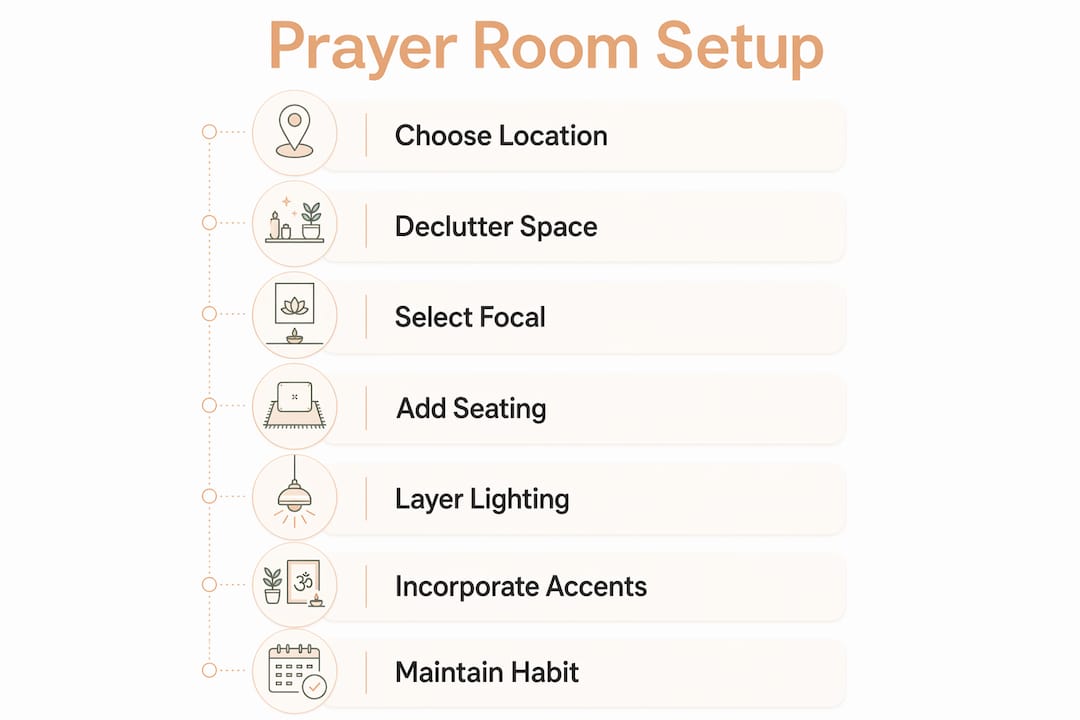
A well-decorated prayer room needs six things: a visible, dedicated spot; one clear focal item (a cross, icon, or framed print); comfortable seating; soft warm light; a calm neutral palette; and a short weekly reset habit to keep it from becoming a catch-all shelf. You do not need a spare room. A bedroom corner or reading nook works just as well as a full room, provided the space is intentional and consistently used.
Quick setup checklist:
- Pick a spot you pass every day (bedroom corner, hallway alcove, window seat)
- Clear the area completely before adding anything back
- Choose one focal devotional item: a cross, crucifix, icon, or a framed print from a source like Divineprints
- Add seating that fits your practice (chair, cushion, or kneeler)
- Install soft, warm lighting (dimmable lamp or flameless candle)
- Limit visible items to 3–5 meaningful objects only
- Schedule a five-minute weekly reset to remove anything that drifted in
Pro Tip: Place your prayer corner where you will see it first thing in the morning. Visibility is the single most reliable trigger for daily use. If it is tucked behind a door, it will be skipped.
Table of Contents
- How do you choose the right spot for a prayer room or corner?
- Declutter first, then set an intention
- What devotional items should anchor your prayer space?
- Seating, rugs, and posture: making the space physically inviting
- How do you layer light for a calm, prayerful mood?
- What colors and materials work best in a prayer room?
- Small accents: plants, textiles, and scent used sparingly
- Noise control, upkeep, and building a daily prayer habit
- Choosing devotional wall art: prints, framing, and placement
- Soundproofing and acoustic treatments for a quieter prayer space
- Using technology respectfully in your prayer space
- Key Takeaways
- Why a dedicated prayer space actually changes your practice
- Divineprints: devotional art for your prayer corner
- Useful sources and further reading
How do you choose the right spot for a prayer room or corner?
The best location is wherever you already move through your day. Daily visibility drives habit far more reliably than a perfectly quiet, out-of-the-way room. A corner of your bedroom, a window seat in the living room, or a hallway alcove all work well.
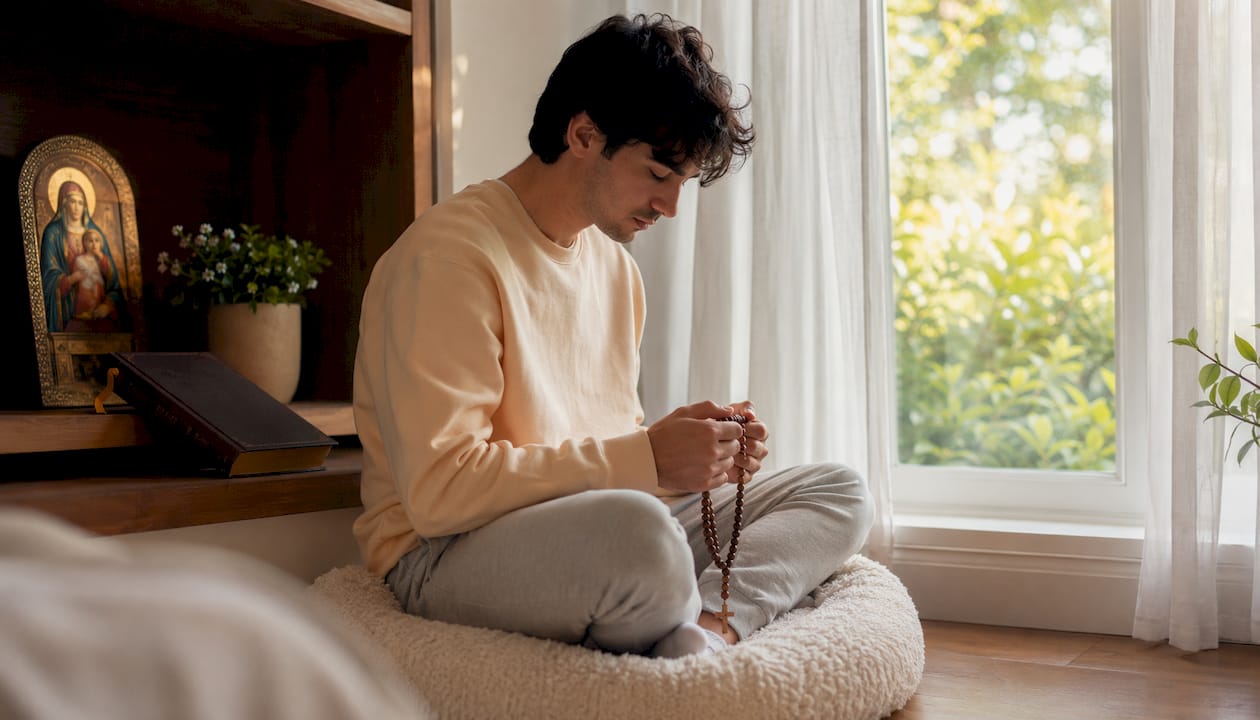
Near a window is often the strongest choice. Natural light shifts the mood without any effort, and a sheer curtain softens harsh afternoon sun into something genuinely calm. A bedroom corner offers privacy and a natural morning or evening trigger. A hallway nook keeps the space visible but compact. Multi-use rooms can work too, provided you use a small architectural gesture, like a floating shelf, a simple screen, or a narrow console table, to signal that this corner is different from the rest of the room.
Some traditions offer orientation guidance worth knowing. Vastu Shastra, the ancient Indian design system, recommends the northeast corner for prayer areas. Many Christian traditions favor placing a focal cross or icon facing east. These are meaningful options, not requirements. Let your tradition guide you if it applies; otherwise, let daily visibility be the deciding factor.
Small-space layout options:
- Floating shelf at eye level + floor cushion below
- Narrow console table + framed print + small chair
- Window seat with a lidded basket for devotional items
- Corner bookshelf with one dedicated shelf cleared for prayer items
| Location | Best for | Trade-off |
|---|---|---|
| Bedroom corner | Privacy, morning/evening routine | Less visible during the day |
| Near a window | Natural light, warmth | May need a curtain for glare |
| Hallway alcove | Daily visibility, habit formation | Limited space for seating |
| Multi-use room | Larger homes, shared spaces | Needs a visual separator to feel sacred |
Declutter first, then set an intention
Remove everything from the chosen area before you add a single item back. This is not just tidying. It resets your relationship with the space and forces a deliberate choice about what belongs there. Visual clutter competes directly with attention, and a prayer corner that doubles as a charging station or book pile will not hold its purpose for long.
Full clear-out and intention checklist:
- Empty the area completely, including the floor, shelves, and any nearby surfaces.
- Write a one-sentence intention for the space (“This corner is for prayer and stillness only”) and place it on a small card inside the space or underneath the focal item.
- Return only items with a direct devotional purpose: a Bible, a cross, a candle, a journal.
- Store secondary devotional items (extra books, seasonal cards) in a lidded basket beside the seating, not on the altar surface.
- Anything that does not support prayer goes elsewhere, permanently.
Pro Tip: Set a five-minute Sunday reset as a recurring calendar reminder. Walk to the corner, remove anything that drifted in during the week, and straighten what remains. Five minutes keeps the space functional for the next seven days.
What devotional items should anchor your prayer space?
Choose one clear focal object and build around it. A cross, crucifix, icon, or a well-framed devotional print all work, but pick one as the visual anchor and limit the total number of visible items to 3–5. More than that, and the eye has nowhere to rest.
Essential items for a Christian prayer area typically include a Bible or devotional, a cross or crucifix, a candle or flameless alternative, a journal, and one personally meaningful object. That is already five. Resist the urge to add more.
Core Christian prayer space checklist:
- Bible or daily devotional (within reach, not just displayed)
- Cross, crucifix, or icon as the primary focal point
- Candle or flameless LED candle for ambiance
- Journal and pen for written prayer
- One personal item: a saint card, a rosary, a small statue
Arrangement options:
- Single floating shelf: focal print centered, candle to one side, small cross or statue below.
- Small table altar: cloth covering, Bible open or closed at center, cross behind, candle in front.
- Layered shelf display: framed print at back, smaller objects in front at varying heights.
A museum-grade framed print scales better than a small card or unframed image. Appropriate sizing, matting, and a clean frame draw the eye and hold attention in a way that a pinned paper simply does not. A saint print, for example, carries centuries of devotional meaning and can anchor an entire corner on its own. For candles, always use a heat-safe holder, keep them away from fabric and paper, and consider flameless LED alternatives if children or pets share the space.
Seating, rugs, and posture: making the space physically inviting
Pick seating that matches how you actually pray. If you sit for long periods of reading and reflection, a supportive chair with a small side table is the right call. If your practice involves kneeling, a padded kneeler or a folded blanket on a non-slip rug works well. Floor cushions and low benches suit meditation-style prayer or shorter sessions.
Practical seating options:
- Upholstered chair with lumbar support for seated reading prayer
- Padded kneeler (prie-dieu) for traditional kneeling prayer
- Large floor cushion or zafu for floor-based practice
- Low wooden bench with a folded blanket for versatility
Keep proportion in mind. A large armchair in a small corner will crowd the space and make the focal item feel secondary. A cushion or small bench keeps the altar visually dominant. A small area rug (roughly 2x3 feet) defines the prayer zone without overwhelming it, and it adds acoustic softness that bare floors lack. Non-slip backing is worth the small extra cost, especially on hardwood.
How do you layer light for a calm, prayerful mood?
Soft, warm, indirect light is what you want. Harsh overhead fixtures flatten the mood and create glare on devotional texts. A dimmable table lamp, a shaded floor lamp, or hidden LED strip lighting behind a shelf all create the layered, meditative atmosphere that supports focused prayer.
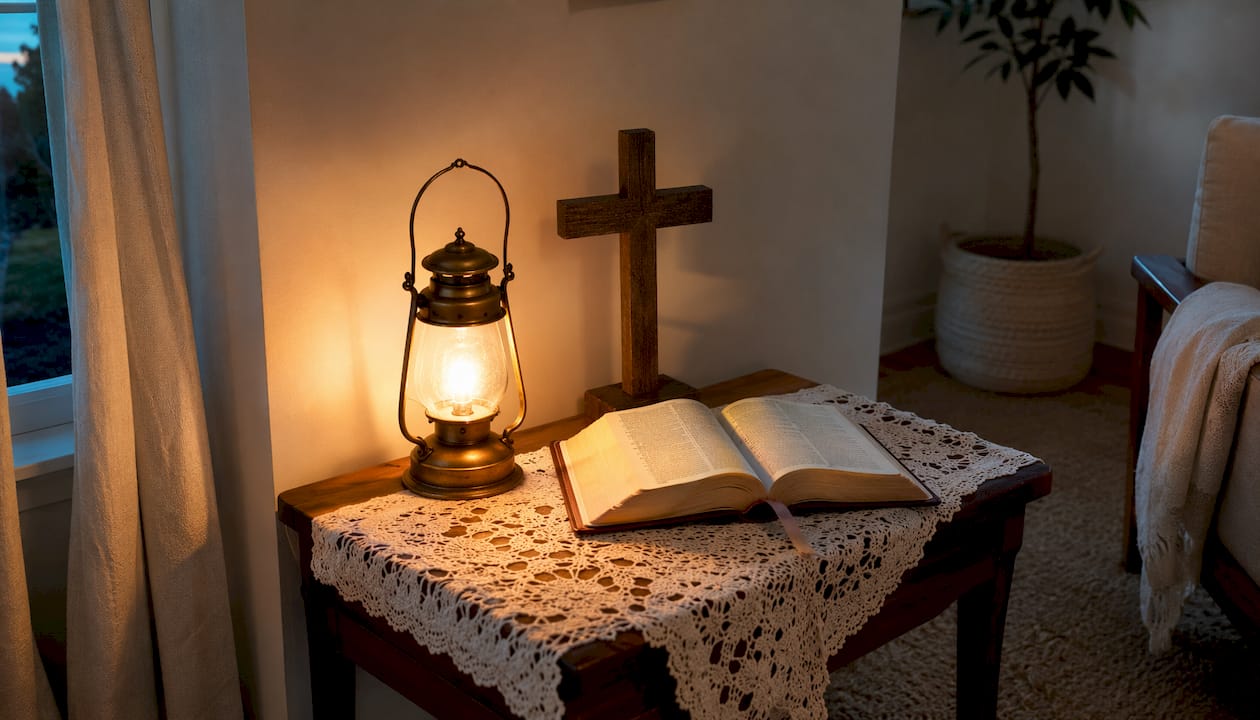
For daytime use, natural light filtered through a sheer curtain is ideal. At night, a dimmable lamp set to its lowest level or a flameless LED candle gives enough light to read by without breaking the stillness. For layered ambient lighting, the goal is always to have light coming from more than one source at a low, consistent level.
Lighting plan by time of day:
- Morning: natural light through sheer curtain + one small lamp if needed
- Evening: dimmable table lamp at low setting or flameless candle
- Night: single warm-toned LED candle, no overhead light
Safety notes for candles and incense:
- Use a stable, heat-safe holder on a non-flammable surface
- Never leave a lit candle unattended or near fabric, paper, or wood
- For incense, open a window slightly for ventilation; avoid enclosed spaces with poor airflow
- Flameless LED candles are a safe, realistic alternative for households with children or pets
Pro Tip: Choose a bulb with a color temperature of 2700–3000K for any lamp in your prayer corner. That range produces a warm amber glow that reads as calm rather than clinical. Position the lamp so light falls on the space, not directly on your face or the devotional text.
What colors and materials work best in a prayer room?
Neutral, muted palettes — soft whites, creams, light grays, and muted greens — reduce visual stimulation and let the focal devotional item carry the visual weight. These are not arbitrary choices. Color psychology consistently links blue and green tones to calm and balance, while warm whites and creams create a sense of safety and warmth without demanding attention.
For materials, wood, marble, brass, and stone are the most common choices in devotional spaces across traditions. They feel durable, grounded, and symbolically clean. A small wooden shelf, a linen cloth, or a stone candle holder adds texture without visual noise.
Pro Tip: If you want to introduce pattern, use it in one textile only: a linen throw, an embroidered cloth on the altar surface, or a small patterned rug. Sacred geometry motifs (crosses, circles, simple repeating forms) add meaning without competing with the focal item.
Small accents: plants, textiles, and scent used sparingly
One living element, one textile, and one scent. That is the rule. A small peace lily or a single stem in a simple vase brings life to the corner without demanding maintenance. A linen throw or a small woven mat adds warmth and texture. A diffuser with frankincense or lavender, or a stick of incense, engages the sense of smell in a way that genuinely shifts the mood toward stillness.
Low-maintenance plant options:
- Peace lily (tolerates low light, air-purifying)
- Pothos (nearly indestructible, trailing form adds softness)
- Small succulent (minimal watering, clean silhouette)
For scent, use incense sparingly in enclosed spaces and always ventilate. Some people are sensitive to smoke-based incense; a reed diffuser or a small essential oil diffuser is a cleaner alternative. Fresh flowers are beautiful but require weekly replacement and can trigger allergies — know your household before adding them.
A seasonal rotation keeps the space from going stale. Swap one accent item at the start of each liturgical season or on a significant feast day: a small Advent wreath in December, a fresh flower in spring, a harvest-toned textile in autumn. The space stays meaningful without requiring a full redesign.
Pro Tip: Keep a small lidded basket beside your seating for seasonal swap items. When you rotate one accent out, it goes in the basket. Nothing accumulates on the altar surface.
Noise control, upkeep, and building a daily prayer habit
Stillness is something you create, not something you find. Scheduling a window of time for prayer, even 10 minutes, does more for consistency than any design choice. Tell the people in your household that this is your time, and treat it like any other appointment.
Habit-building framework:
- Cue: A visible trigger you encounter daily (the corner itself, a morning alarm, a specific mug you only use during prayer time).
- Routine: A short, repeatable sequence (sit, light the candle or lamp, open the Bible or devotional, pray or read for a set time).
- Reward: Something that closes the session positively (a moment of gratitude, a written note in the journal, a brief pause before standing).
For noise, soft textiles and rugs absorb sound better than bare walls and floors. A heavy curtain on a nearby window reduces street noise noticeably. In apartments, a white noise machine or a quiet prayer music track played through a small speaker can mask household sounds without adding distraction.
Technology in the prayer space: Keep it minimal and intentional. A small Bluetooth speaker playing quiet instrumental worship music or a guided prayer audio is genuinely helpful. Set it to auto-off after 20–30 minutes so it does not outlast your session. Keep your phone face-down or in another room. The goal is to use technology as a tool, not let it become the focal point.
Choosing devotional wall art: prints, framing, and placement
The focal print is the single most important design decision in a prayer corner. Size, matting, and frame quality all affect how sacred the space feels. A print that is too small reads as an afterthought; one that is too large overwhelms a compact corner. For a small altar or floating shelf, a print in the 8x10 to 11x14 inch range is usually right. Above a console table or in a larger nook, 16x20 or larger works well.
How to choose subject matter:
- Saints: patron saints, historical figures, or saints connected to your prayer intentions carry specific devotional weight. A saint print can serve as a daily reminder of a specific virtue or intercessory focus.
- Biblical scenes: the Transfiguration, the Nativity, or the Resurrection anchor the space in the Gospel narrative.
- Scriptural verses: a verse rendered in clean typography functions as both art and daily reminder.
- Abstract devotional imagery: crosses, light, and symbolic forms work well for minimalist spaces.
Placement rules:
- Hang or place the print at eye level when seated, not standing.
- Leave proportional breathing room above a small altar: roughly the same width as the print on each side.
- For layered displays, place the largest framed piece at the back and smaller objects in front at varying heights.
For liturgical seasons, consider rotating a single print. Swap in a biblical event print for Lent or Advent, then return to your everyday focal piece. Divineprints offers museum-grade fine art prints and canvases in multiple sizes and frame types, including framed and unframed options, making it straightforward to find a piece scaled for a small corner or a larger wall. Their saint prints collection is particularly well-suited for devotional corners, with prints of patron saints, angels, and Gospel-inspired imagery available in sizes that work for both shelf altars and full wall displays.
Pro Tip: When framing a devotional print, choose a mat that adds at least 2 inches of white or cream space around the image. Matting increases perceived value and draws the eye inward toward the subject, which is exactly what you want in a prayer space.
Soundproofing and acoustic treatments for a quieter prayer space
You do not need professional soundproofing to create a noticeably quieter corner. Soft surfaces absorb sound; hard surfaces reflect it. A thick area rug, a heavy curtain, an upholstered chair, and a wall-mounted textile (a tapestry, a woven hanging, or even a large framed canvas) all reduce echo and dampen ambient noise.
For apartment living, a draft-excluding door sweep on a bedroom door cuts hallway noise significantly. A bookshelf filled with books on the wall adjacent to a noisy neighbor acts as a low-cost acoustic buffer. If the space is in a corner, you already have two walls working in your favor.
White noise machines, available for under $40 at most home goods stores, are the most practical single upgrade for noise-sensitive spaces. They mask irregular sounds (traffic, voices, appliances) without adding music or spoken content that competes with prayer.
Using technology respectfully in your prayer space
Technology belongs in a prayer room only when it serves the prayer, not when it competes with it. A small speaker playing quiet instrumental worship music, a Scripture app open to a daily reading, or a guided meditation audio are all genuinely useful. The test is simple: does this device help you focus, or does it give you a reason to check notifications?
Set clear boundaries before you sit down. Put your phone on Do Not Disturb, screen face-down, or leave it in another room entirely. If you use a tablet for a Bible app or a prayer guide, close every other app first. A speaker with a sleep timer is better than one you have to remember to turn off.
Apps like Pray As You Go, Hallow, or the USCCB’s daily readings are designed specifically for focused prayer time and work well in a home prayer space. Use them as a starting point, then set the device aside.
Key Takeaways
A dedicated prayer corner works because consistent visual cues, a single focal item, and a short weekly reset habit turn an ordinary corner into a reliable space for daily spiritual practice.
| Point | Details |
|---|---|
| Choose a visible location | Place your prayer corner where you pass daily; visibility drives habit more than quiet or size. |
| One focal devotional item | A well-framed cross, icon, or print anchors the space; limit visible items to 3–5 total. |
| Soft, warm lighting | Use a dimmable lamp or flameless candle at 2700–3000K; avoid harsh overhead light. |
| Weekly five-minute reset | Remove anything that drifted in, straighten what remains, and refresh the space each week. |
| Divineprints for focal art | Divineprints offers museum-grade saint prints and biblical scene canvases in sizes suited for small altars and prayer corners. |
Why a dedicated prayer space actually changes your practice
Most people underestimate how much the physical environment shapes the interior one. A corner with a cross, a warm lamp, and a cushion does something a phone reminder cannot: it signals to your body that it is time to stop moving and start listening. That shift is not mystical. It is behavioral. Consistent visual cues in a specific place build a psychological association over time, and that association is what turns an intention into a daily practice.
The conventional advice is to find a quiet room and close the door. But for most people in real homes with real households, that is not available. What is available is a corner, a shelf, and ten minutes. The design choices in this article, visibility over seclusion, one focal item over many, soft light over bright, are all in service of one goal: making it easier to show up than to skip it.
A simple corner with a framed saint print, a candle, and a Bible can carry more spiritual weight than an elaborately furnished room that never gets used. The space does not need to be impressive. It needs to be present, intentional, and yours.
Divineprints: devotional art for your prayer corner
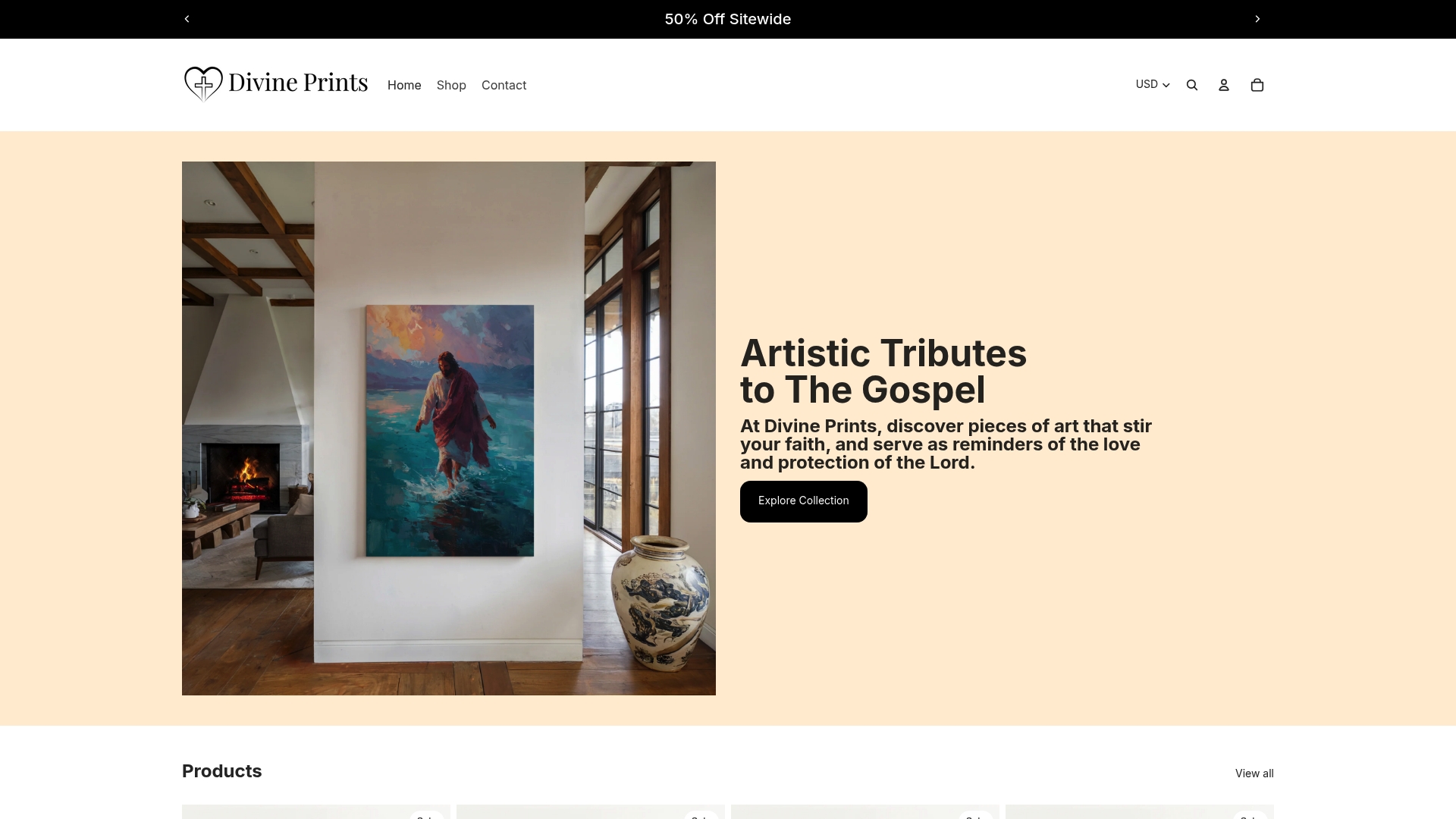
When you are ready to choose a focal print for your prayer space, Divineprints offers a range of museum-grade Christian wall art designed specifically for devotional settings. Their prints are available framed and unframed, in multiple sizes, so you can find something proportional whether you are working with a floating shelf or a full wall above an altar.
The Sacred Heart of Jesus print is one of the most requested focal pieces for home prayer corners, and the saints collection covers patron saints, angels, and Gospel figures in a range of styles from traditional to contemporary. For liturgical-season rotation, the biblical events collection offers Lent, Advent, and Easter-appropriate imagery that swaps in cleanly alongside an everyday focal piece.
Browse the full collection at Divineprints and find a print that fits your space, your tradition, and your practice.
Useful sources and further reading
The sources below informed this article. Each one is worth bookmarking if you want to go deeper on a specific aspect of prayer room design.
- Creating a Sacred Space — FOCUS: Faith-based guidance on setting up a home prayer space, with practical steps grounded in Catholic devotional practice. Best for faith-specific setup advice.
- How to Create a Prayer Space at Home — DC Douglas Interiors: Interior design perspective on small-space prayer corners, including photographed examples of compact setups. Best for visual inspiration and layout ideas.
- How to Create a Minimalist Prayer Space — Cozy Corner Daily: Detailed declutter method and minimalism philosophy applied to devotional spaces. Best for the clear-out process and storage strategies.
- How to Create a Prayer Space at Home — Grace Uplifted: Habit-formation and behavioral design perspective on prayer spaces, including the visibility rule. Best for building a daily prayer routine.
- Prayer Room Design Guide — Wudu Wash Pro: Practical lighting and ambiance guidance for prayer rooms. Best for lamp selection and bulb temperature recommendations.
- A Room for Reflection — The Business Standard: Architecture and design case studies on creating spiritual zones in modern homes. Best for material choices and small architectural gestures.
- Christian Wall Art: A Faith-Centered Home Decor Guide — Divineprints: Practical guidance on selecting, framing, and placing faith-based wall art in a home setting. Best for art selection and placement decisions.
- Decorative Lighting Buying Guide — Lights & Things: Fixture and bulb recommendations for every room, including ambient and layered lighting setups. Best for lamp and fixture selection.