

Divineprints is a reliable U.S. source for contemporary Jesus prints and framed canvases that hold both devotional weight and modern visual appeal. If you want to move fast, here are the three visual approaches worth knowing:
- Minimalist line and monochrome: Clean silhouettes or single-line portraits. Works in any room, reads as art-forward without feeling overtly religious. Best for living rooms, offices, and secular-leaning recipients who still hold faith.
- Abstract and symbolic: Geometric forms, color fields, triangles, and circles that encode theological meaning without graphic realism. Think Dalí’s Christ of Saint John of the Cross as a reference point. Strong choice for prayer corners and anyone who prefers theology over portraiture.
- Typographic and scripture prints: Verse-based or word-forward compositions. Accessible, gift-ready, and broadly acceptable across Christian traditions.
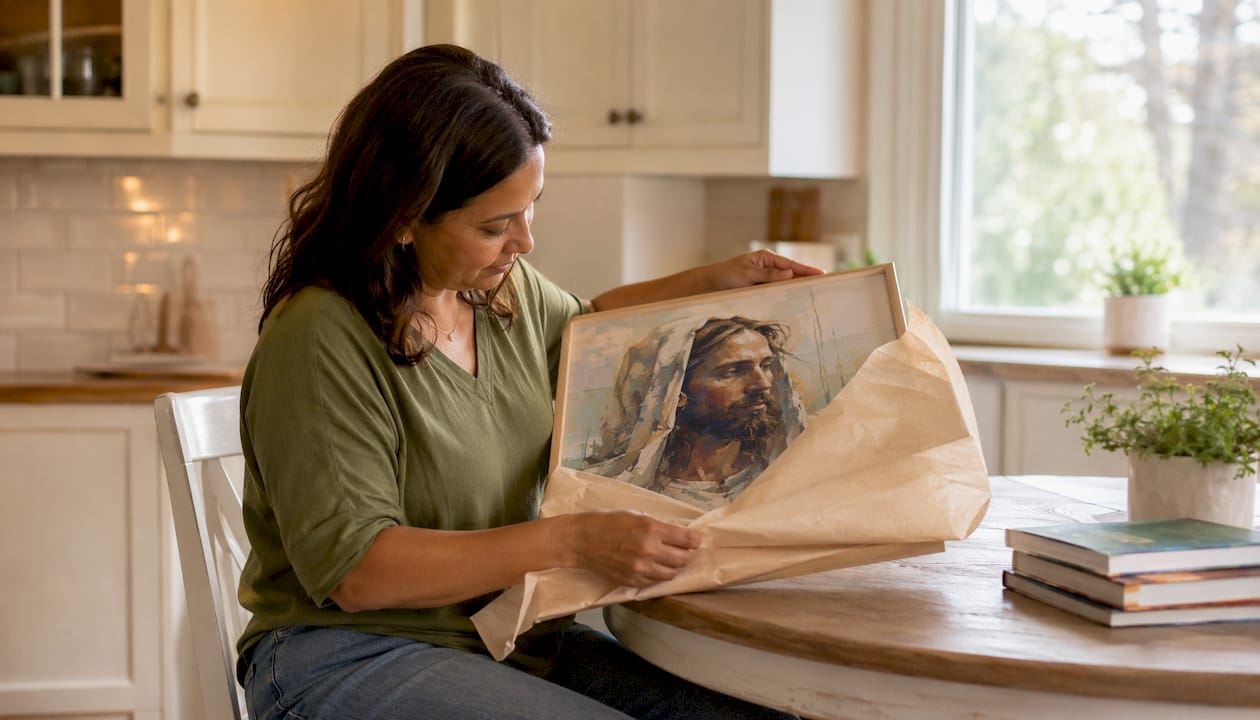
For format: grab an unframed paper print if budget is tight, a canvas wrap for a room’s focal piece, or a framed print when the piece is a gift. Most U.S. orders from Divineprints ship made-to-order, so plan ahead for holidays.
Table of Contents
- What does modern Jesus art actually look like today?
- What format and size should you choose?
- How do you choose the right piece for a room or as a gift?
- What print quality specs actually matter?
- Which occasions call for which type of Jesus art?
- Curated picks from Divineprints for modern Jesus art
- How do you hang and style modern Jesus art at home?
- What should U.S. buyers know about shipping, returns, and care?
- Does ethical sourcing matter when buying modern Jesus art?
- Key Takeaways
- Why contemporary Jesus imagery still matters
- Useful sources and further reading
What does modern Jesus art actually look like today?
The phrase “modern Jesus art” covers a wider range than most buyers expect. At one end, you have minimalist line drawings, often a single continuous stroke forming a face or figure. At the other, you have conceptual works that place Christ in consumer culture entirely. Knowing the categories helps you pick the right piece for the right wall.
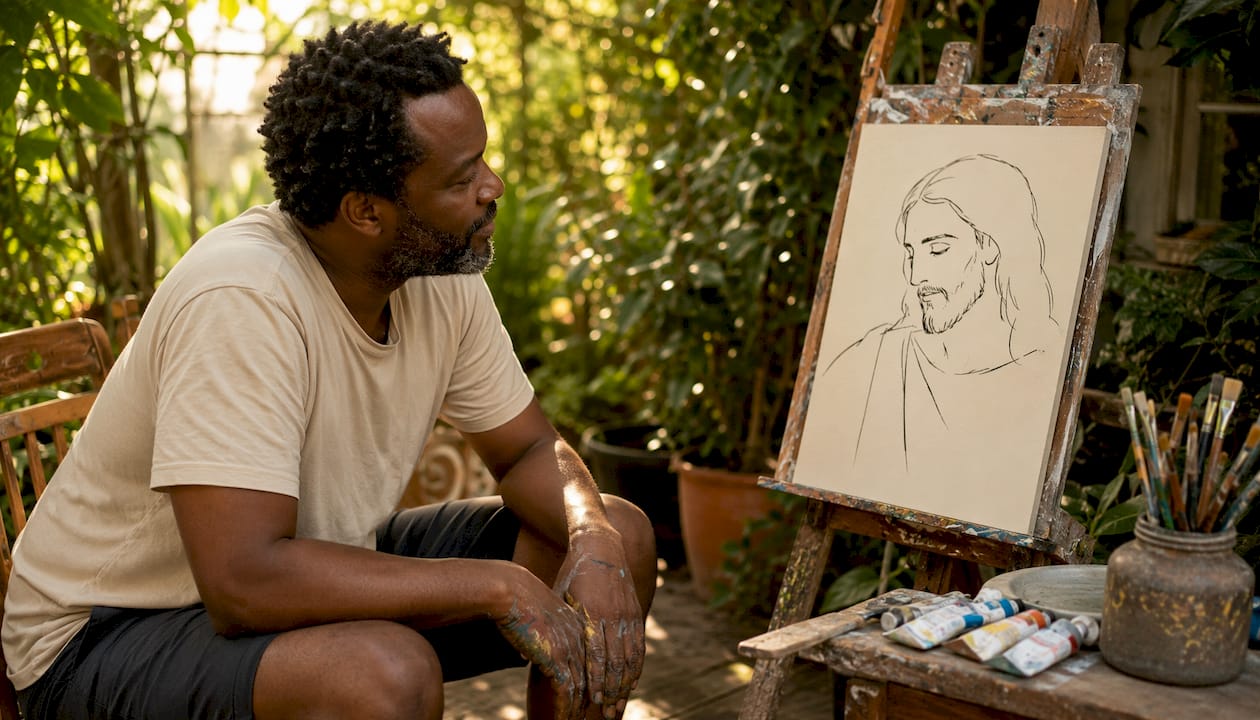
Minimalist line and silhouette strips the image down to its essential gesture. No color, no texture, just form. These pieces feel contemporary in any interior and work especially well in living rooms or offices where you want faith present but not dominant.
Abstract and symbolic work is where art history and theology meet. Geometric composition uses triangles, circles, and color fields to suggest the Trinity, unity, or ascension without depicting suffering literally. Collectors prize these for their theological intentionality. A prayer corner or a dedicated devotional space is the natural home for this kind of piece.
Typographic and scripture prints center on the Word, literally. A verse rendered in careful lettering, sometimes overlaid on a soft wash of color. These are the easiest to gift across traditions because the image is the text itself.
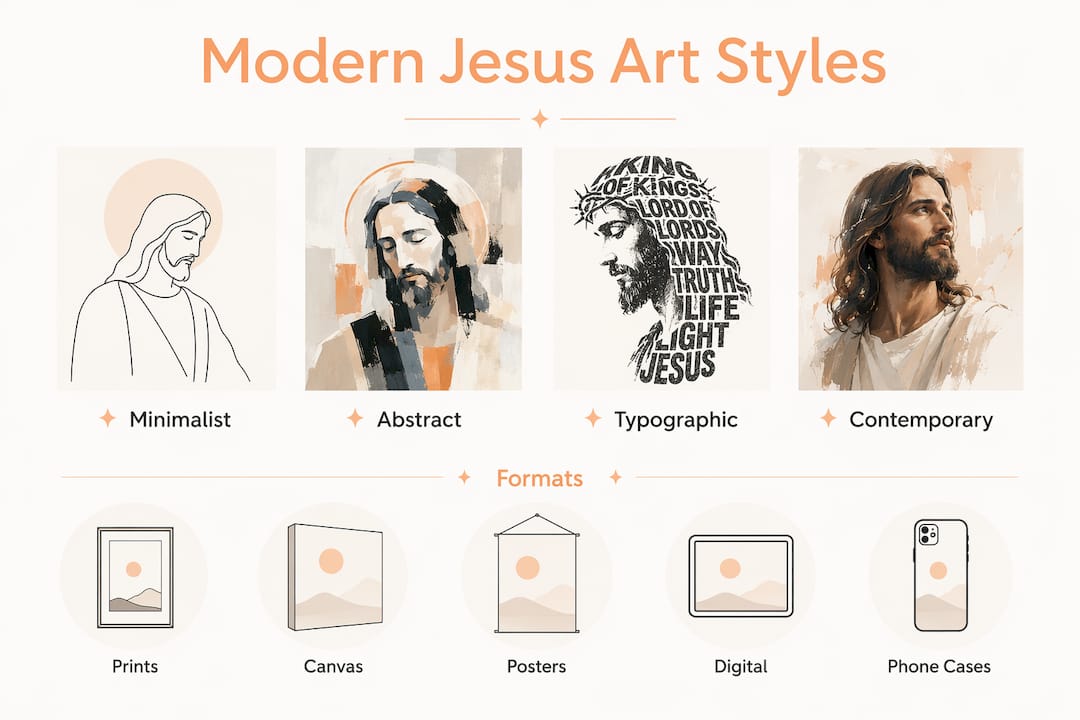
Contemporary reinterpretations are the most provocative category. Some artists, like those featured by the Jesuit Media Lab, mix sacred iconography with consumer-culture symbols, a pop-icon Pietà next to a detergent box, to make the sacred visible in the ordinary. Conrad Garner’s Jesus 2.0 assembles American archetypes, athlete, patriot, cultural icon, into a single satirical figure. Christian Jankowski’s Casting Jesus used a game-show format to interrogate who Jesus looks like today, drawing Vatican commentary on modern representation. These aren’t decor pieces for most buyers, but they show how alive the conversation is.
For home decor and gifts, the first three categories are where most shoppers land. For deeper context on how contemporary artists are updating traditional iconography, the modern religious artists guide at Divineprints is worth a look.
What format and size should you choose?
Format shapes how a piece feels in a room as much as the image itself does.
- Unframed art prints (paper): Lowest cost, easiest to ship, and flexible because the buyer chooses the frame. Archival paper prints hold color for decades when stored correctly. Best for budget buyers or anyone who already has a frame in mind.
- Canvas wraps: No frame needed. The image wraps around a wooden stretcher, giving a gallery feel. Durable and moisture-resistant compared to paper. The right call for a focal wall or a large statement piece.
- Framed prints: Gift-ready out of the box. The frame adds perceived value and removes a decision for the recipient. Heavier to ship, so confirm packaging quality before ordering.
- Digital downloads: High-resolution JPEG or PDF files for printing at home or through a local print shop. Instant, affordable, and useful when you need something fast.
Quick size cheat sheet:
| Size | Best use |
|---|---|
| 8×10 | Desk, nightstand, small gallery grouping |
| 11×14 | Bedroom accent, shelf display |
| 16×20 | Living room, above a console table |
| 24×36 | Focal wall, above a sofa or mantel |
Portrait orientation suits most Jesus imagery naturally. Landscape works for narrative biblical scenes. Square formats fit gallery walls and modern grid arrangements. For a narrow hallway, a tall portrait in 11×14 or 12×18 keeps the proportions from feeling cramped.
How do you choose the right piece for a room or as a gift?
A short checklist cuts the decision time significantly.
- Match style to room or recipient. Minimalist line art fits modern interiors. Abstract symbolic work suits devotional spaces. Typographic prints work almost anywhere.
- Confirm theological sensitivity. Literal portraiture feels right for traditional Catholics and evangelical buyers. Symbolic or abstract work is safer for recipients across broader Christian traditions.
- Pick the right size first. Measure the wall before you browse. A 16×20 print on a large wall disappears; a 24×36 on a small wall crowds the room.
- Set a format based on budget and occasion. Paper print for everyday decor, canvas for a statement piece, framed print for a milestone gift.
- Check artist credit and print specs. Know whether you’re buying an original, a limited-edition print, or an open-edition reproduction. Resolution, paper weight, and ink type matter for longevity.
- Read the return and shipping terms before checkout. Made-to-order pieces usually can’t be returned unless damaged.
Questions worth asking: Is the piece archival quality? What’s the return window? Does it ship with hanging hardware? Is the imagery appropriate for the recipient’s tradition?
Pro Tip: For gifts that need to work across different Christian backgrounds, choose symbolic abstraction or a typographic scripture print over a literal portrait. The image invites reflection without assuming a specific devotional relationship.
What print quality specs actually matter?
Buying a print without checking the specs is how you end up with a faded, pixelated piece in six months.
- Giclée printing: The standard for fine art reproduction. Pigment-based inks sprayed at high resolution onto archival paper or canvas. Fade-resistant for decades under normal conditions.
- Archival paper: Acid-free, lignin-free paper that won’t yellow over time. Look for 200–300 gsm weight for prints that feel substantial.
- Museum-grade canvas: Cotton or poly-cotton blend stretched over kiln-dried pine or spruce. A 1.5-inch stretcher depth gives a gallery-wrap look without a frame.
- UV-protective coating: Applied to canvas or behind glazing on framed prints. Slows color degradation from ambient light.
- Included hanging hardware: D-rings, sawtooth hangers, or wire. Confirm it’s included, especially for framed pieces.
Care tips: Keep prints out of direct sunlight. Wipe frames with a dry microfiber cloth. Store unframed paper prints flat in an acid-free sleeve or tube. If you’re glazing a framed piece yourself, choose UV-filtering acrylic over standard glass.
Art critics and religious scholars note a broader shift toward symbolic composition in modern sacred works precisely because geometric and abstract forms hold up better over time, both physically and culturally, than hyper-realistic portraiture.
Which occasions call for which type of Jesus art?
The occasion shapes the format almost as much as the recipient’s taste does.
- Baptism: A soft, symbolic piece in a small frame. Pastel color fields or a gentle line portrait. Size 8×10 or 11×14 fits a nursery without overwhelming it.
- First Communion or Confirmation: A framed canvas in 16×20 or larger signals the milestone. Choose a piece with clear devotional intent, a biblical scene or a reverent portrait, rather than a conceptual work.
- Housewarming: A typographic scripture print or a minimalist canvas. Something that reads as art first and faith second works well in a shared living space.
- Christmas or Easter: Digital downloads are practical for last-minute gifting. Print locally, frame it yourself, and you have a personal gift at low cost.
- Church or parish gift: Go large, 24×36 canvas, and choose imagery that resonates across the congregation, a biblical event print or a symbolic composition rather than a single-tradition portrait.
For seasonal buying, order at least two weeks ahead of major holidays. Expedited shipping is usually available but adds cost. Gift-ready framing eliminates the need for additional packaging. The biblical event prints collection at Divineprints covers narrative scenes well for milestone occasions.
Curated picks from Divineprints for modern Jesus art
Divineprints carries pieces across all three visual approaches. Here’s a compact look at what’s available for U.S. buyers.
| Product | Style | Format options | Best use |
|---|---|---|---|
| The Sacred Heart of Jesus | Contemporary devotional | Print, canvas, framed | Prayer space, Confirmation gift |
| The Transfiguration of Jesus | Biblical narrative | Print, canvas, framed | Living room focal piece, milestone gift |
| Jesus Embracing a Black Man in the Clouds | Contemporary, inclusive | Print, canvas | Housewarming, devotional, gift |
- All pieces are available as museum-grade fine art prints and canvases in multiple sizes.
- U.S. orders are made-to-order. Standard lead time is typically several business days before shipping; check the product page for current estimates.
- Returns are accepted for damaged items. Photograph any damage on arrival and contact customer service with the original packaging.
- Product pages include high-resolution photography, clear size and material specs, and framing options.
For a broader browse, the modern Christian art options guide at Divineprints walks through three visual approaches with product recommendations.
How do you hang and style modern Jesus art at home?
Placement is where most buyers make avoidable mistakes.
- Eye-level center: Hang the center of the piece at 57–60 inches from the floor. That’s the standard gallery height and what feels natural when standing.
- Above furniture: Leave 6–8 inches of space between the top of a sofa or console and the bottom of the frame. Less than that and the piece looks like it’s sitting on the furniture.
- Focal wall: One large piece, 24×36 or bigger, reads stronger than three small ones scattered across a wall. If you’re grouping, treat the cluster as a single unit and center that unit at eye level.
- Gallery arrangement: Lay pieces on the floor first. Aim for 2–3 inches of space between frames. Start hanging from the center outward.
- Narrow entryway: A tall portrait in 11×14 or 12×18 draws the eye forward and makes the space feel longer. Avoid wide landscape formats here.
- Mantelpiece: Lean a framed piece rather than hanging it. It’s easier to adjust and creates a layered, lived-in look.
For drywall, use picture-hanging strips rated for the frame weight. For plaster or brick, a proper anchor is worth the extra step. The Christian wall art guide at Divineprints covers color palette coordination and placement in more detail.
What should U.S. buyers know about shipping, returns, and care?
Made-to-order means the piece is produced after you place the order. Plan for production time plus transit, not just transit alone. For most Divineprints orders, that means ordering at least a week ahead of when you need the piece, and two or more weeks ahead for holidays.
Before checkout, confirm:
- Return window: Most made-to-order retailers accept returns only for damaged or defective items.
- Condition requirements: Items usually need to be in original packaging and condition.
- Damage claims: Photograph the damage immediately, save all packaging, and contact customer service within the timeframe stated in the policy.
- Expedited shipping: Available for most U.S. orders at additional cost. Check the product page for current lead times.
For long-term care, keep framed pieces away from direct sunlight and humidity. Unframed prints store best flat in an acid-free sleeve. Canvas wraps can be dusted lightly with a dry cloth; avoid water or cleaning sprays on the print surface.
Does ethical sourcing matter when buying modern Jesus art?
For many buyers, the answer is yes, and it’s worth asking a few direct questions before purchasing.
Artist compensation: Is the artist paid fairly for the original work? Open-edition prints from large print-on-demand platforms often pay artists a small royalty. Specialty faith-based retailers like Divineprints work with artists whose work is curated and credited, which supports more direct compensation.
Materials: Archival, acid-free materials are better for the environment and for longevity. Cheap prints on low-grade paper use more resources over time because they need replacing sooner.
Production location: U.S.-based printing reduces shipping emissions and supports domestic production. Confirm where the piece is printed, not just where the company is based.
Cultural representation: Contemporary Jesus art increasingly reflects diverse traditions. Pieces like inclusive contemporary portrayals acknowledge that representation in sacred imagery matters to many buyers. Choosing art that reflects your community’s background, or that of the recipient, is itself an ethical consideration.
The Jesuit Media Lab notes that artists who use dissemblance, placing sacred imagery in everyday commercial contexts, often do so to make the divine accessible rather than to commodify it. Intent matters, and knowing something about the artist’s perspective helps you evaluate whether a piece aligns with your values.
For a gallery perspective on how contemporary art reframes worship imagery, Chase Fine Art offers curatorial context worth reading.
Key Takeaways
The fastest path to buying modern Jesus art is matching visual style to room and recipient, then confirming format, size, and print specs before checkout.
| Point | Details |
|---|---|
| Match style to intent | Minimalist for modern decor, abstract/symbolic for devotional spaces, typographic for broad gifting. |
| Format follows occasion | Paper print for budget, canvas wrap for focal walls, framed print for milestone gifts. |
| Check print specs | Look for giclée printing, archival paper (200–300 gsm), pigment-based inks, and UV protection. |
| Plan for made-to-order lead times | Order at least one to two weeks ahead of holidays; expedited shipping adds cost. |
| Divineprints for U.S. buyers | Offers museum-grade Jesus prints and canvases across all three visual styles, with U.S. shipping and framing options. |
Why contemporary Jesus imagery still matters
The instinct to update how Jesus is depicted is as old as Christian art itself. What’s different now is the speed and range of the conversation. A geometric abstraction, a pop-icon Pietà, a portrait that reflects a Black Christ, each of these is doing something the flat gold-leaf icon couldn’t: meeting people where they actually are.
What strikes me about the best modern sacred art is that it doesn’t try to replace traditional imagery. It sits alongside it and asks a different question. Dalí’s Christ of Saint John of the Cross hides the face entirely and still communicates sacrifice more powerfully than many literal crucifixion scenes. The 20th-century tradition of reworking the Crucifixion through abstraction, expressionism, and symbolism shows that the impulse to find new visual language for ancient truth is legitimate and generative, not a departure from faith.
For buyers, this means the choice between a minimalist line portrait and a typographic scripture print isn’t just aesthetic. It’s a statement about how you want faith to show up in your space. Both are valid. The piece that makes you stop and think, or pray, or simply feel something, is the right one.
Useful sources and further reading
- Modern Art and Religion: 20th Century Artists and the Crucifixion — Art UK: Institutional curation of modern sacred works across the last century.
- Christ of Saint John of the Cross — Wikipedia: Background on Dalí’s geometric approach and its theological intent.
- A Jesuit Artist Is Creating ‘Pop Icons’ Like You’ve Never Seen — Jesuit Media Lab: On dissemblance and commercial iconography as a path to the sacred.
- Jesus 2.0: The All American Second Coming — Conrad Garner: Cultural commentary on American archetypes in modern Christ imagery.
- Casting Jesus — Lisson Gallery: Christian Jankowski’s conceptual project on representation and identity.
- Religious Artists Modern: Faith, Form, and Fresh Vision — Divineprints: How contemporary artists are updating traditional Christian iconography.
- Christian Artwork for Your Home: A Faith-Filled Guide — Divineprints: Practical placement and styling advice for sacred art in living spaces.
- Best Jesus Artist Picks and Christian Art Providers in the US — Divineprints: Curated artist picks and provenance context for U.S. buyers.