

St. Catherine of Bologna is widely recognized as the patron saint of artists, honored for her manuscript illumination, music, and a creative life she gave entirely to devotion rather than acclaim. She is not the only name artists call on, though.
- St. Luke the Evangelist — traditionally linked to painting, especially icons
- Blessed Fra Angelico — patron for sacred art specifically
- St. Joseph — patron of artisans and craftsmen, distinct from fine artists
- St. Cecilia — patron of musicians
What follows traces her life, why the Church and artists themselves settled on her, how other patrons fit alongside her, and how you can bring that devotion into your own studio.
Key Takeaways
St. Catherine of Bologna’s patronage of artists rests on a documented life of devotional art and perseverance through spiritual doubt and not on legend alone.
| Point | Details |
|---|---|
| Primary patron | St. Catherine of Bologna (1413–1463) is the widely recognized patron saint of artists. |
| Canonization timeline | Beatified in 1524, canonized in 1712; feast day observed March 9. |
| Why she fits modern artists | Pope Benedict XVI cited her struggle with spiritual doubt as relevant to creative struggle today. |
| Alternative patrons | St. Luke suits painters and iconographers; Fra Angelico suits sacred artists seeking theological depth. |
| Bring devotion home | Divine Prints offers framed St. Catherine and saint prints suited to a studio or prayer space. |
Table of Contents
- The Life of St. Catherine of Bologna
- Why Artists Turn to St. Catherine of Bologna
- Other Saints Artists Commonly Invoke
- How Do Artists Honor St. Catherine of Bologna?
- Where Can You See Her Relics and Artwork Today?
- A Studio Perspective on St. Catherine’s Example
- Bring St. Catherine’s Devotion Into Your Own Space
- Frequently Asked Questions
- Sources
The Life of St. Catherine of Bologna
Catherine was born on September 8, 1413, and died on March 9, 1463, in Bologna, Italy. She entered religious life as a Poor Clare, but before that, she spent formative years at the court of Ferrara, where she received an education unusual for a woman of her century: painting, music, calligraphy, and Latin letters.
That court education became the foundation of a lifelong creative practice inside the cloister. She illuminated a breviary by hand, painted small devotional images for her sisters, and reportedly played music as part of convent life. None of it was made for an audience beyond the convent walls. Her work existed to teach, to pray, and to mark the liturgical calendar for a community that had no need for outside recognition.
Here’s the timeline that matters for anyone researching her officially:
- 1413 — Born in Bologna to a family connected to the Ferrara court
- 1431 — Enters the Order of St. Clare after her father’s death
- 1463 — Dies on March 9, later fixed as her feast day
- 1524 — Beatified
- 1712 — Canonized by Pope Benedict XIII
That’s a considerable time gap between her beatification and her canonization, a slow process that reflects how carefully the Church weighed her cause before settling it.
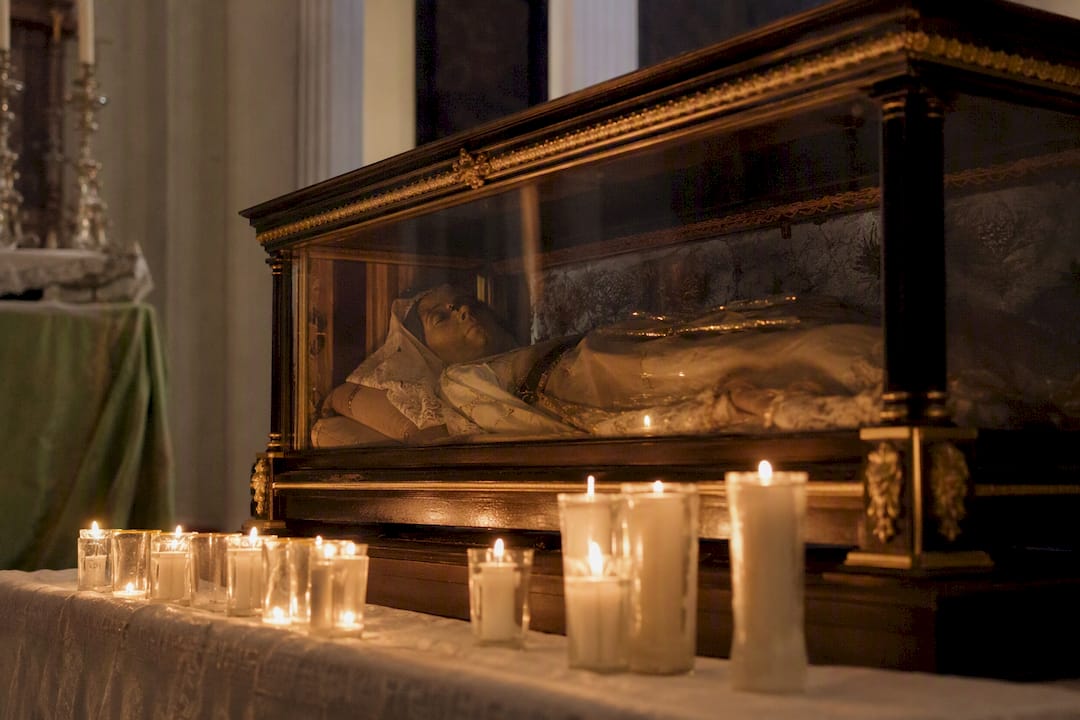
Her body is reported to be incorrupt and remains on display at the Church of Corpus Domini in Bologna, a detail that has kept pilgrims visiting for centuries. For believers who find textual history a little abstract, a physical relic changes the nature of devotion entirely. It gives people something to stand in front of.
Why Artists Turn to St. Catherine of Bologna
Her claim to patronage rests on something more specific than a title bestowed by tradition. It rests on documented work and documented struggle.
Catherine’s illuminated breviary borrowed motifs from needlework, a detail scholars point to as evidence of a self-taught, hands-on relationship with craft rather than formal academy training. She wasn’t working from a manual. She was inventing technique as she needed it, the way most working artists still do.
- Her art served the convent’s devotional life, not her own reputation
- She combined disciplines, illumination, music, and calligraphy, rather than specializing narrowly
- Her manuscripts functioned as teaching tools as much as art objects
- She experienced documented periods of spiritual doubt that she worked through rather than around
That last point is where her patronage gets real theological weight. Pope Benedict XVI described her as “still very modern”, pointing specifically to her experience of what he called the darkness of faith, the temptation to doubt that even a deeply devoted life doesn’t eliminate.
Catherine’s struggles with spiritual darkness and her perseverance through them are precisely what make her relatable to modern believers and artists who wrestle with doubt in their own creative or spiritual work.
That framing matters because it clarifies what invoking Catherine actually means. Artists don’t ask her for talent or inspiration the way you’d rub a lucky charm. They ask for her intercession, a request rooted in her example of persistence through doubt, not a shortcut around the hard parts of making something. Her patronage is grounded in a documented life, not in vague legend.
Other Saints Artists Commonly Invoke
Catherine holds the primary claim, but she’s not working alone. Depending on the medium and the moment, artists have leaned on several other figures for centuries, each for slightly different reasons.
- St. Luke the Evangelist. Traditionally credited as the author of the Third Gospel and Acts, Luke carries a long-standing association with painting and icons, partly through legend that he painted an image of the Virgin Mary. He’s the natural choice for painters working in a devotional or iconographic tradition.
- Blessed Fra Angelico. A Dominican friar and painter, beatified by Pope John Paul II in 1992, Fra Angelico is venerated specifically for fusing serious theological depth with serious technical skill. Artists who want a model for making sacred art, not just art with a sacred subject, tend to gravitate here.
- St. Joseph. Often confused with a patron of artists, Joseph is more precisely the patron of workers and artisans, craftsmen who build and make with their hands in a trade sense. If you’re a woodworker or metalworker, he fits better than a fine artist’s patron.
- St. Cecilia. The go-to patron for musicians, useful if your creative practice runs toward composition or performance rather than the visual arts.
If you paint icons in a traditional style, Luke may feel closest to your work. If you’re pursuing sacred art with formal training, Fra Angelico is the natural fit. For nearly everyone else wrestling with the daily discipline of making something meaningful, Catherine remains the broadest and most personally resonant choice.
How Do Artists Honor St. Catherine of Bologna?
Devotion to Catherine doesn’t require anything elaborate, but some artists create small devotional corners enhanced with religious candles that complement saint prints and deepen focus. A handful of small, repeatable practices are enough to keep her example present in daily creative work.
- Say a short prayer before beginning work. Something as simple as asking for her intercession against doubt and for perseverance in the task ahead. Loyola Press offers accessible devotional material if you want a fuller text to work from.
- Bless your workspace. Many Catholic households and studios use a simple blessing prayer over a room or desk, an old practice that still holds up for anyone spending hours at an easel or a drafting table.
- Offer a finished piece on her feast day. March 9 is a natural marker for wrapping up a project, or simply pausing to acknowledge the work of the past year.
- Mark March 9 with intention. Some studios and parish art groups organize small exhibitions or gatherings tied to her feast, echoed in how organizations like the Patron of the Arts Association structure their own yearly observances.
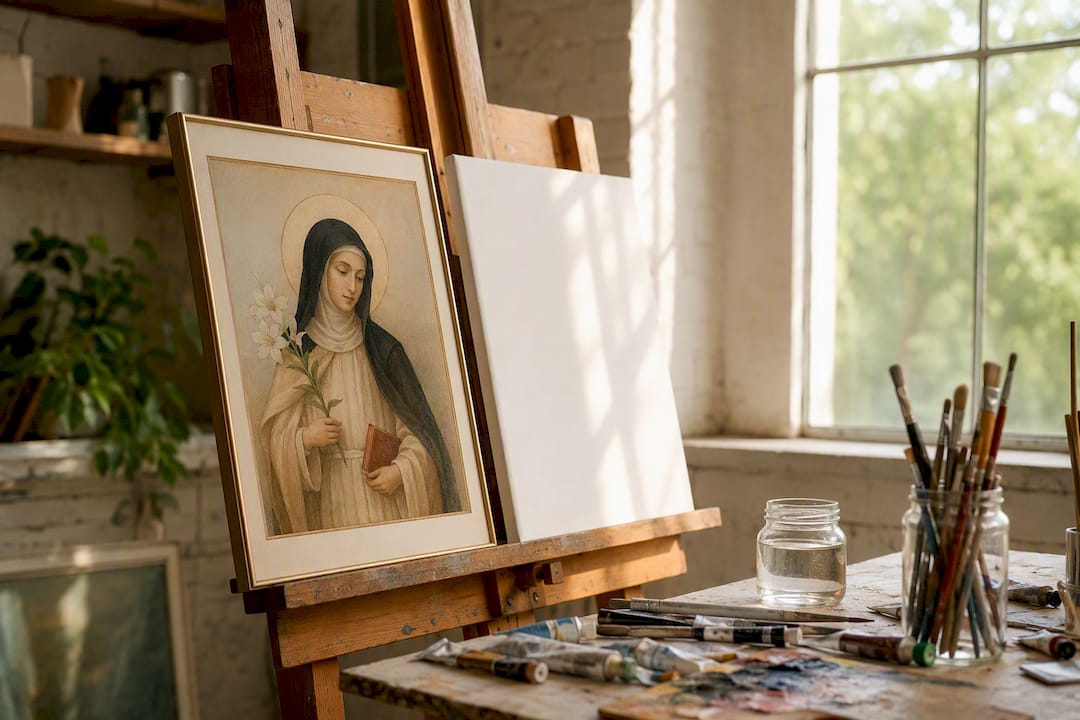
Pro Tip: Keep a small printed image of St. Catherine near your easel or desk, not as decoration, but as a visual cue to pause and reset when the work stalls. A physical reminder does something a mental one doesn’t: it interrupts you mid task, which is exactly when doubt tends to creep in.
Where Can You See Her Relics and Artwork Today?
Catherine’s incorrupt body remains displayed at the Church of Corpus Domini in Bologna, a site that has drawn pilgrims for roughly five centuries. That kind of continuous physical veneration is rare even by the standards of Catholic saint cults, and it’s a large part of why her devotion has never faded into pure legend.
Her original illuminated manuscripts remain in Italian archives and church collections, mostly inaccessible to casual visitors. For readers outside Italy, public-domain reproductions of related sacred art are available through sources like Wikimedia Commons, useful for study or reference even if they’re not devotional-grade prints.
- Church of Corpus Domini, Bologna, holds her incorrupt body and remains an active pilgrimage site
- Original manuscripts are held in Italian ecclesiastical archives, largely closed to the public
- High-quality devotional prints and reproductions are the practical option for readers in the United States who want an image for prayer or study
A Studio Perspective on St. Catherine’s Example
Creative doubt doesn’t announce itself politely. It shows up mid project, usually right when the work is hardest, and it rarely cares how many years you’ve been at this. What Catherine’s biography offers isn’t a cure for that doubt. It’s evidence that the doubt itself doesn’t disqualify you from good, lasting work.
Artists who’ve built small devotional habits around her, an image kept on the easel, a short prayer before a session, tend to describe the same thing: not inspiration exactly, but a kind of steadiness. A reminder that the work is worth finishing even on the days it feels pointless.
That’s really the whole case for keeping her image somewhere you’ll actually see it while you work, which is where a well-made saint print earns its place in a studio, not as decoration, but as a fixed point to return to.
Bring St. Catherine’s Devotion Into Your Own Space
Divine Prints makes museum-grade prints and canvases of St. Catherine of Bologna and other patron saints, sized and framed to work in a studio, a bedroom, or a prayer corner, not just a church sanctuary. A well-made image does something a phone screen can’t: it stays in view, quietly, through every session at the easel.

The Saint Prints collection covers dozens of figures beyond Catherine, so if you’re drawn to Fra Angelico or St. Luke instead, you’ll find them there too. Pieces like The Sacred Heart of Jesus show the print quality and framing options available across the catalog. These also work well as gifts for Confirmation, especially for a young artist or student choosing a confirmation patron tied to creative work.
Divine Prints ships to customers across the United States. Browse the Saints collection, pick a size and frame that fits your wall or easel, and order directly from the product page.
Frequently Asked Questions
Who is the official patron saint of artists? St. Catherine of Bologna holds the widest recognition as patron saint of artists, credited for her manuscript illumination, music, and devotional creative life.
Is St. Luke also a patron saint of artists? Yes. St. Luke is traditionally associated with painting and icons, making him a common alternative patron, especially for iconographers.
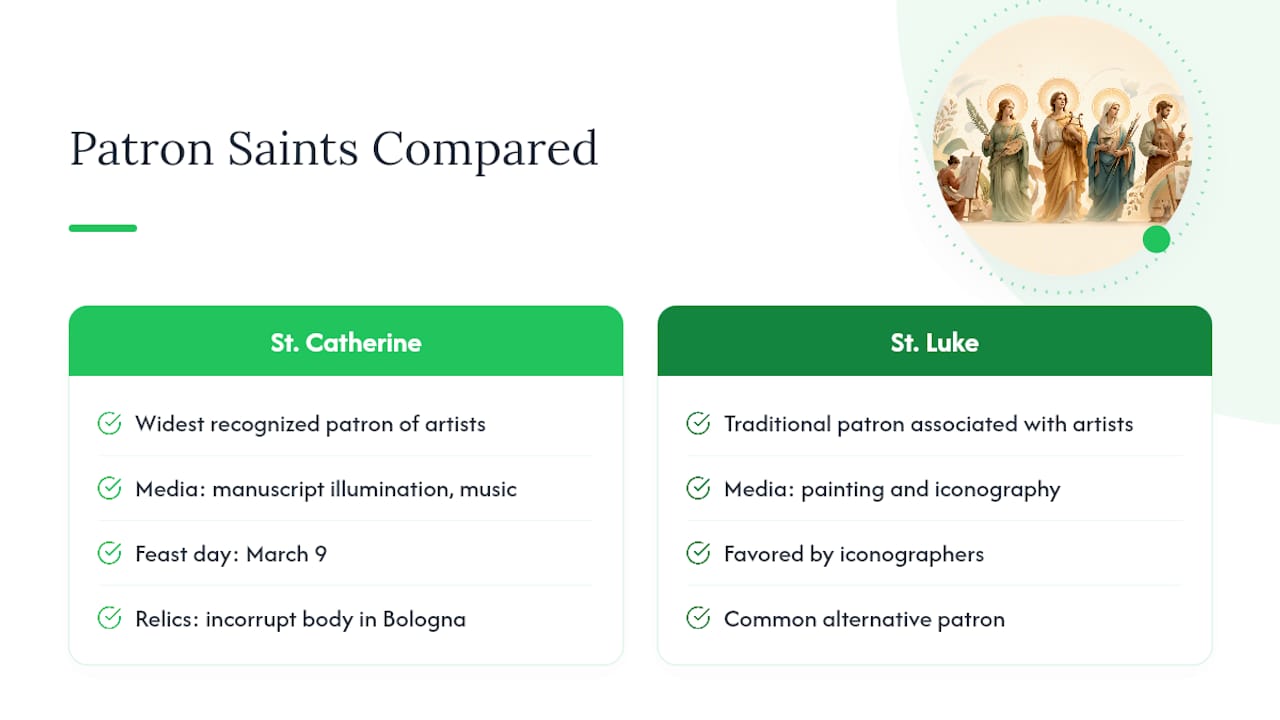
What is St. Catherine of Bologna’s feast day? Her feast day is March 9, marking the date of her death in 1463.
Why is Blessed Fra Angelico venerated by artists? Fra Angelico was beatified in 1992 for a body of sacred art that fused technical mastery with theological depth, making him a model for artists pursuing sacred work specifically.
Where are St. Catherine of Bologna’s relics located? Her incorrupt body is displayed at the Church of Corpus Domini in Bologna, Italy, a longtime pilgrimage destination.