

Students overwhelmingly turn to two saints: St. Joseph of Cupertino, patron of test-takers and anxious learners, and St. Thomas Aquinas, patron of scholars and Catholic universities. Teachers have their own patron in St. John Baptist de La Salle, while science majors lean on St. Albert the Great and Scripture students on St. Jerome. This guide walks through a shortlist, short biographies, how to pick the right one, and prayers you can use tonight.
TL;DR:
- St. Joseph of Cupertino is most suitable for students facing exam anxiety, especially those who struggle with traditional learning methods, and his feast day is September 18.
- St. Thomas Aquinas is preferred for subjects involving reasoning, faith, and logic, and he is widely invoked on his feast day, January 28.
- For short-term needs like a single exam, praying to a saint with a relevant life story or feast day close to the test day increases the chances of meaningful support.
- A simple prayer routine, including a brief request before studying and a thank-you afterward, helps incorporate saintly aid into daily study habits.
- Using visuals like saint prints and written intentions in study spaces reinforces the habit of prayer as a companion to preparation, not a substitute for studying.
Table of Contents
- The Patron Saint of Students Shortlist
- Meet the Saints Students Actually Pray To
- How to Choose the Right Patron Saint for You
- Short Prayers for Study Days and Exam Mornings
- Bringing a Patron Saint Into Your Study Space
- A Personal Note on Studying With Saints
- Sources
- FAQ
The Patron Saint of Students Shortlist
Different saints answer different kinds of academic panic. Some calm exam nerves, some cover a subject, and a few are simply good company for anyone stuck at a desk at midnight.
- St. Joseph of Cupertino (September 18): the go-to patron for test-takers and anxious students.
- St. Thomas Aquinas (January 28): patron of scholars, philosophers, and Catholic universities.
- St. John Baptist de La Salle (April 7): patron of teachers, named so by Pope Pius XII in 1950.
- St. Albert the Great (November 15): patron for science and natural philosophy students.
- St. Catherine of Alexandria (November 25): patron of students, philosophers, and those facing exams requiring sharp argument.
- St. Jerome (September 30): patron of biblical scholars, translators, and librarians.
- St. Francis de Sales (January 24): patron of writers and journalists, useful for essay-heavy coursework.
- St. Gemma Galgani (April 11): invoked by students carrying illness or emotional strain alongside coursework.
- St. Isidore of Seville (April 4): patron of students and, more recently, of internet researchers.
- St. Aloysius Gonzaga (June 21): patron of Catholic youth and students in formation.
Each name below links to a fuller profile so you can match a saint to your actual situation rather than picking at random.
Meet the Saints Students Actually Pray To
St. Joseph of Cupertino struggled badly with basic schoolwork as a young man; friars nearly rejected him from the priesthood over his poor academic performance. He is commonly cited as the primary patron for students and exam-takers, especially those who freeze up or learn differently than their peers. A widely circulated devotional line asks him to “obtain for me a lively faith, an ardent love, unwavering hope, and success in this examination.” His feast day falls on September 18.
St. Thomas Aquinas entered the Dominican order against his family’s wishes and went on to write the Summa Theologica, one of the most influential works in Catholic theology. He is widely recognized as a patron saint of students, scholars, and Catholic universities, invoked specifically when a subject requires reasoning through faith and logic together. A short devotion asks him for “keenness of mind, capacity to remember, and skill in learning.” His feast day is January 28.
St. John Baptist de La Salle founded the Brothers of the Christian Schools in seventeenth century France and built one of the first systematic teacher training programs in Europe. Pope Pius XII proclaimed him patron of all teachers of youth on May 15, 1950, a recognition that still shapes how Catholic schools frame teaching as a vocation rather than just a job. His feast day is April 7.
St. Albert the Great taught Aquinas himself and wrote extensively on biology, astronomy, and chemistry centuries before those fields had modern names. He is traditionally associated with science students who need patience with lab work or research that resists easy answers. His feast day is November 15.
St. Catherine of Alexandria is remembered for out-arguing pagan philosophers sent to convert her from Christianity, which is precisely why students facing oral exams or debate invoke her. Catholic reference sources list her among the patrons connected to students and specific fields of study. Tradition holds she was martyred for her faith around the fourth century. Her feast day is November 25.
St. Jerome spent decades translating the Bible into Latin, producing the Vulgate that shaped Western Christianity for over a thousand years. Students of Scripture, language, or translation work turn to him when a text refuses to make sense. His feast day is September 30.
One detail worth sitting with: Joseph of Cupertino’s own biographers frame his story less as a shortcut and more as proof that struggling students aren’t disqualified from doing something meaningful with their minds.
How to Choose the Right Patron Saint for You
Pick a saint the way you’d pick a study partner: someone whose story actually matches your situation, not just whoever tops the list.
Three things to weigh:
- Life match. Did the saint struggle with something you’re struggling with? Joseph of Cupertino fits students who feel academically behind; Aquinas fits students who need to reconcile faith and reason.
- Practical fit. Are you praying through a single exam or asking for help with a whole vocation, like teaching or research? A one-time test calls for a different saint than a four-year program.
- Liturgical fit. Does the feast day land near your exam season, or does your school or parish already have a devotion to that saint? Community ties make a habit stick.
A simple three-step routine for exam day: say a brief, specific prayer to your chosen saint before you start; run through your actual study checklist, notes reviewed, sleep gotten, materials packed; then offer a short prayer of thanks afterward, regardless of how the exam felt.
Pro Tip: Pair a small devotional print with a one-line written intention taped nearby. Seeing it each time you sit down to study builds the habit faster than the prayer alone.

Prayer is a companion to preparation, not a substitute for it. Diocesan accounts of St. Joseph’s life treat his story as an example of providence and perseverance, not a guaranteed shortcut around actual studying.
Short Prayers for Study Days and Exam Mornings
Keep these where you’ll actually see them: a phone note, a study planner, or taped above a desk.
- To St. Joseph of Cupertino: “Obtain for me a lively faith, an ardent love, unwavering hope, and success in this examination. I ask this through Christ our Lord. Amen.” A widely used exam prayer attributed to devotion around his life.
- To St. Thomas Aquinas: “Grant me a keen mind, a good memory, and the skill to explain what I have learned clearly.”
- A one-minute dorm or classroom routine: set a small print of your chosen saint where you study, pray one line before opening your books, and say a short thank-you after closing them, win or lose.
Keep shared devotional images tasteful and unobtrusive in classrooms or dorm common areas. A quiet corner reminder works better than a display that competes with the room’s actual purpose.
Bringing a Patron Saint Into Your Study Space
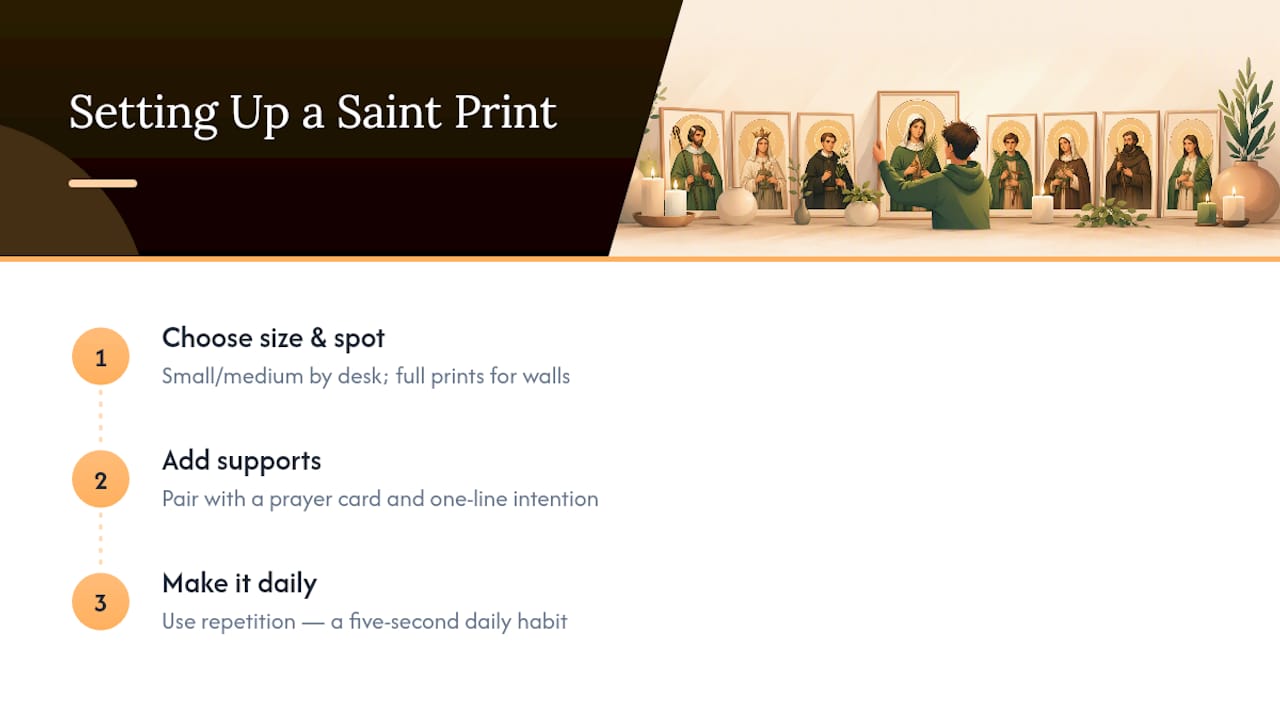
A saint print earns its place on a wall the same way a study routine earns its place in your week: through repetition. A full Saint Prints collection is available, sized for dorm walls, prayer corners, and classroom displays, ready to pair with the short prayers above.
A small or medium print near your desk, paired with a prayer card and a one-line written intention, turns an abstract devotion into a five-second daily habit. It also makes a fitting religious gift for a student building that habit for the first time.
A Personal Note on Studying With Saints
Joseph of Cupertino didn’t succeed because he was naturally gifted. He succeeded because he kept showing up. That’s the real lesson for any student pairing prayer with the unglamorous work of actual preparation.
— Griffin
Sources
- St. Joseph of Cupertino – St. Bernard Church (SBCA)
- St. Thomas Aquinas — University of Notre Dame Faith
- St. Albert the Great — University of Notre Dame Faith
FAQ
What Is the Saint Prayer for Students?
The most common one is the exam prayer attributed to St. Joseph of Cupertino: a request for faith, love, hope, and success in the examination. Students also use a shorter Aquinas prayer asking for a keen mind and clear memory before study sessions.
Who Is the Patron Saint of Female Students?
St. Catherine of Alexandria is one of the most frequently invoked patrons for female students, remembered for her sharp reasoning in debate and her connection to students and philosophers. Her feast day, November 25, is a common time for schools to hold devotions to her.
Is St. Thomas Aquinas the Patron Saint of Students?
Yes. He is widely recognized as a patron saint of students, scholars, and Catholic universities, invoked especially for intellectual work that connects faith and reason. His feast day is January 28.
Is St. Benedict the Patron Saint of Students?
St. Benedict is best known as the patron of Europe and of monastics, not specifically of students. Students seeking a more direct academic patron typically turn to St. Joseph of Cupertino for exams or St. Thomas Aquinas for scholarship instead.