

Choose the saint whose life intersects with what you’re facing right now, whether that’s your vocation, a struggle, or a season of change, after asking the Holy Spirit for guidance and reading that saint’s story, not just a summary. Before you settle on a name, check your parish’s rules for Confirmation submissions. The saint becomes meaningful only through what you do after picking, not the moment of picking itself.
TL;DR:
- Prayerful discernment over several days helps clarify which saint truly resonates with your current struggles or life circumstances.
- Checking parish-specific rules for canonization status, gender, and submission deadlines is crucial before finalizing your Confirmation name.
- Fully reading a saint’s biography, including struggles and failures, helps determine if their story challenges or inspires you more than a short summary.
- Maintaining a tangible reminder, such as a holy print or medal, significantly supports long-term devotion beyond the initial selection.
- Relying solely on a saint’s brief story or summary risks missing the deeper virtues and challenges that make their life a meaningful guide.
Table of Contents
- How Do You Choose a Patron Saint?
- How Do You Narrow a Shortlist to One Saint?
- What Parish Rules Should You Check Before Finalizing a Name?
- How Do You Build a Lasting Relationship With Your Patron Saint?
- Why Reading a Saint’s Full Story Beats Skimming a Summary
- What I Learned Choosing My Own Patron
- Keep Your Patron Saint Close With a Print That Lasts
- Sources
How Do You Choose a Patron Saint?
You don’t pick a patron saint the way you pick a screen name. It’s less about finding the “right” one and more about noticing where your life already overlaps with someone else’s. Here’s how to build an actual shortlist instead of staring blankly at a list of 10,000 names.
Start with prayer, not Google. Before you open a single book, ask the Holy Spirit to lead you. A simple formula works: “Holy Spirit, show me the saint who can walk with me right now. Help me recognize them when I see them.” Say it for a few days in a row. This isn’t a throwaway step. Prayer changes what you notice when you start reading.
Look at your baptismal or Confirmation name first. If you were baptized Thomas, Catherine, or Francis, that’s not a coincidence to ignore. Many people never realize their given name already carries a patron. Check the feast day tied to that name and start there before looking anywhere else.
Match by vocation, season of life, or struggle. This is where the search gets practical. A nurse might look at St. Camillus de Lellis. A student facing exam stress might find St. Joseph of Cupertino worth a look. Someone in recovery from addiction has real company in saints who fought their own battles before converting. Comprehensive patronage indexes exist specifically to search by occupation, illness, or cause, and they’re worth ten minutes of your time.
Pay attention to repetition. If a name keeps showing up, that’s data. Maybe a homily mentioned St. Monica three Sundays running. Maybe your grandmother had a devotion to St. Jude that nobody in the family ever explained. Maybe a confirmation teacher keeps bringing up the same saint. Don’t dismiss the pattern as coincidence.
Try a traditional random method, prayerfully. Drawing a holy card from a stack, opening a book of saints to a random page, or using an online saint generator are all long-standing, accepted ways families discover a patron, as long as prayer surrounds the process. Some generators now include recently canonized saints, so the pool keeps growing. A random verse generator works on a similar principle if you want to see how the “open at random, then reflect” method feels before trying it with a saints book.
Here’s a simple sequence for building your list:
- Pray and ask the Holy Spirit for clarity over several days.
- Check your baptismal or Confirmation name for an obvious starting point.
- Search a patronage index by vocation, illness, or life circumstance.
- Note any saint’s name that keeps recurring in your life without effort.
- If nothing surfaces, use a random draw method and treat the result as a starting point for prayer, not a final answer.
You should end this stage with two or three names, not one. Narrowing comes next.
How Do You Narrow a Shortlist to One Saint?
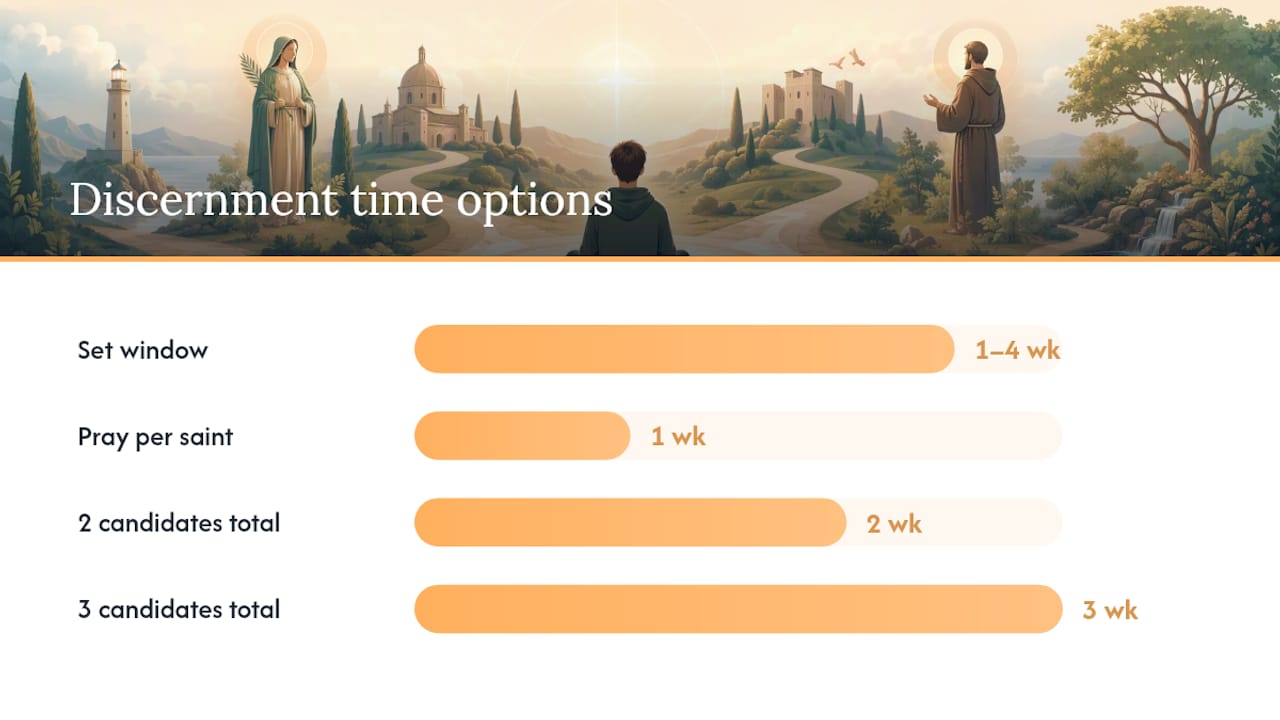
Once you have two or three candidates, the goal shifts from generating options to testing them. This takes a little time. Rushing it tends to produce a choice that feels hollow six months later.
- Set a one to four week window. Give yourself real time. Discernment isn’t a five-minute decision, and there’s no rushed formula that works better than patience.
- Pray a short daily line to each candidate. Something as simple as “Show me if you’re meant to walk with me” said for a week per saint gives you something to notice.
- Read one full biography every few days, not a two-paragraph summary. A holy card tells you what a saint did. A real biography tells you who they were, including the parts that were messy or unfinished.
- Journal what resonates. After each reading, write one sentence: what struck you, what unsettled you, what you’d want to imitate.
- Ask two questions of each candidate: Does this saint inspire imitation, or does he or she offer comfort in a specific struggle? Which virtue do I actually want to grow in over the next year?
Experts on Confirmation preparation consistently point out that the right choice reflects where you currently stand in your faith, not the most famous name on the list or the safest-sounding option. A saint who quietly struggled with doubt for twenty years before finding peace might serve you better than a martyr whose story feels distant from your daily reality.
Talk to your Confirmation sponsor or a priest partway through this process. They’ve watched other people go through the same decision and can often ask a question you haven’t thought to ask yourself. Still, don’t let that conversation replace your own prayer and reading.
Pro Tip: If a saint’s story still bothers you or won’t leave your mind after two weeks of reading and praying, that discomfort is often the signal, not a reason to move on.
The decision check at the end is simple: does this saint still resonate after you’ve prayed with the name and read the actual story, not just after the first excitement of finding it? If yes, you’re ready to commit. If not, give it a few more days before switching candidates.
What Parish Rules Should You Check Before Finalizing a Name?
Nothing derails a good discernment process faster than finding out two days before Confirmation that your chosen name doesn’t meet your diocese’s requirements. Church teaching frames a patron’s name as a model of charity and an intercessor, but how that plays out administratively varies from diocese to diocese.
Some parishes require the name to belong to a canonized saint. Others allow blesseds or figures still in the beatification process. A number of dioceses still expect the Confirmation name to match the candidate’s gender, though this practice is loosening in some places. None of this is universal, which is exactly why you need to ask rather than assume.
Check these before you submit anything:
- Your parish’s Confirmation formation coordinator, who usually has the definitive local answer.
- The parish handbook or Confirmation packet, if one was distributed.
- Your diocese’s website, which sometimes publishes formal guidelines.
- The submission deadline itself. Most parishes set one, and asking early avoids a last-minute scramble.
Ask these questions during your discernment window, not after you’ve already fallen in love with a name that turns out to be ineligible at your parish.
How Do You Build a Lasting Relationship With Your Patron Saint?
Picking a name is the easy part. Making it stick is where most people quietly drop the ball, usually within the first few months after Confirmation.
The habits that work are small and repeatable, not dramatic:
- Say a short intercessory prayer to your saint a few times a week, even just a sentence.
- Pray a novena to your saint once a year, especially in the weeks leading to their feast day.
- Read a little more of the saint’s life story every month rather than considering the research finished.
- Mark the feast day on a calendar and build a small ritual around it, a favorite meal, a candle, a specific prayer said at dinner.
- Keep a physical reminder near your prayer space: a holy card, a medal, or a print of the saint hung somewhere you actually look at daily.
That last habit matters more than people expect. A printed image kept in view does something a phone screen doesn’t: it turns a private decision into a visible, daily reminder. You walk past it, you glance at it while getting ready, and the saint stays present instead of fading into a name on a Confirmation certificate.
Try picking one concrete virtue from your saint’s life each month and working on it deliberately. If your patron is known for patience under suffering, spend a month noticing your own impatience. If they’re known for radical generosity, look for one specific way to practice it. This turns devotion into something lived rather than something remembered once a year on the feast day.
Why Reading a Saint’s Full Story Beats Skimming a Summary
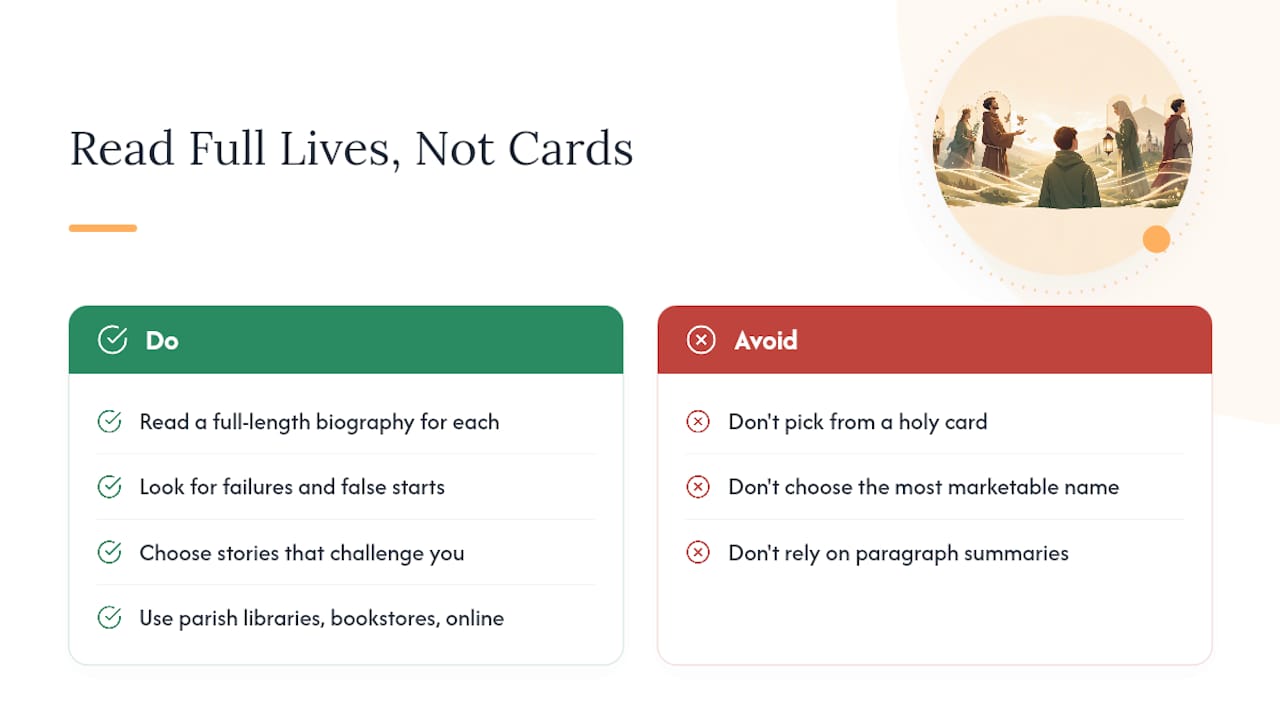
Holy cards are useful for a quick introduction, but they flatten a person into a single sentence: patron of this, died like that. Real biographies show the parts that don’t fit on a card, the years of doubt, the failed plans, the conversion that took decades instead of a single dramatic moment.
Practitioners who study confirmation preparation warn against treating saint selection like shopping for the most marketable name. Reading full biographies, including the failures and false starts, reveals whether a saint both indicts and inspires, meaning the story should challenge you a little, not just flatter the version of yourself you already like.
St. Augustine spent years chasing everything except God before his conversion. St. Peter denied Christ three times before becoming the rock the Church was built on. These aren’t footnotes. They’re the reason the stories hold up decades later instead of fading into forgettable religious trivia.
When you’re deciding between two candidates, read at least one full-length biography of each rather than relying on a paragraph summary. Reader-friendly full lives are widely available in parish libraries, Catholic bookstores, and online collections. The extra hour of reading tends to save months of wondering whether you picked the wrong name.
What I Learned Choosing My Own Patron
I spent about three weeks going back and forth between two names before one finally settled. What tipped it wasn’t a dramatic sign. It was rereading the same biography twice and noticing the same line bother me both times, which felt like the discomfort the process is supposed to produce.
Afterward, I hung a small print of that saint near where I pray each morning. It sounds minor, but seeing the image daily did more to keep the devotion alive than any resolution I made on Confirmation day. A visual reminder outlasts good intentions.
That’s the part nobody tells you going in: the choosing matters less than what happens after.
— Griffin
Keep Your Patron Saint Close With a Print That Lasts
A photo on your phone gets buried under a hundred other notifications within a week. A printed image in your prayer space doesn’t. There are resources designed to fill the gap between choosing a patron saint and actually living with one.

The saint prints collection covers a wide range of patrons, from well-known Confirmation choices to lesser-known figures tied to specific vocations or struggles, available in framed and unframed options sized for a bedroom prayer corner, a dorm wall, or a parish office. If your saint has a strong Marian or Sacred Heart devotion tied to their story, a print like The Sacred Heart of Jesus pairs naturally alongside it. These prints are often chosen as Confirmation, baptism, or First Communion gifts, intended to be hung and appreciated over time rather than stored away.
Once you’ve settled on a name, consider selecting a print that fits your space and preferences and place an order accordingly. It’s a small, lasting way to keep that saint present past the feast day.
Sources
- Six ways to deepen your relationship with your patron saint
- Patron saint and confirmation name
- How to discover your patron saint for 2026
- Patron saints A–Z