

The San Damiano Cross portrays the entire Paschal Mystery, Christ’s death, resurrection, and ascension, in a single painted icon, and it was the image St. Francis of Assisi was praying before in 1206 when he heard a call to “rebuild my church.” That vision launched the Franciscan movement, and the cross has remained its defining emblem ever since. Unlike the gaunt, suffering Christ common in later medieval crucifixes, this one shows a figure who is alert, upright, and luminous. His eyes are open. His body glows white against a dark red field.
The cross carries three tightly linked associations worth knowing before you look closer:
- St. Francis of Assisi, whose 1206 encounter with the cross reoriented his life and gave rise to the Franciscan order
- San Damiano, the small chapel outside Assisi where the original event took place and where a replica now hangs
- the Basilica of Saint Clare, where the original 12th-century cross has been preserved and displayed since 1957
The Franciscan Sisters of Perpetual Adoration date the cross to roughly the year 1100, making it older than the Gothic crucifixion scenes most churchgoers picture when they hear the word “crucifix.” That gap in style is not an accident. It reflects a deliberate theological choice about what the artist wanted viewers to feel first: not horror, but hope.
Key Takeaways
The San Damiano Cross fuses Christ’s death, resurrection, and ascension into one icon, and that unified image, not suffering alone, is what called Francis of Assisi to his mission of renewal.
| Point | Details |
|---|---|
| Core meaning | The icon depicts the Paschal Mystery as one event, showing Christ triumphant rather than only suffering. |
| Historical origin | Painted around 1100 in Umbria, the cross prompted Francis’s 1206 call to “rebuild my church.” |
| Current locations | The original resides in the Basilica of Saint Clare; a replica hangs in the San Damiano chapel. |
| Key figures | Christ, ten angels, Mary, John, Mary Magdalene, the centurion, and several damaged lower saints appear on the panel. |
| Devotional use | Franciscans and lay Christians use the image for home altars, gifts, and parish catechesis distinct from the Tau cross. |
Table of Contents
- San Damiano Cross Meaning: History, Dating, and Provenance
- A Visual Walkthrough of the Cross’s Figures and Symbols
- What Theologians Say the Cross Actually Represents
- The Cross’s Place in Franciscan Identity and Devotion
- Choosing a Faithful San Damiano Cross Reproduction
- Why This Icon Still Matters for Personal Faith
- Sources
San Damiano Cross Meaning: History, Dating, and Provenance
Art historians place the cross’s creation around 1100, painted by an unnamed Umbrian artist working in a style that blends Romanesque structure with Byzantine iconographic conventions. That hybrid style matters. Byzantine icons were never meant to be naturalistic portraits; they were theological teaching tools, built from symbolic color, posture, and gesture so that an illiterate medieval congregation could “read” doctrine off the wall. The San Damiano Cross belongs to that tradition, which is why it looks less like a snapshot of an execution and more like a visual sermon.
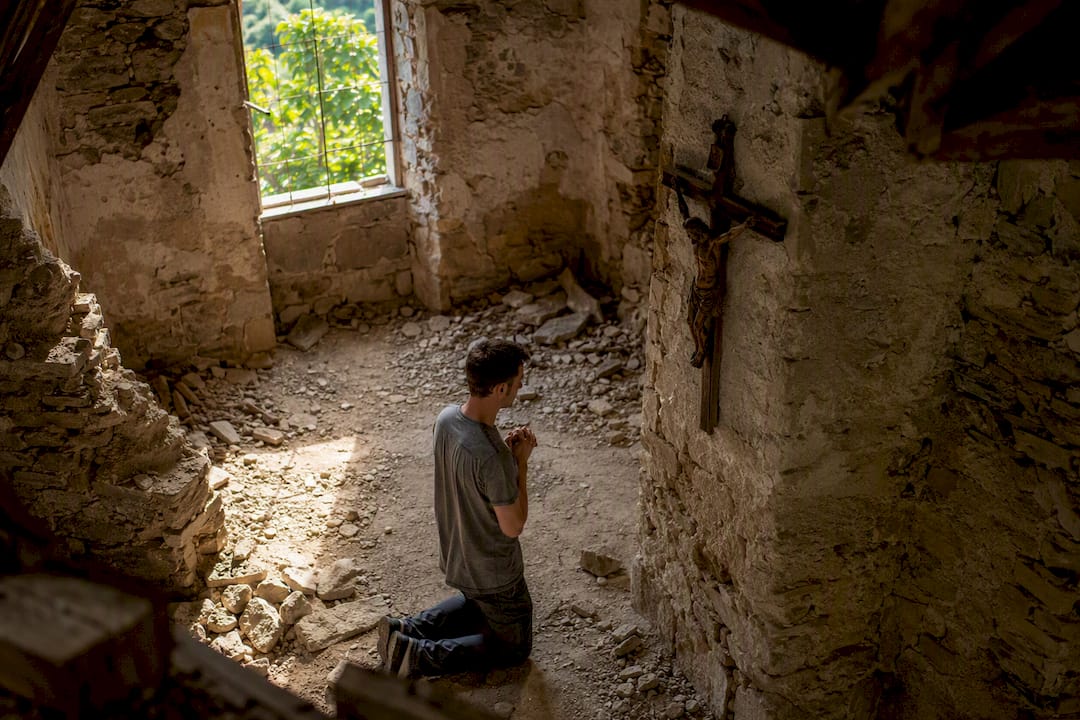
The cross gets its name from the small stone chapel of San Damiano, just outside the walls of Assisi. By 1206, that chapel had fallen into near ruin, and a young Francis of Assisi wandered in during a period of personal crisis. Praying before the crucifix, he reported hearing Christ speak, commanding him to “go and rebuild my church, which you can see is falling into ruin.” Francis took the words literally at first and began repairing the chapel’s crumbling stones. He later understood the command more broadly, as a call to renew a Church he believed had drifted from the Gospel.
The cross did not stay at San Damiano. When the Poor Clares, the cloistered order founded by St. Clare of Assisi, relocated within the city, they carried the crucifix with them for safekeeping. Franciscans USA documents that the sisters moved the cross to what is now the Basilica of Saint Clare in 1257, and it has remained under their care in that basilica since. A faithful replica now hangs in the original chapel at San Damiano, so pilgrims can still stand where Francis knelt even though the original panel lives elsewhere.
That distinction between original and replica matters for a few reasons:
- The Basilica setting allows for climate-controlled preservation of a painting that has already survived nine centuries.
- The San Damiano replica keeps the devotional experience tied to its historical location.
- Scholars studying the icon’s pigments and construction rely on access to the preserved original rather than reproductions.
A Visual Walkthrough of the Cross’s Figures and Symbols
Reading the San Damiano Cross takes patience, because the artist packed roughly a dozen figures and several symbolic devices into one composition. Here is how to move through it the way a medieval viewer likely would, from center outward.
- Christ at the center. His body is painted nearly white, standing out sharply against the deep red background. His arms are not slumped in death but slightly raised, almost welcoming. His eyes are open rather than closed, and his halo carries a small cross inscribed within it, a detail unique to Christ among all the figures on the panel.
- The roundel above his head. A small circular scene shows Christ ascending, flanked by angels, essentially compressing the Ascension into the same image as the crucifixion. Church Life Journal counts ten angels distributed across the panel, several clustered around this upper scene as though celebrating rather than mourning.
- The witnesses at Christ’s sides. To one side stand the Blessed Mother and Mary Magdalene; to the other, St. John and Mary the mother of James. Their postures and gestures, hands raised toward their faces or reaching toward Christ, mark them as the Gospel witnesses present at Calvary, painted smaller than Christ to signal their subordinate role in the scene.
- The centurion and companions below. A Roman centurion, traditionally identified as Longinus, appears near the base along with a figure sometimes labeled Stephaton and a small servant boy. These lower figures have suffered more paint loss over the centuries, and some scholars hesitate to confirm the identity of two damaged saints near the foot of the cross, occasionally proposed as Cosmas and Damian.
- The peripheral details. Near the top, a small hand, the Hand of God the Father, extends in blessing. Traditional inscriptions referencing Christ’s name appear near the halo. A bird figure at the base has been read by different scholars as either a rooster, a symbol of denial and dawn, or a peacock, an ancient symbol of resurrection and immortality; the Peace and All Good teaching guide flags this as one of the panel’s genuinely contested details rather than a settled fact.
The gold background surrounding the entire scene is worth pausing on. Gold in icon painting is not decorative. It signals divine, uncreated light, the same visual language Eastern Christian iconographers had used for centuries to indicate that a scene occurs outside ordinary time.
What Theologians Say the Cross Actually Represents
Theologians reading the San Damiano Cross keep returning to one framework: the Paschal Mystery, the Church’s term for the unified event of Christ’s suffering, death, resurrection, and ascension, treated not as three separate stories but as one continuous act of salvation. The cross earns its reputation as a theological masterwork because it renders all three phases simultaneously rather than choosing one to depict. The way most later Western crucifixes chose to freeze the moment of death alone.
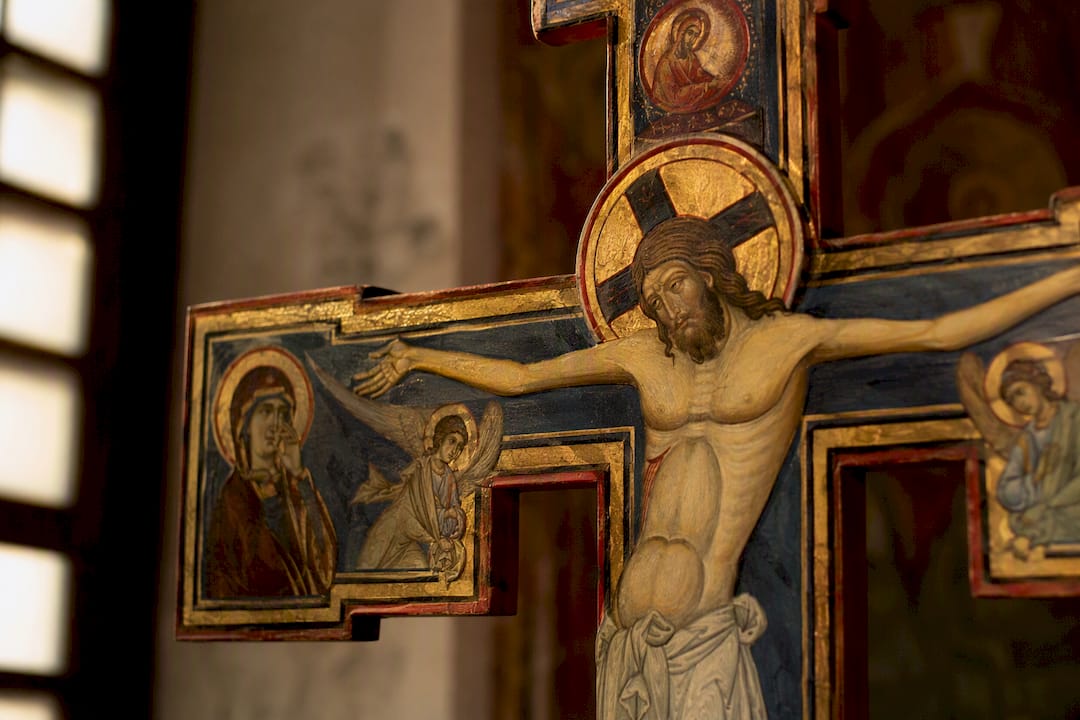
Church Life Journal’s analysis argues that the artist’s choices, the luminous white body, the cross-marked halo, the open and uplifted arms, deliberately shift the viewer’s emotional center of gravity from agony toward victory. Christ is not shown collapsing under the weight of the cross. He stands within it, already transfigured. A separate reflection in the Catholic Herald describes this reading as presenting Christ’s death as “medicine of immortality,” a phrase meant to capture the idea that the crucifixion itself already contains the cure it makes possible, rather than functioning as a grim prerequisite that resurrection later fixes.
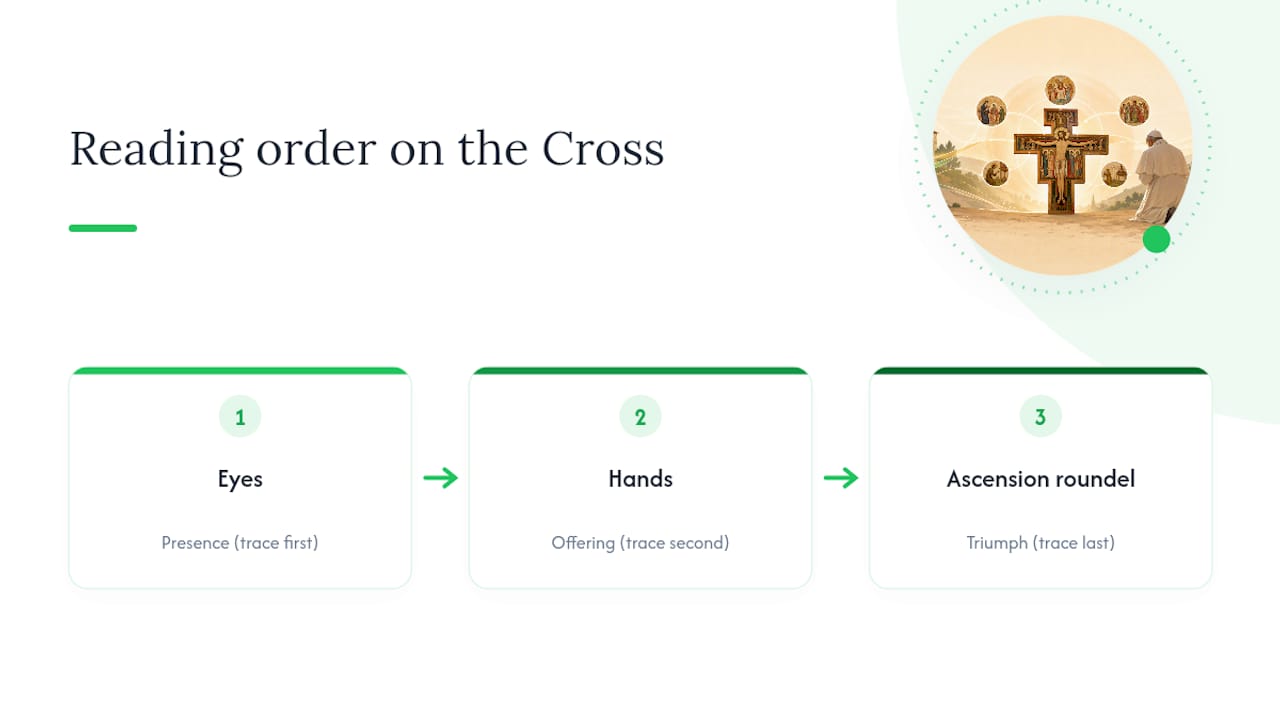
Pro Tip: When you look at the cross, try tracing the eyes first, then the hands, then the small ascension roundel above. That order mirrors how the icon was designed to be read: presence, offering, then triumph.
A few cautions are worth holding onto here. Not every figure identification on the panel commands scholarly consensus, and reputable sources differ on certain details such as whether a bird figure at the base is meant to be a rooster or a peacock. The broader theological reading, Christ as triumphant rather than merely tortured, rests on much firmer ground across sources than any single figure’s name does. It is reasonable to hold the big picture with confidence while treating some of the finer identifications as informed but debatable.
The Cross’s Place in Franciscan Identity and Devotion
For Franciscans, the San Damiano Cross is not simply historical decor. It is the visual shorthand for their founding mission: the call to “rebuild” a Church in need of renewal, understood now as spiritual and communal restoration rather than literal stonework. Franciscans USA notes that the image remains central to how the order explains its own identity to newcomers, which is part of why reproductions of the cross appear so widely in Franciscan parishes, retreat houses, and formation programs.
Outside formal Franciscan settings, the cross has become one of the more recognizable devotional images in Catholic and broader Christian homes, often chosen for:
- Home altars and prayer corners, where its resurrection focus suits daily contemplative prayer
- Confirmation, baptism, and First Communion gifts, since the image pairs naturally with themes of renewal and calling
- Classroom and parish displays, where its rich figural detail supports catechesis on the Passion narrative
It is worth distinguishing the San Damiano Cross from the Tau cross, the other symbol closely tied to Francis. The Tau, a simple T-shaped mark drawn from the Greek letter, represents Francis’s personal sign of penance and poverty, and Franciscans often wear it as jewelry or stitch it into habits. The San Damiano Cross, by contrast, is a full narrative icon meant for contemplation rather than a personal emblem worn on the body. Choose the Tau for a minimalist devotional gift; choose the San Damiano image when you want the fuller theological story on display.
Replicas of the cross, whether painted, printed, or carved, carry no formal liturgical restrictions for private or parish devotional use, though displaying one in a sanctuary setting is generally left to a parish’s own discretion and can be enhanced through Sacred Ceremony planning resources.
Choosing a Faithful San Damiano Cross Reproduction
If you want the San Damiano Cross in your home or parish, fidelity to the original matters more than most buyers assume. The Basilica di Santa Chiara’s own description of the crucifix stresses how color accuracy and correct proportions preserve the icon’s theological balance; a cropped or heavily stylized version can quietly shift emphasis away from the ascension roundel or the surrounding witnesses, flattening a resurrection icon into a generic crucifix.
A few practical guidelines help:
- Favor reproductions that keep the full panel, including the upper roundel and lower figures, rather than close crops on Christ alone.
- For a home altar or prayer nook, a mid-size framed print (roughly 16x20 inches) reads clearly without overwhelming a small space; larger canvases suit a parish foyer or classroom wall.
- Check that reds and golds are not washed out. Muted color flattens the icon’s contrast between suffering and triumphant light.
Pro Tip: Pair the cross with a small shelf or ledge beneath it for a candle or rosary. The San Damiano image was designed for sustained, quiet attention, not a passing glance.
Divineprints’ collection of saint prints includes options suited to exactly this kind of devotional display, and pairing the cross with a nearby Saint Francis of Assisi print reinforces the historical connection for anyone building out a prayer corner. For broader arrangement ideas, Divineprints’ guide to gallery wall layouts for Christian homes covers spacing and grouping for devotional art collections.
Why This Icon Still Matters for Personal Faith
The invitation Francis heard, to rebuild something falling into ruin, was never only about a chapel’s stone walls. Most people carry some part of their spiritual life that has gone quiet or neglected, and the San Damiano Cross frames that neglect as an invitation rather than a failure. What strikes me most about the icon is its refusal to leave you at the cross. It keeps pulling your eye upward, toward the roundel, toward the angels, toward the resurrection the artist refused to separate from the suffering.
Spend real time with the image rather than a glance. Let the open eyes and raised arms do what they were painted to do nine centuries ago.
— Griffin
Sources
- Franciscan Sisters of Perpetual Adoration — San Damiano Cross
- The San Damiano Crucifix: A Theological and Spiritual Interpretation — Church Life Journal, University of Notre Dame
- Franciscans USA — San Damiano Cross
- The Cross That Called Francis — Catholic Herald