

Plan a single cohesive footprint, choose one strong anchor piece, keep 2–3 inches between frames, and center the whole group at 57–60 inches from the floor. That is the entire method. Everything else is execution.
Before a single nail goes in, lay every frame on the floor or tape full-scale kraft paper templates to the wall. Design pros consistently flag skipping this step as the most common gallery wall mistake, and for devotional displays it matters even more because some pieces, a baptism certificate, a hand-painted icon, a rosary shadowbox, are irreplaceable.
Quick planning checklist you can pin:
- Measure the wall and the furniture below it
- Choose a footprint width of about two-thirds the furniture’s width
- Select one anchor piece (usually the largest or most sacred)
- Decide on a layout template (grid, salon, linear, cluster, or staircase)
- Cut kraft paper templates for every frame
- Tape templates to the wall; live with them for a day
- Confirm 2–3 inch gaps between frames
- Mark nail locations through the templates
- Hang, level, and step back
Table of Contents
- What gallery wall layout works best for devotional art?
- How to plan your layout before drilling anything
- Spacing, scale, and centering rules that actually work
- How to choose frames and matting for a devotional display
- Adding 3D items and rotating for liturgical seasons
- What hardware do you need to hang devotional art safely?
- How long does a gallery wall project take, and what does it cost?
- How Divineprints can help you build your devotional display
- How to safely hang fragile or sacred devotional items
- How to preserve devotional artworks through seasonal changes
- How to select artwork that fits a devotional theme
- How liturgical symbolism should guide your arrangement
- Key Takeaways
- The paper template is the most underrated step
- Useful sources and planning tools
What gallery wall layout works best for devotional art?
Five layout templates cover nearly every wall shape and devotional intent. Picking the right one before you order prints saves time and keeps the arrangement from looking accidental.
Grid arranges frames in uniform rows and columns with equal spacing. It reads formal and ordered, which suits a dedicated chapel corner, a sanctuary wall, or a home office where you want the display to feel intentional. A typical devotional grid might use six 8×10 saint prints in two rows of three, all in matching frames.
Salon/eclectic mixes sizes and orientations freely. This is the right choice for a family prayer wall that combines saint prints, a child’s First Communion photo, and a small crucifix. Place the anchor slightly off-center and keep heavier, larger pieces toward the center and lower to ground the composition.
Linear runs frames in a single horizontal or vertical line. It works well in narrow hallways or above a long console table holding a small statue or candle. Three to five prints of the same height, evenly spaced, read clean and reverent.

Centered cluster radiates outward from one focal piece, often a cross or a large Sacred Heart print. Surrounding pieces decrease in size as they move outward, creating a natural hierarchy that mirrors liturgical emphasis.

Staircase follows the diagonal of the handrail. Step each frame up at roughly the same interval as the stair rise, using smaller and medium frames rather than large ones. Consistent vertical offsets of about 7–8 inches per step keep the line readable.
For footprint sizing, treat the whole arrangement as a single artwork spanning roughly 60–75% of the furniture width below it.
How to plan your layout before drilling anything
A floor mockup and paper templates together take about an hour and prevent every costly mistake.
- Measure the wall width and the furniture below it.
- Calculate your target footprint: multiply furniture width by 0.65 as a starting point (a 72-inch sofa yields a roughly 47-inch-wide arrangement).
- Choose your anchor piece and place it first on the floor.
- Arrange remaining frames around it on the floor until the composition feels balanced.
- Trace each frame onto kraft paper and cut out the templates.
- Tape templates to the wall with painter’s tape.
- Photograph the taped wall and the floor layout for reference during hanging.
- Live with the templates for at least a few hours, ideally overnight.
- Mark nail locations through the paper before removing templates.
Pro Tip: For wire-hung frames, measure the distance from the top of the frame to the wire at full tension, then subtract that number from the frame’s top edge position on the wall. That gives you the exact nail height without guesswork.
Digital mockup tools like WallMockup and GalleryPlanner let you enter wall dimensions, add frame sizes, and preview spacing before ordering. This is especially useful when planning to purchase multiple saint prints from Divineprints, since you can confirm proportions before the order ships.
Spacing, scale, and centering rules that actually work
Center the visual midpoint of the whole group at 57–60 inches from the floor, the museum eye-level standard. When hanging above a sofa or console, aim for 6–10 inches between the furniture’s top surface and the bottom frame edge.
Spacing between frames should be consistent and moderate to unify the arrangement, generally close enough to feel cohesive but with enough room for each piece to stand out… Tight hallways can drop to 1.5 inches; two-story walls or very large frames can stretch to 4 inches. Consistency matters more than the exact number.
For devotional hierarchy, place crosses, icons, or a Sacred Heart print at or near the visual center. Slightly higher placement within the cluster signals prominence without requiring a separate display. Patron saint prints and smaller devotional pieces radiate outward from that center.
Footprint math for common sofa widths:
- 72-inch sofa: target footprint 43–54 inches wide
- 84-inch sofa: target footprint 50–63 inches wide
- 96-inch sofa: target footprint 58–72 inches wide
How to choose frames and matting for a devotional display
A unified frame finish or mat style is often the single easiest move to make a diverse religious collection read as one purposeful statement rather than a pile of separate purchases.
Three combinations that work consistently:
Traditional gilt/gold: Suits classical iconography, Byzantine-style saint prints, and formal chapel spaces. Pair with cream or ivory mats. The warmth of gold reinforces the solemnity of the imagery.
Simple black or dark walnut: Works for modern devotional prints and contemporary takes on biblical scenes. Clean lines keep the focus on the image. This combination reads well with modern Christian wall art that uses bold color and graphic composition.
Warm natural wood: Suits a family prayer corner or a bedroom display mixing saint prints with personal sacrament photos. The organic tone feels intimate rather than institutional.
Pro Tip: If you are mixing frame styles, repeat at least one element across all frames: the same mat color, the same frame width, or a consistent finish tone. One shared element is enough to unify the group visually.
A faith-centered home decor guide can help you match framing choices to the specific devotional tone you want, whether that is contemplative, celebratory, or liturgically formal.
Adding 3D items and rotating for liturgical seasons
Designers recommend treating gallery walls as living displays, mixing 2D prints with small sculptural pieces for dimension. For devotional walls, this means a small crucifix, a rosary in a shadowbox, or a patron saint medal mounted on a backing board can sit alongside framed prints without looking out of place.
Picture ledges are the most practical solution for seasonal rotation tied to Advent, Lent, Easter, and patron feast days. Swap prints in and out without patching a single hole.
Seasonal rotation checklist:
- Plan a bundle of prints for each major liturgical season before the year starts
- Label ledge positions with small tape markers so pieces return to the right spot
- Photograph the current layout before any swap
- Store off-season prints flat in acid-free sleeves
Pro Tip: Use museum-grade shadowboxes for fragile sacrament memorabilia, baptism candles, or embroidered textiles. The sealed environment protects against dust and humidity without requiring special storage.
For more ideas on Christian wall decor alternatives beyond framed prints, including canvas wraps and mixed-media options, Divineprints has a dedicated guide.
What hardware do you need to hang devotional art safely?
| Hardware | Safe weight range | Best wall type | Notes |
|---|---|---|---|
| Adhesive strips (e.g., Command) | — | Drywall, painted surfaces | No holes; limited by weight |
| Standard picture hook | — | Drywall | Single nail; use two for wide frames |
| Drywall anchor + screw | — | Drywall | Required when no stud is available |
| Stud-mounted screw | — | Any | Most secure; locate stud first |
| French cleat | — | Drywall or masonry | Best for very heavy framed canvases |
| Picture ledge | Varies by bracket | Drywall | Ideal for seasonal swaps |
For fragile or sacred objects, anchor into a stud or use a French cleat rather than relying on drywall anchors alone. Small 3D items on ledges should sit against a small museum putty dot to prevent shifting.
Pro Tip: Before hanging anything irreplaceable, test the hardware with a similarly weighted object for 24 hours. A hook that holds a book overnight will hold your icon.
How long does a gallery wall project take, and what does it cost?
Timeline:
- Planning and mockups: 1–2 days
- Ordering prints and framing: 1–3 weeks (custom framing takes longer)
- Installation day: 2–4 hours
Rough cost bands (DIY, US market):
- Basic: unframed prints plus simple frames from a home goods store, $50–$150 total for a 6-piece wall
- Mid-range: quality frames with mat boards and museum-grade prints, $200–$500
- Premium: custom framing plus professional installation, $600 and up
Decisions that most affect cost:
- Number of pieces and their sizes
- Framing level (off-the-shelf vs. custom)
- Whether you hire a professional installer
- Print quality (standard vs. museum-grade archival paper)
Using picture ledges instead of individual hooks reduces installation time and cuts the cost of patching if you move.
How Divineprints can help you build your devotional display
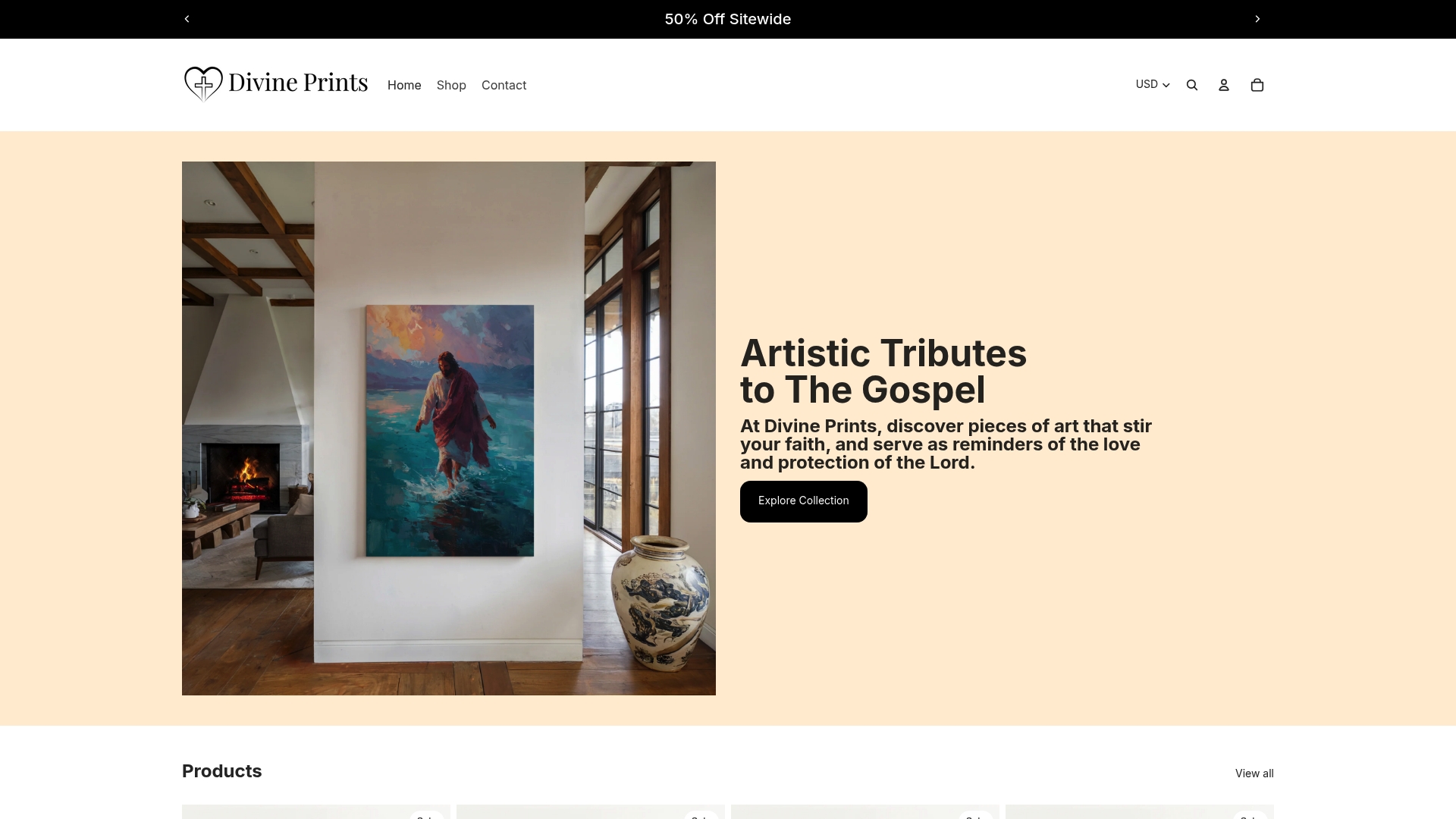
Divineprints offers curated saint and biblical-event prints in sizes suited to every layout described above, from small 5×7 accent pieces to large anchor prints. Framed and unframed options are available, and the framing choices align with the traditional, modern-minimal, and warm-natural combinations covered earlier.
- The Saints collection is the natural starting point for a devotional gallery wall, with patron saint prints that work as anchor pieces or supporting prints.
- Biblical event prints suit thematic groupings for Advent, Lent, and Easter rotations.
- The Sacred Heart of Jesus print is a strong anchor-piece choice for a centered cluster layout.
Pro Tip: Order your anchor piece first, then build the surrounding prints around its size and frame finish. Starting with the largest piece prevents the common mistake of buying supporting prints that are too large to fit the planned footprint.
How to safely hang fragile or sacred devotional items
Fragile pieces, painted icons, antique frames, embroidered panels, require a different approach than standard prints. Always anchor into a wall stud or use a rated drywall anchor, never rely on a single small nail for anything irreplaceable. For items over 20 lbs, a French cleat distributes weight across a wider surface and eliminates the single-point failure risk of a hook.
Hang fragile glass-covered pieces with two hooks rather than one to prevent tilting stress on the frame corners. Use nylon-coated picture wire rather than bare wire to reduce the chance of fraying. For painted wooden icons or panels, avoid hanging directly against an exterior wall in climates with significant temperature swings, since condensation can damage the wood over time.
How to preserve devotional artworks through seasonal changes
Seasonal rotation is hard on prints if storage is careless. Store off-season pieces flat, never rolled, in acid-free sleeves or between sheets of glassine paper. Keep them away from direct sunlight, humidity, and temperature extremes, all of which accelerate fading and paper degradation.
For archival prints on museum-grade paper, UV-protective glass or acrylic in the frame extends the life of the image significantly. When swapping pieces in and out of frames, handle prints by the edges only. A smudge from skin oils is nearly impossible to remove from fine art paper without professional cleaning.
Dust frames and glass gently with a microfiber cloth before returning pieces to the wall each season. Check hanging hardware at the same time: wire stretches, hooks loosen, and adhesive strips lose grip over time, especially in rooms with humidity changes.
How to select artwork that fits a devotional theme
The guiding question is whether the image invites prayer or reflection rather than simply decorating a surface. For Catholic and Christian homes, this usually means choosing images rooted in recognized iconographic tradition or Scripture, rather than generic spiritual imagery that lacks a specific faith reference.
For a cohesive devotional wall, group prints thematically: a Marian corner with Our Lady of Guadalupe, the Annunciation, and a patron saint of the family; or a Christological wall centered on the Sacred Heart, the Transfiguration, and a Gospel scene. Thematic grouping creates a narrative the eye follows naturally. Faith-based wall art that carries a clear subject and iconographic source reads more reverently than decorative religious motifs without specific meaning.
Avoid mixing styles so divergent that the wall loses coherence: a Byzantine icon next to a cartoon-style illustration, for instance, creates visual tension that distracts from the devotional purpose.
How liturgical symbolism should guide your arrangement
The cross or crucifix holds the highest symbolic rank in Christian devotional art and should occupy the visual center or the highest point in the arrangement. An icon of Christ takes precedence over icons of saints. Marian imagery traditionally sits to the right of Christ in classical iconographic programs, a convention worth honoring even in a casual home display.
For a family prayer wall, place the most sacred piece at eye level center, then arrange patron saints of family members outward from that anchor. Personal sacrament photos and smaller devotional pieces fill the outer positions. This hierarchy mirrors the structure of a traditional altarpiece and gives the wall a clear focal logic that visitors and family members read intuitively.
When a wall includes both 2D prints and a small 3D crucifix or statue, place the 3D object at the center or on a dedicated ledge at the visual midpoint. Mixing dimensions at the center reinforces the anchor without competing with the surrounding prints.
Key Takeaways
A devotional gallery wall succeeds when the footprint, spacing, and hierarchy are planned before any nail goes in, and when framing choices unify the collection into a single reverent statement.
| Point | Details |
|---|---|
| Plan footprint first | Size the arrangement to 60–75% of the furniture width below it before ordering any prints. |
| Use the 57–60 inch rule | Center the whole group’s visual midpoint at 57–60 inches from the floor for museum eye level. |
| Keep spacing consistent | Maintain 2–3 inches between frames; consistency matters more than the exact gap size. |
| Unify with frames or mats | One shared frame finish or mat color makes diverse devotional prints read as a single display. |
| Use ledges for seasonal rotation | Picture ledges allow liturgical-season swaps without patching walls or risking fragile pieces. |
The paper template is the most underrated step
Most people skip the kraft paper template step because it feels like extra work. It is the opposite: it is the step that eliminates all the rework. A taped paper layout on the wall shows you in two minutes whether the arrangement is too wide, too low, or off-center, problems that take an hour to fix after the nails are in.
For devotional walls specifically, the stakes are higher. You are not just hanging decorative prints. You are placing images that carry spiritual meaning for your household, and getting the hierarchy and balance right matters in a way it simply does not for a collection of travel photos. The centered cluster layout with a Sacred Heart or crucifix at the visual anchor, surrounded by patron saints and personal sacrament pieces, is the arrangement that most consistently produces a wall that feels like a devotional space rather than a decorated one.
Divineprints builds its catalog around exactly this kind of intentional display, with saint prints and biblical-event imagery sized and styled to work together. Start with the anchor piece, build the footprint around it, and use the templates before you drill. The whole project, from first measurement to final hang, fits in a weekend.
Useful sources and planning tools
The references below back the methods described in this guide and offer additional planning resources.
- How to Style a Gallery Wall the Right Way, According to Designers — House Beautiful: covers the floor mockup method and picture ledge recommendations from working designers.
- Gallery Wall Layout Ideas: Spacing & Sizing — Art Academi: detailed spacing and centerline height guidance with sizing examples.
- How to Plan a Gallery Wall Layout (With Mockups) — WallMockup: paper template method and footprint math explained step by step.
- Gallery Wall Layout Generator and Planner — WallMockup: free browser tool for entering wall dimensions and previewing frame arrangements.
- Free Online Gallery Wall Designer — GalleryPlanner: drag-and-drop planner with auto-layout and spacing preview.
- How to Decorate a Prayer Room — Divineprints: Divineprints guide to sacred placement and seasonal displays in dedicated prayer spaces.
- Creating a Home Ambiance That Starts at the Door — Apothecary Home: broader home-styling context for how a gallery wall contributes to overall room atmosphere.