

In art, guardian angels function as visual shorthand for protection, guidance, and quiet companionship, a role that has held steady from early Christian mosaics through contemporary reinterpretation. Their depiction shifted with each era, moving from distant scriptural messengers to humanized Renaissance guides, then into sentimental Victorian prints and finally ambiguous modern reimaginings. What follows traces that evolution through the motifs, canonical works, and a practical way to read these images wherever you encounter them.
TL;DR:
- Victorian guardian angel images, like the bridge motif, aimed to reassure anxious parents about child’s safety during times of high mortality.
- Contemporary depictions often portray guardian angels with fragmented faces or cage-like wings, emphasizing ambivalence about protection and control.
- Visual symbols such as wings, halos, and protective gestures have flexible meanings influenced by context, era, and medium, from church art to tattoos.
- Mass-produced prints in the 19th century standardized guardian angel imagery, embedding it into household devotional objects and memorials.
- Recognizing specific iconography helps interpret guardian angels as personal protectors, guides, or symbols of faith, depending on their pose, color, and setting.
Table of Contents
- What Is the Origin of Guardian Angels in Art?
- Renaissance and Baroque: Humanizing the Guardian Angel
- Victorian Devotional Prints and the Bridge Motif
- How Contemporary Artists Reinterpret the Guardian Angel
- Guardian Angel Symbolism: Reading Wings, Halos, and Gestures
- Notable Guardian Angel Artworks and What They Reveal
- How to Read a Guardian Angel Image, Step by Step
- What Guardian Angel Attributes and Colors Actually Mean
- Guardian Angels Beyond Painting: Stained Glass, Mosaics, and Prints
- Popular Culture’s Influence on Guardian Angel Imagery
- Guardian Angels vs. Saints, Archangels, and Other Protective Figures
- Why This History Still Shapes How We See Protection
- Bring Guardian Angel Symbolism Into Your Own Home
- Sources
- FAQ
What Is the Origin of Guardian Angels in Art?
Guardian angel imagery draws from specific scriptural passages long before painters gave the idea a face. Matthew 18:10 references angels who “always see the face of my Father,” a line theologians read as evidence of personal, assigned protectors. The Tobit-Raphael narrative supplied something artists needed even more: an actual story, with the angel Raphael accompanying young Tobias on a journey full of danger, and that plot became a template painters returned to for centuries, as detailed in the source texts and iconography behind guardian angels in Christian art.
The term itself entered English usage earlier than most people assume. The Oxford English Dictionary traces “guardian angel” to English texts by the mid-1600s, with evidence pointing to usage before 1631. That timing matters because it lands right before the visual explosion of guardian-angel imagery in Catholic Europe.
Early Christian and Byzantine art laid groundwork with formal, hierarchical angel figures, stiff-postured and symbolic rather than warm. A few threads from that period carried forward:
- Angels as intermediaries between divine authority and human need, not independent actors.
- Wings and haloed light established early as markers of celestial status.
- Byzantine mosaics favoring frontal, static poses that later Renaissance artists would deliberately break from.
Renaissance and Baroque: Humanizing the Guardian Angel
Renaissance naturalism changed everything about how angels looked and felt. Artists studying human anatomy and expression started giving angels believable gazes, relaxed postures, and gestures that read as tender rather than ceremonial. A guardian angel no longer just appeared. It reached, leaned, and looked at the person it protected.
The 17th century saw a genuine surge in guardian-angel imagery, and art historians tie this directly to Catholic theological emphasis on free will, where angels were reframed as counselors guiding personal choice rather than one-time messengers, according to commentary on the theology behind guardian angels. Pietro da Cortona’s 1656 treatment of the subject and Palma il Giovane’s guardian-angel drawings both reflect this narrative turn, placing angels in active, guiding roles within real settings rather than symbolic voids.
When looking at Baroque guardian-angel paintings, a few compositional details reveal the shift:
- Placement: the angel typically stands slightly behind or above the protected figure, never in front, blocking the person’s own path.
- Eye lines: angels look toward the person they guard, not upward toward heaven, a break from earlier convention.
- Guiding hands: an outstretched palm or hand at the shoulder replaces the stiffer pointing gestures of earlier centuries.
Victorian Devotional Prints and the Bridge Motif
Mass printing changed guardian-angel imagery from church commission to household object. Bernhard Plockhorst’s Schutzengel, produced as prints throughout the 19th century, became one of the most widely reproduced religious images of its era, and it fixed a visual convention that still dominates guardian-angel imagery today: an angel guiding two children across a rickety bridge or along a cliff edge, according to background on guardian angel imagery.
That bridge motif was not accidental. It gave anxious 19th-century parents a visual reassurance during an era of high child mortality, and the image found its way into nurseries, memorial cards, and funeral parlors alike. A few things fixed these conventions in place:
- Cheap lithography made the same handful of compositions available to nearly every Christian household.
- The child-and-angel pairing tied guardian imagery specifically to innocence and vulnerability.
- Memorial use, placing the print at gravesites or in mourning cards, gave the motif a second life beyond decor.
How Contemporary Artists Reinterpret the Guardian Angel
Modern and contemporary artists have largely abandoned the sentimental Victorian formula, and what replaces it is often unsettling rather than comforting. Wings appear as enclosing, cage-like shapes instead of instruments of flight. Some artists paint doubled or fragmented faces on guardian figures, suggesting a protector who watches but does not necessarily comfort.
This shift reflects a real question contemporary work keeps circling back to: where does protection end and control begin? Visual artists working with guardian symbolism increasingly explore that ambivalence, using fractured wings or surveillance-like framing to suggest care that can also feel like confinement, a tension noted in recent work on symbols of guardian angels across spiritual and visual culture. Rather than reassurance, these pieces often leave viewers with something closer to unease. That emotional complexity marks the clearest break from a century and a half of comforting nursery imagery, and it signals that the guardian angel as a subject still has room to grow rather than repeat itself.
Guardian Angel Symbolism: Reading Wings, Halos, and Gestures
Every guardian angel image relies on a shared visual vocabulary, even when the artist bends the rules. Wings signal movement and the crossing of boundaries between the divine and human realms. Halos and radiating light mark holiness and authority without a single word of text. Protective gestures, an arm extended, a body positioned behind or above someone vulnerable, communicate the angel’s function at a glance.
Context changes how these symbols read. A guardian angel on a Baroque altarpiece signals doctrinal authority and communal worship. The same wings and halo on a 19th-century memorial card shift toward personal grief and consolation. A guardian angel tattoo today often strips away the halo entirely, keeping only wings as a marker of loss or protection, since guardian angel symbolism shifts by object type and cultural context even when the core motif stays recognizable.
| Motif | Common Reading | Where It Appears Most |
|---|---|---|
| Wings | Movement, crossing between realms | Paintings, stained glass, tattoos |
| Halo or radiant light | Holiness, divine authority | Altarpieces, icons, frescoes |
| Outstretched arm or hand | Active protection, guidance | Baroque narrative paintings |
| Positioning above or behind a figure | Watchfulness without interference | Devotional prints, memorial cards |
| Bridge, path, or staff | The journey of life, guided passage | Victorian prints, illustrated books |
Notable Guardian Angel Artworks and What They Reveal
A handful of works anchor this history and reward a closer look.
- Marcantonio Franceschini, The Guardian Angel (1716): Held today in the Dulwich Picture Gallery collection, this painting balances soft coloring with a calm, devotional tone rather than dramatic action, and Art UK’s collection record offers useful documentation of the composition.
- Pietro da Cortona, Guardian Angel (1656): A Baroque treatment that leans into movement and narrative urgency, the angel’s posture suggesting active, ongoing guardianship rather than a fixed pose.
- Bernhard Plockhorst, Schutzengel prints: The 19th-century image that defined mass devotional culture, its bridge-and-children composition reproduced endlessly across prints and postcards.
- Palma il Giovane, guardian-angel drawings: Produced in early 17th-century Venice, these works emphasize counsel and quiet guidance, fitting the era’s broader theological shift toward angels as personal advisors.
Museum collections also preserve narrative guardian-angel scenes with real dramatic stakes, including a painting of a guardian angel rescuing Emperor Maximilian from the Martinswand, which shows how far the motif could stretch into legend and rescue narrative.
How to Read a Guardian Angel Image, Step by Step
Reading these images gets easier once you have a method rather than a general impression. Try this sequence next time you stand in front of one, whether it hangs in a museum or sits in a devotional shop.
- Identify the object type first. An altarpiece, a printed devotional card, and a tattoo all carry different weight and audience, and that context shapes the meaning before you even look at the angel itself.
- Note the attributes. Wings, halo, clothing style, and the age of the protected figure all narrow down the period and intent behind the piece.
- Read the action. Is the angel shielding, guiding, or carrying someone? Each verb points to a different theological emphasis, from active rescue to quiet accompaniment.
- Weigh the tradition and audience. A Catholic altarpiece, an Eastern Orthodox icon, and a Protestant illustrated Bible each frame guardian angels with different theological weight, even when the visual elements overlap.
Pro Tip: Pay attention to negative space around the angel’s hands. Artists often use the gap between a raised palm and a child’s shoulder to suggest protection without control, a subtle compositional choice that’s easy to miss on a quick look.
What Guardian Angel Attributes and Colors Actually Mean
Color and attribute choices in guardian-angel art rarely happen by accident, though meanings shift depending on tradition and period. White robes dominate most Western depictions, standing in for purity and divine light rather than earthly rank. Gold, whether in halos or background leaf, signals eternity and untouchable holiness, a convention borrowed directly from Byzantine icon painting and carried into Renaissance altarpieces.
Blue appears often in Marian-adjacent guardian scenes, linking the angel’s protective role to the broader iconography of the Virgin Mary as protector. Red shows up less frequently on guardian figures specifically, since it’s more commonly reserved for martyrdom and sacrifice in the wider saint tradition, which helps distinguish a guardian angel from a saint or martyr at a glance even before you check for wings.
Theologically, the choice to depict a guardian angel as youthful and androgynous rather than aged or gendered carries its own weight. Angels are traditionally understood as spiritual beings without physical sex, and artists across Catholic and Orthodox traditions have generally avoided giving them strongly masculine or feminine features, favoring soft, ageless faces instead. This ties back to Matthew 18:10 and the broader theological point that angels serve a function rather than embody a personality, and it’s one reason guardian-angel figures often feel more universal and less individualized than saints, who are depicted with specific faces, ages, and personal histories tied to their earthly lives.
The gesture of a hand held flat, palm outward, rather than pointing, also carries theological weight: it signals a blessing or protective barrier rather than direction or command, reinforcing the idea of a guardian who shields rather than instructs.
Guardian Angels Beyond Painting: Stained Glass, Mosaics, and Prints
Painting gets most of the attention in guardian-angel history, but the motif has thrived just as strongly in other mediums, each with its own visual demands. Stained glass, for instance, forces a different kind of simplification. Lead lines and colored panes can’t render subtle facial expression the way oil paint can, so stained-glass guardian angels tend to rely more heavily on pose, wing shape, and color blocking to communicate protection.
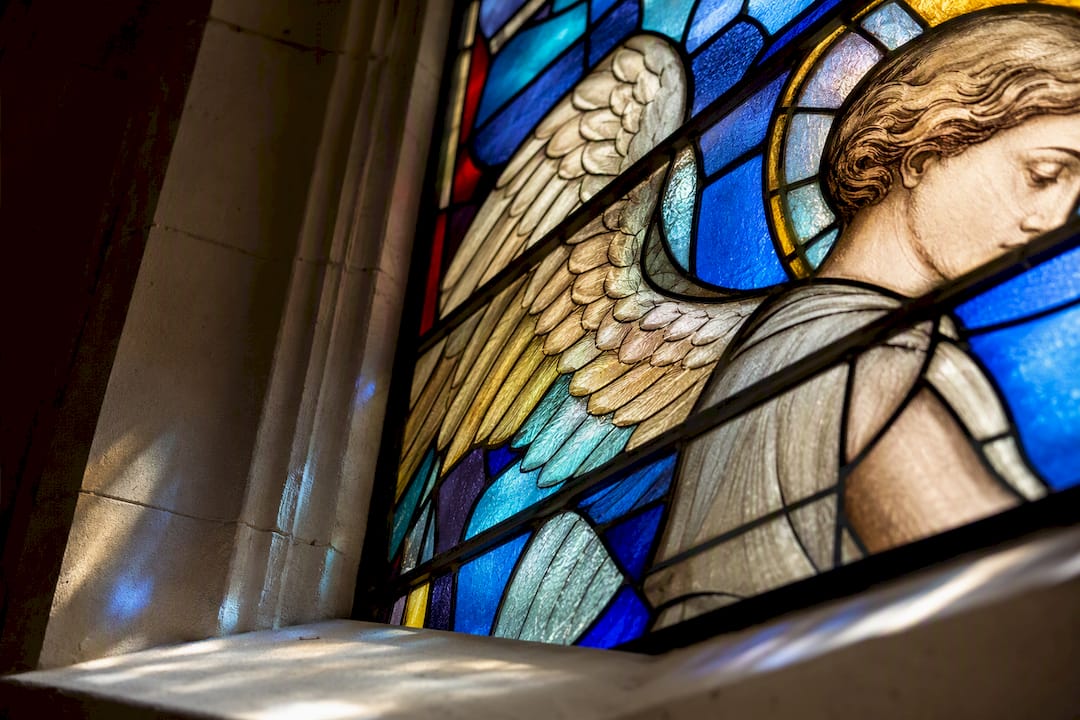
Mosaics, particularly in Byzantine and early medieval churches, favor flat, frontal guardian figures set against gold backgrounds, prioritizing permanence and grandeur over the intimacy Renaissance painters later pursued. Fresco work, being tied to architecture, often places guardian angels in transitional spaces within a church, above doorways or along processional paths, using the angel’s protective symbolism to frame physical movement through sacred space.
Prints changed the guardian angel’s audience more than any other medium. Once lithography made reproduction cheap in the 19th century, guardian-angel imagery moved out of churches and into homes at scale, which is exactly how the Schutzengel-style bridge motif became so universally recognized. Today, that print tradition continues in a more accessible form: fine art reproductions and canvases let households keep the same iconographic tradition alive without needing access to a cathedral fresco or a museum-held original. The medium changes, but the underlying visual grammar, wings, light, protective gesture, carries through.
Popular Culture’s Influence on Guardian Angel Imagery
Film, television, and greeting-card design have reshaped how contemporary audiences picture guardian angels, often pulling the image further from its theological roots and closer to comfort-object territory. Mid-20th-century media popularized a softer, more whimsical guardian angel, distinct from the solemn Baroque or Byzantine versions, and that softened version has looped back into devotional art, influencing how some contemporary prints render wings and expression.
This cultural feedback loop cuts both ways. Popular imagery has made guardian angels more approachable to a secular audience, useful for anyone drawn to protective symbolism without a specific religious framework. But it’s also flattened some of the theological nuance that Baroque and Renaissance artists worked hard to build into the subject, particularly the idea of the angel as counselor rather than simple comforter. Tattoo culture reflects this shift clearly: guardian-angel tattoos frequently borrow only the wings, stripping away halo, robe, and narrative context entirely, turning a once-doctrinal image into a personal, often secular symbol of loss or protection.
Greeting cards and gift shops have similarly simplified the imagery into a small set of repeatable poses, mostly variations on the Plockhorst bridge composition, because that formula tests as reassuring across a broad, non-specialist audience. The theological depth painters once built into gesture and gaze rarely survives that commercial simplification, which is part of why museum-quality reproductions of historical works still carry more interpretive weight than a generic greeting-card angel.
Guardian Angels vs. Saints, Archangels, and Other Protective Figures
Guardian angels occupy a distinct niche among protective spiritual figures in art, and the differences matter for anyone trying to read a devotional collection accurately. Saints are depicted as specific, named individuals with personal histories, attributes tied to their earthly lives (a particular tool, wound, or garment), and often a patronage over a specific group or cause. A guardian angel, by contrast, is generally anonymous and universal, assigned to an individual rather than famous for a life story.
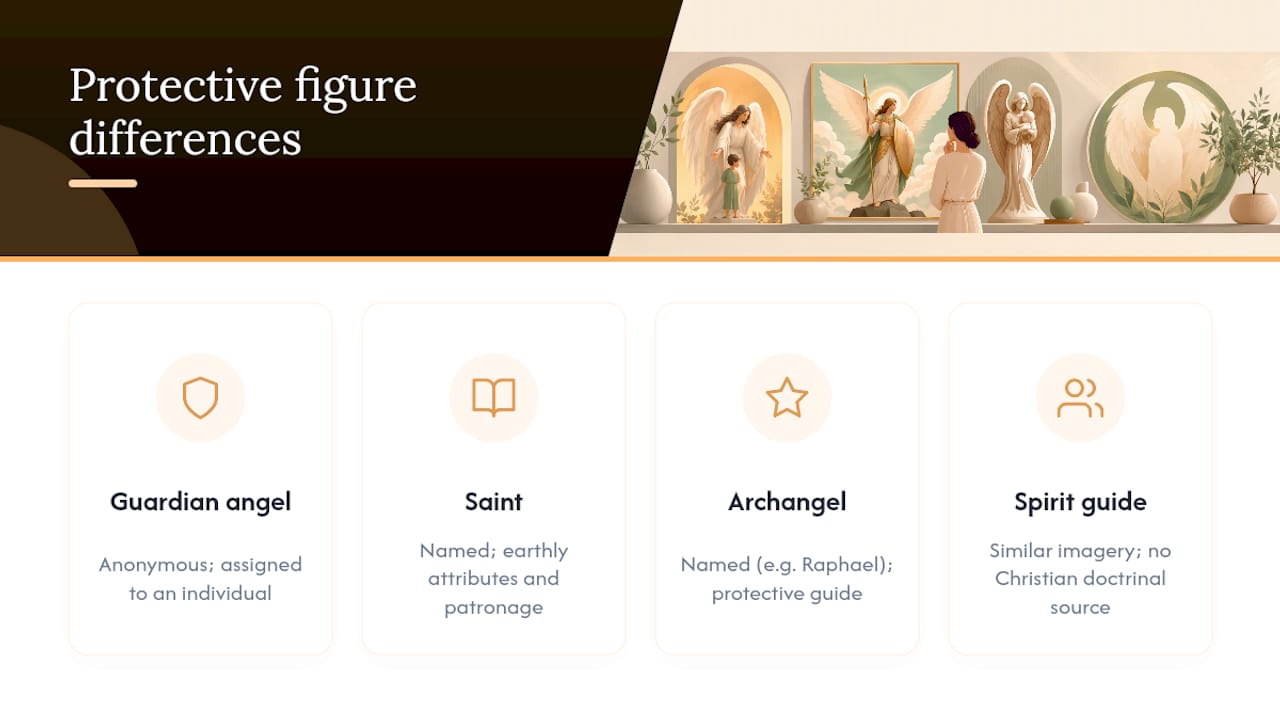
Archangels sit somewhere between the two. Figures like Raphael, drawn directly from the Tobit narrative, are named and carry specific attributes, yet they still function more like guardian angels than saints, offering protection and guidance rather than intercession based on lived example. Readers interested in how archangel iconography diverges from generic guardian imagery can find more detail in this guide to archangels in art, which traces how Raphael specifically bridges both traditions.
Secular “spirit guide” imagery, increasingly common in contemporary wellness and New Age visual culture, borrows guardian-angel wings and light motifs but strips away the Christian theological framework entirely. The core difference comes down to accountability and source: a Christian guardian angel is understood as assigned by God for a specific purpose tied to Matthew 18:10 and church tradition, while a secular spirit guide typically implies a more personalized, self-directed spiritual relationship without that doctrinal anchor. Visually, the two can look nearly identical, wings, soft light, a protective pose, which is exactly why context and intended audience matter so much when interpreting any given piece.
Why This History Still Shapes How We See Protection
Understanding guardian-angel iconography changes how you look at devotional art, not just in museums but in the objects people choose for their own homes. Once you know that a bridge motif signals Victorian parental anxiety, or that a flat, extended palm carries different theological weight than a pointing hand, a print stops being decoration and starts being a small, specific statement about protection and faith. That’s the same lens Divine Prints brings to its educational writing on archangels and the guardian angel prayer, where iconography and devotional practice meet in practical terms. Knowing the visual grammar makes choosing a piece for a nursery, a memorial, or a prayer corner a more deliberate decision rather than a guess.
— Griffin
Bring Guardian Angel Symbolism Into Your Own Home
Divine Prints turns the iconographic details covered here, wings, halo, protective gesture, into a practical selection guide rather than an academic exercise. If you know a bedroom print calls for a softer, Victorian-style guardian scene while a memorial gift calls for something closer to the solemn tone of Franceschini’s composition, you can shop with intention instead of guessing at what “feels right.”

The Angel Prints collection at Divine Prints offers museum-quality reproductions sized for homes, offices, and prayer spaces, printed on matte fine art paper or canvas and backed by a lifetime warranty against fading or defects. For gift-giving occasions tied to specific figures, the Saint Prints collection rounds out a devotional gallery wall with patron saints alongside guardian imagery. Prints ship to various locations and arrive ready for installation for home or parish settings. Browse the Angel Prints collection today to find the piece that matches the protective imagery you’ve just learned to read.
Sources
- Oxford English Dictionary
- Guardian Angels in Christian Art: Source texts, Iconography
- The Guardian Angel | Art UK
- Guardian Angel Symbolism: Protection, Faith, and Art — SymbolLore
FAQ
What symbolizes a guardian angel in art?
Wings, halos or radiant light, and protective gestures like an outstretched arm or a positioning above a vulnerable figure are the core symbols, though meaning shifts depending on the object and cultural context.
Who painted the well-known Guardian Angel painting?
Several artists are associated with the subject, but Marcantonio Franceschini’s 1716 The Guardian Angel and Pietro da Cortona’s 1656 version are the most frequently cited museum examples.
What do angels symbolize in paintings generally?
Angels typically represent divine communication, protection, and the boundary between heavenly and earthly realms, with specific roles (messenger, guardian, warrior) distinguished by attributes like wings, weapons, or gestures.
Which angel is associated with creativity?
There’s no single, universally recognized angel tied to creativity in traditional Christian iconography; the archangel Raphael is more strongly associated with healing and guided journeys through the Tobit narrative, a distinction worth knowing if you’re choosing devotional art around a specific theme rather than a general guardian figure.