

The Immaculate Heart of Mary refers to her interior life: her love for God and for Jesus, her holiness, her joys and sorrows, and her maternal compassion for every believer. “Immaculate” points to her preservation from original sin and her lifelong freedom from personal sin by grace, not to some separate miracle involving Christ’s own conception. The devotion built around this idea, expressed through the feast day, consecration prayers, and images paired with the Sacred Heart, exists to draw Catholics closer to Christ through Mary’s example.
TL;DR:
- The Immaculate Heart symbolizes Mary’s interior life of love, obedience, and faith, rooted in her being preserved from original sin and cooperating with grace.
- Devotional imagery, such as swords and flames, reflects biblical prophecy and theological themes of sorrow, love, and purity associated with Mary’s life and her response to Christ’s Passion.
- The devotion is biblically grounded in Luke 2:19, Luke 2:35, and Revelation 12, highlighting Mary’s pondering, sorrow, and prophetic significance without serving as standalone proof texts.
- Its historical development includes formalization by St. John Eudes and public reinforcement through Fatima revelations, emphasizing prayer, conversion, and interior holiness over specific rituals.
- The Immaculate Heart is celebrated liturgically after the Sacred Heart, with practical practices like Scripture reading, prayer, and icons in the home helping deepen devotion without assuming magical efficacy.
Table of Contents
- Immaculate Heart Meaning According to Catholic Teaching
- What Do the Sword, Flames, and Roses Actually Symbolize?
- Where the Bible Grounds This Devotion
- How the Devotion Grew from St. John Eudes to Fatima
- When Is the Feast of the Immaculate Heart?
- How to Practice the Devotion Without Overcomplicating It
- Immaculate Heart vs. Sacred Heart: What’s the Real Difference?
- Bringing the Immaculate Heart into Your Home
- Clearing Up the Most Common Confusions
- Why This Devotion Still Matters for How We Pray
- Keep the Devotion Present with Divine Prints
- Sources
- FAQ
Immaculate Heart Meaning According to Catholic Teaching
Catholic doctrine treats the Immaculate Heart as a description of Mary’s soul, not a separate dogma competing with the Immaculate Conception. The Immaculate Conception refers to the moment Mary herself was conceived free from original sin. The Immaculate Heart refers to the ongoing reality of that grace: a heart that loved God completely, obeyed without reservation, and carried both the joy of the Annunciation and the grief of Calvary without ever turning from faith.
The Catechism excerpt hosted by the USCCB frames Mary’s holiness as something received, not self-generated. Her sinlessness flows from Christ’s redemptive work applied to her in advance, which is why Marian devotion always circles back to her Son. Catholics do not treat Mary as a fourth member of the Trinity or a rival source of grace. She cooperated with grace at every stage of her life, and the Church holds that cooperation up as a model.
This distinction matters for how veneration works in practice:
- Worship (latria) belongs to God alone. Catholics never direct it toward Mary, the saints, or any created being.
- Veneration (dulia) is the honor given to Mary and the saints, similar in kind to honoring a parent or a hero, but categorically different from adoration of God.
- The USCCB’s own explanation of Marian devotion states plainly that Mary’s maternal and intercessory role depends entirely on Christ’s mediation. She points to him; she does not replace him.
- Every approved Marian title and devotion, including the Immaculate Heart, exists within this framework. None of them stand as independent objects of belief.
Understanding the Immaculate Heart this way clears up a lot of confusion before it starts. It is not a rival devotion competing with Christ for attention. It is a lens for seeing how one human being responded to grace with total consistency, which is exactly why the Church holds her up as a pattern for every believer’s own interior life.
What Do the Sword, Flames, and Roses Actually Symbolize?
Devotional art rarely explains itself, and the Immaculate Heart is one of the more symbol-dense images in Catholic iconography. Each element carries a specific theological reference, though the exact combination varies by artist and era.
- The single sword. A heart pierced by one sword usually echoes Simeon’s prophecy in the Temple, where he tells Mary that a sword will pierce her own soul. It represents anticipated grief tied to Christ’s passion.
- The seven swords. Some images multiply the sword into seven, representing the traditional “Seven Sorrows of Mary.” These trace major griefs across her life, from the flight into Egypt to the burial of her Son.
- Flames. A heart wreathed in fire signals ardent love, the same visual grammar used for the Sacred Heart of Jesus. Fire here means intensity, not destruction.
- Roses. Roses layered around or beneath the heart typically stand for purity paired with love, a combination unique to Marian imagery.
- Lilies. Where roses emphasize love, lilies emphasize purity on its own, drawing on centuries of Marian association with the flower.
- Rays of light. Radiating light around the heart or around Mary’s figure recalls the “woman clothed with the sun” from Revelation 12, a passage devotional tradition has long applied to Mary.
- The exposed heart itself. Placing the heart outside the body, visible and central, is a visual device for making interior life literal. It says: here is what she carried inside.
According to the National Shrine’s explainer on this symbolism, sorrow and love appear together deliberately. The image gives believers a model of faithful endurance through suffering, not just a portrait of serene devotion.
Artistic emphasis shifts across periods. Baroque-era images often lean into the sorrow, showing a heart heavy with swords. Later devotional prints, especially those tied to the 20th-century Fatima revival, tend to foreground the flame and the rose, softening the visual weight toward love and hope. Neither approach is “more correct.” Art historians who study Christian iconography note that these details developed across different traditions and were never locked into one official code.
Pro Tip: When you’re trying to read a specific print, look for the dominant symbol first. If sorrow-related imagery (multiple swords, dark tones) leads the composition, the artist is likely emphasizing the Seven Sorrows tradition. If flame and rose dominate, the piece leans toward the Fatima-era emphasis on love and consecration.
Where the Bible Grounds This Devotion
The Immaculate Heart devotion is not invented from nowhere. It has real scriptural anchors, though Scripture supplies the raw material and later theological reflection builds the fuller picture.
- Luke 2:19 and 2:51. Twice in Luke’s infancy narrative, Mary “kept all these things, pondering them in her heart.” These verses are the direct textual root of calling Mary’s interior life a “heart” at all. The USCCB’s own readings for the Memorial of the Immaculate Heart draw on exactly this language, stressing her interior attentiveness to God’s word.
- Luke 2:35. Simeon’s prophecy to Mary in the Temple, that “a sword will pierce your own soul,” supplies the sorrow half of the imagery. It is the textual source behind every single-sword depiction of the Immaculate Heart.
- Revelation 12. The “woman clothed with the sun” is read devotionally as an echo of Mary, especially in Marian art. Scripture scholars debate how directly this passage refers to Mary versus the Church as a whole, so it functions as a devotional resonance rather than a strict proof text.
Put together, these passages give the devotion a real biblical starting point: a woman who reflects deeply, absorbs sorrow without despair, and carries both grief and glory quietly. Everything built on top, the swords, the flames, the feast day, developed later as the Church meditated on what those few verses implied.
How the Devotion Grew from St. John Eudes to Fatima
The Immaculate Heart devotion has a real history, and it did not arrive fully formed. It grew in stages, shaped by individual mystics, popular piety, and eventually one of the most famous private revelations in Catholic history.
- St. John Eudes (17th century). A French priest, Eudes is widely credited with formalizing devotion to both the Sacred Heart and the Immaculate Heart as paired objects of contemplation. He wrote extensively on Mary’s heart as a model of interior union with Christ, giving the devotion its first systematic theological shape.
- 18th and 19th century spread. The devotion moved from theological writing into parish life gradually, picking up momentum through Marian apparitions and the broader 19th-century Marian revival that also produced devotions like the Miraculous Medal.
- Fatima (1917). The apparitions reported at Fatima gave the devotion its modern popular form. According to the Vatican’s own text on the Message of Fatima, the reported messages called for conversion, prayer, and reparation, with consecration to the Immaculate Heart and the practice of First Saturdays presented as responses to that call.
- Private revelation versus doctrine. It’s worth being precise here: Fatima is a private revelation. Catholics are not obligated to believe in it the way they’re obligated to accept the Creed. The Church approved it as worthy of belief, but consecration and First Saturdays remain devotional traditions layered on top of universal doctrine, not replacements for it.
The practical result is a devotion with two distinct layers: a doctrinal core (Mary’s holiness, her cooperation with grace) that every Catholic holds, and a popular layer (specific prayers, specific practices) that developed later and carries a different, more optional kind of authority.
When Is the Feast of the Immaculate Heart?
The Immaculate Heart of Mary is celebrated as an obligatory memorial on the Saturday following the Solemnity of the Sacred Heart of Jesus. Because the Sacred Heart feast itself moves with the date of Easter, the Immaculate Heart memorial shifts on the calendar from year to year rather than landing on a fixed date.
The placement is deliberate. Putting Mary’s feast immediately after Christ’s Sacred Heart solemnity visually and liturgically subordinates her heart to his, reinforcing that Marian devotion flows from and points back to Christ.
The Vatican’s Directory on Popular Piety and the Liturgy frames devotions like this one as complementary to the liturgy, never as competitors to it. Popular piety is meant to feed into sacramental life, not run parallel to it in isolation.
In practice, parishes express the feast in a handful of familiar ways:
- A Mass with readings and prayers specific to the memorial, often drawing on the Luke passages about Mary pondering God’s word.
- Marian chapels or side altars seeing increased visits and candle lighting around the feast date.
- Processions or public recitations of the Rosary in parishes with strong Marian traditions, particularly those with historical ties to Fatima devotion.
- Home devotional observance, where families might pray a consecration prayer or simply spend extra time with Scripture and reflection that day.
None of these practices are mandatory beyond attending Mass on days the Church requires it. The feast is an invitation to focus attention, not a checklist.
How to Practice the Devotion Without Overcomplicating It
Nobody needs an elaborate ritual to honor the Immaculate Heart. The most reliable practices are also the simplest, and the Church’s own guidance backs that up directly.
- Start with Scripture and the Rosary. The Vatican’s Directory on Popular Piety recommends anchoring any Marian devotion in Scripture, the Rosary, and regular Mass attendance before adding anything more specific.
- Learn a consecration prayer, if it draws you. Consecration to the Immaculate Heart is a formal act of entrusting your life to Mary’s intercession. It’s meaningful within the tradition, but it works best as an expression of a relationship already grounded in Christ, not a substitute for one.
- Try First Saturdays if it fits your rhythm. This practice, tied to the Fatima revelations, involves confession, Communion, the Rosary, and reflection on the mysteries of the Rosary on the first Saturday of the month. Treat it as a devotional aid, not an obligation.
- Keep it tethered to parish life. A quiet moment before an image at home is good. Pairing that with actual sacramental participation, confession, Mass, ongoing formation, is what keeps devotion from drifting into private spirituality detached from the Church.
Pro Tip: If a specific consecration formula or devotional promise feels more like a formula for guaranteed results than an act of faith, that’s worth bringing to a priest in conversation. Genuine Marian devotion forms character over time. It isn’t a transaction.
Immaculate Heart vs. Sacred Heart: What’s the Real Difference?
The Sacred Heart of Jesus represents the divine love of Christ himself and is a legitimate object of worship, since Jesus is God. The Immaculate Heart of Mary represents her human love and holiness, and it receives veneration, not worship, since Mary is a creature, however exalted her role.
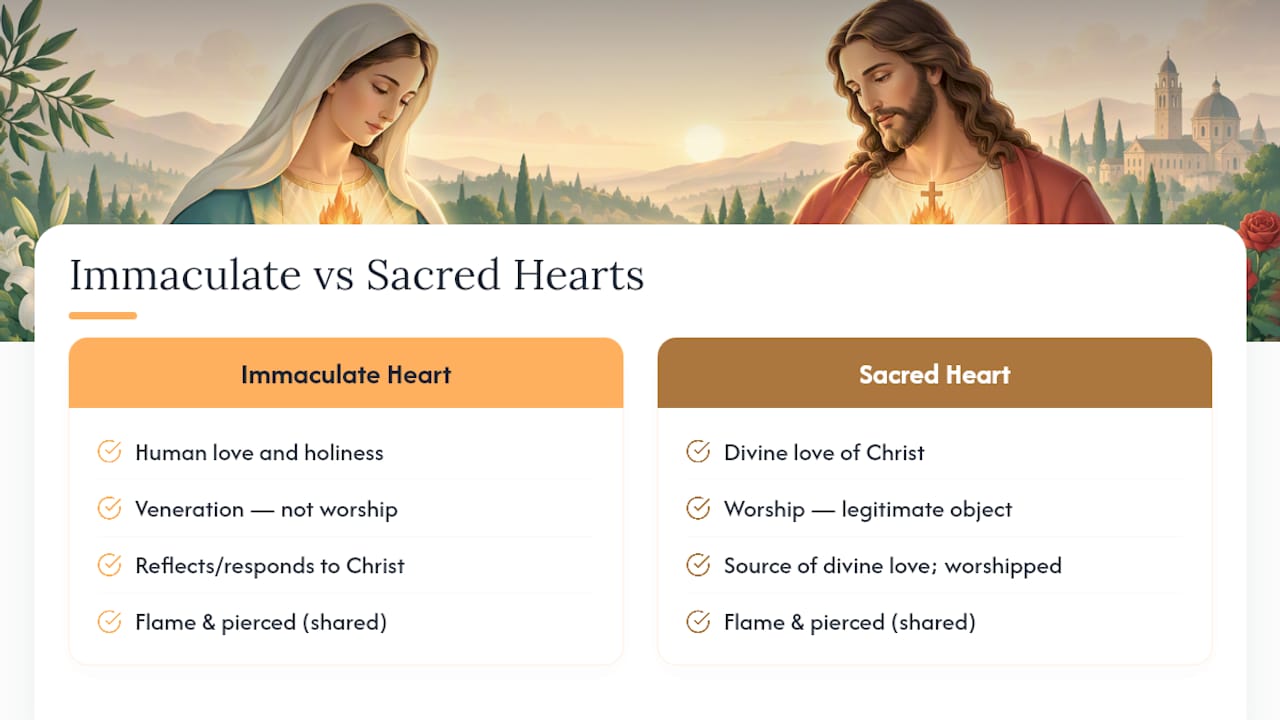
That distinction is the whole answer to a question that trips up a lot of people encountering these images side by side for the first time. Both hearts appear wreathed in flame, both get pierced (Christ’s by the lance, Mary’s by Simeon’s sword), and both show up constantly paired in devotional art and in parish chapels. The pairing is intentional. It visually reinforces that Mary’s love is a reflection of and response to Christ’s, never a competing source of grace.
The Catholic Answers tract on the Immaculate Heart puts the devotional purpose plainly: honoring Mary’s heart means imitating her virtues and being led, through her, to a deeper relationship with her Son. A detailed look at Sacred Heart symbolism shows just how closely the visual language of both devotions overlaps, right down to the flame and the piercing.
Bringing the Immaculate Heart into Your Home
Devotional art has always worked as a memory aid. An image on a wall does something a passing thought can’t: it’s there every day, at the same height, in the same corner of a room, quietly asking for a second of attention. That’s the whole logic behind hanging a print of the Immaculate Heart near where you pray.
A few practical notes on doing this well:
- Pair it thoughtfully. An Immaculate Heart print paired with a Sacred Heart image reinforces the relationship between the two devotions rather than isolating Mary’s image on its own.
- Add Scripture nearby. A small card or print with Luke 2:19 next to the image ties the art back to its biblical root.
- Mind the placement. A prayer corner, a bedroom wall, or a home altar works better than a high-traffic space where the image becomes background noise. Our home altar setup ideas cover this in more detail.
- Choose a respectful frame and size. A devotional image deserves the same care you’d give any meaningful piece of art, sized to the space and framed simply enough that the image stays the focus.
- Avoid treating the object itself as magical. The print is a memory aid and a prayer prompt, not a talisman. The devotion lives in the practice, not the object.
Clearing Up the Most Common Confusions
A handful of misunderstandings come up constantly around this devotion, and most of them dissolve with one clear sentence.
- “Catholics worship Mary.” They don’t. Catholics venerate her; worship is reserved for God alone, a distinction the USCCB addresses directly.
- “Immaculate Heart and Immaculate Conception mean the same thing.” They’re related but distinct. One describes her conception without original sin; the other describes her ongoing interior holiness.
- “Fatima is required Catholic belief.” It isn’t. Private revelations like Fatima are approved as worthy of belief, not mandated as dogma the way the Creed is.
- “There’s an official, fixed list of what every symbol means.” Iconography varies across artists and eras, and reading every sword or rose as a fixed code overreads what the scholarship on this imagery actually supports.
- “Devotional practices guarantee results.” They don’t work like transactions. If a specific promise attached to a prayer or practice raises questions, that’s a good reason to talk with a priest rather than guess.
Why This Devotion Still Matters for How We Pray
What strikes me most about the Immaculate Heart isn’t the swords or the roses. It’s the pondering. Twice, Luke tells us Mary held things in her heart without needing to resolve them immediately, sitting with mystery rather than rushing to explain it away.
That’s a genuinely countercultural posture now. Most of us reach for an answer, an opinion, a take, within seconds of encountering something we don’t understand. Mary’s example suggests a different discipline: attention first, compassion next, fidelity over the long run. You don’t need a consecration prayer memorized or a specific devotional formula mastered to imitate that. You need a willingness to sit quietly with what’s difficult, the way she did at the foot of the cross, and trust that faith holds even when clarity doesn’t come immediately.
That’s the whole invitation this devotion extends. Not certainty on demand, but steadiness under uncertainty.
— Griffin
Keep the Devotion Present with Divine Prints
There are plenty of ways to hold onto a devotion, but few work as consistently as a piece of art you actually see every day. Fine art prints and canvases built specifically for Catholic devotional use, including images of the saints, Mary, and Christ designed to anchor a prayer corner or home altar rather than just decorate a wall, make that easy.
Many pieces are made on matte fine art paper or canvas, often with warranties against defects or fading, and usually ship worldwide, so setting up a proper devotional space doesn’t require a special trip or a compromise on quality. If you’re drawn to pairing the Immaculate Heart with the Sacred Heart, the Sacred Heart of Jesus print makes that pairing simple. Browse the full Saint Prints collection to find an image that fits your prayer space, or explore Jesus Prints if you want to build out a fuller devotional wall. Either way, pick a print and give your prayer corner something worth returning to.
Sources
For readers who want to go straight to the primary texts, the Catechism excerpt via USCCB explains the doctrinal basis. The Vatican’s Message of Fatima covers the modern devotional revival. The Directory on Popular Piety situates the devotion within liturgy, and the National Shrine’s symbolism essay and Catholic Answers tract round out the iconography and pastoral framing.
- Catechism excerpt via USCCB
- National Shrine — Love Amidst Sorrow: The Symbolism of the Immaculate Heart of Mary
- Vatican — Message of Fatima
- Catholic Answers: Immaculate Heart of Mary — Meaning, feast day & devotion
FAQ
What Is the Difference Between the Sacred Heart and the Immaculate Heart?
The Sacred Heart represents Christ’s divine love and is worshiped as God; the Immaculate Heart represents Mary’s human holiness and love, and receives veneration, not worship. Both images share visual elements like flame and piercing because Mary’s heart reflects and responds to Christ’s.
What Color Skin Did Mary Have?
Scripture doesn’t describe Mary’s physical appearance, but as a first-century Jewish woman from Nazareth in the region now part of Israel, she would have had a Middle Eastern complexion. Devotional art across cultures has depicted her in locally familiar features for centuries, which is a matter of artistic tradition rather than doctrine.
What Are the Sins Against the Immaculate Heart of Mary?
This phrase comes from Fatima-related devotional writing rather than official Church doctrine, and specific enumerated lists vary between sources, so there’s no single universally defined list. What’s consistent across Fatima’s message is the call to conversion, prayer, and reparation rather than a formal catalog of offenses.
Is the Immaculate Heart Biblical?
The core scriptural root is real: Luke 2:19 and 2:51 describe Mary pondering things in her heart, and Luke 2:35 records Simeon’s prophecy of a sword piercing her soul. The fuller devotional picture, including imagery from Revelation 12, developed through later theological reflection built on that biblical foundation.
Do Catholics Worship the Immaculate Heart of Mary?
No. Catholics venerate Mary and her Immaculate Heart, a form of honor distinct from the worship reserved for God alone, as the USCCB explains directly. The devotion is meant to draw believers closer to Christ through Mary’s example, not to compete with worship of God.