

The Sacred Heart symbolizes the boundless, merciful love of Jesus Christ, made visible through the image of his human heart, wounded and burning with love for humanity. It represents a distinct Catholic devotion, one with formal liturgical recognition, centered on adoring Christ’s inner life and redemptive suffering. Catholics express it through practices like the First Fridays devotion and an annual feast day, both rooted in a set of 17th-century visions.
TL;DR:
- The Sacred Heart symbolizes Jesus’ divine love and suffering, represented through specific iconography like flames, thorns, wounds, and a cross.
- Its development began with medieval mystics and was popularized by visions reported by St. Margaret Mary Alacoque in the 17th century.
- Devotional practices today include First Fridays, novenas, acts of consecration, and reparation prayers, with emphasis on gradual commitment over time.
- The imagery’s purpose is to point to Christ’s internal life and love, not to be viewed as an anatomically literal organ.
- The devotion is based on private revelations, with teachings focused on contemplating divine mercy rather than introducing new doctrine.
Table of Contents
- What Does the Sacred Heart Symbolism Actually Mean?
- How Did the Sacred Heart Devotion Begin?
- How Do Catholics Practice Sacred Heart Devotion Today?
- What Does the Catholic Church Actually Teach About the Sacred Heart?
- Why Does Sacred Heart Imagery Look the Way It Does in Art?
- What the Sacred Heart Gets Wrong in Casual Conversation
- Choosing a Sacred Heart Print for Your Home or Parish
- Where to Read More About the Sacred Heart
- Sources
What Does the Sacred Heart Symbolism Actually Mean?
A heart pierced by a lance, wrapped in thorns, topped with a small cross, and glowing with light looks like a strange combination the first time you see it. Nothing about it is arbitrary. Every element answers a specific theological question about who Jesus is and what his suffering accomplished.
The heart itself is the starting point. In Catholic devotional language, the heart stands for a person’s inner life: their affections, intentions, and will. Vatican News frames the devotion as an act of adoring the center of Jesus, the place where his sentiments and intentions toward humanity reside. You’re not venerating an organ. You’re contemplating a person through a sign that happens to be his heart.
From there, the image builds outward with four more elements, each carrying its own weight:
- The flame. Fire rising from the top of the heart represents love that consumes and never burns out. It is the visual shorthand for divine love as an active, ongoing force rather than a past event.
- The crown of thorns. Rather than sitting on Christ’s head as it does in Crucifixion scenes, the thorns typically wrap around the heart. That placement is deliberate: it signals that Jesus experienced his Passion centrally in his affections and interior life, not merely on his skin.
- The wound and the blood and water. A lance mark, often with streams of blood and water flowing from it, recalls the Gospel account of the crucifixion in John 19:34. Later theological writers connected that image to John 7:38 and its language of living water, reading the wound as a sign of sacrificial love and, by extension, the sacraments the Church draws from it.
- The cross. A small cross rises from the top of the heart, often drawn smaller than you’d expect given its importance. Artists shrink it deliberately, planting the symbol of redemption directly in the heart rather than letting it dominate the composition.
- The radiance. Rays of light emanating outward suggest divine glory breaking through suffering. It’s the note of hope layered over the wound and thorns.
Put together, these five elements form the standard iconography you’ll see repeated across centuries of Catholic art, from painted chapel murals to the print hanging above someone’s kitchen table.
Pro Tip: If you’re trying to explain the image to a child or a newcomer to the faith, start with the flame, not the wound. Leading with “burning love” before “pierced heart” keeps the emphasis where Catholic teaching puts it: love first, suffering as its expression.
One misunderstanding comes up constantly: people assume the image is meant to be anatomically literal, as if the Church is asking believers to focus on a physical organ. That’s backwards. Catholic Answers and the Catholic Encyclopedia both stress that the heart functions as a vehicle, a sign pointing toward Christ’s emotional and moral life, not a body part isolated for its own sake. The devotion has always aimed at the Person, using the heart the way a wedding ring points to a marriage rather than existing as jewelry for its own sake.
How Did the Sacred Heart Devotion Begin?
The devotion has roots that stretch back centuries before it took the shape you’d recognize today.
- Medieval mystics laid the groundwork. Bernard of Clairvaux, writing in the 12th century, meditated on the wound in Christ’s side as an entry point into his love. A century or two later, Gertrude the Great, a German Benedictine mystic, wrote extensively about the heart of Jesus as a refuge and source of intimacy with God. Neither established formal devotional practices, but both planted the theological seeds.
- St. Margaret Mary Alacoque received the visions that changed everything. Between 1673 and 1675, this French Visitation nun reported a series of apparitions at the convent of Paray-le-Monial. In them, Jesus revealed his heart as a symbol of his love for humanity and asked for specific acts of reparation and devotion in return.
- Claude de la Colombière gave the visions credibility. Margaret Mary’s Jesuit confessor recognized the authenticity of her experiences and helped promote the devotion within the Church, giving it the institutional backing that a young nun’s private visions needed to spread beyond her own convent.
- The devotion moved from local practice to universal feast. What started as one community’s prayer life gradually spread through the 18th and 19th centuries, gaining papal encouragement along the way. The Church eventually fixed the Solemnity of the Most Sacred Heart of Jesus on the Friday following the third week after Pentecost, a date that ties the feast directly to the liturgical rhythm of the Easter season.
By the time the 19th century closed, the Sacred Heart had gone from one nun’s private revelation to a fixture of Catholic parish life across the globe, a trajectory that Britannica’s overview traces alongside the devotion’s connection to the Immaculate Heart of Mary devotion that developed alongside it.
How Do Catholics Practice Sacred Heart Devotion Today?
Knowing what the symbol means is one thing. Knowing what to actually do with that knowledge is another, and the devotion comes with a fairly specific set of practices attached to it.
The best-known is the First Fridays devotion. It asks Catholics to receive Communion on nine consecutive first Fridays of the month as an act of reparation, tied to promises attributed to Jesus in the visions given to St. Margaret Mary. The nine-month commitment matters: it’s meant to build a sustained habit of devotion rather than a single gesture, and many parishes still schedule extra confession times or evening Masses on those Fridays to make it easier for working Catholics to keep the commitment.
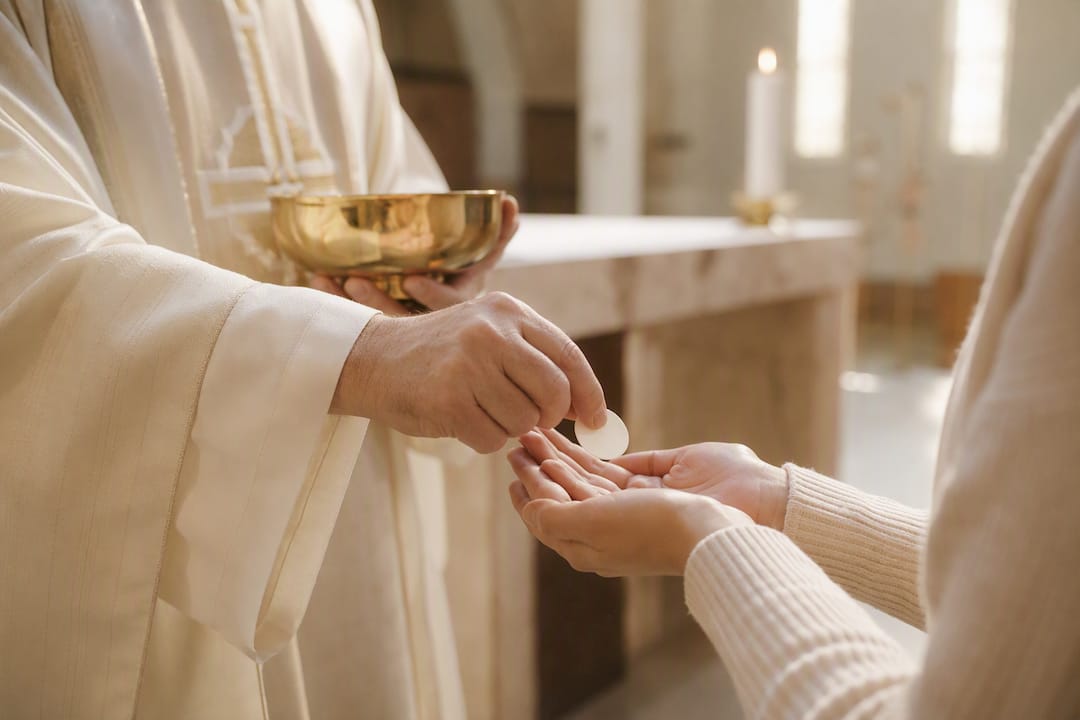
The Solemnity itself lands on the Friday after the third week following Pentecost, usually in June. Parishes typically mark it with special Mass intentions, hymns built around Sacred Heart imagery, and sometimes a public act of consecration for the parish or diocese.
Beyond those two anchors, several other practices show up in devotional life:
- Novenas, nine days of focused prayer, often prayed in the lead-up to the feast or during personal crises.
- Acts of consecration, in which individuals, families, or entire parishes formally entrust themselves to the Sacred Heart.
- Acts of reparation, short prayers or Holy Hours offered specifically to make amends for indifference or offenses against Christ’s love.
- Short devotional prayers, like the litany of the Sacred Heart, recited individually or in group settings.
Pro Tip: Don’t try to adopt every practice at once. Start with a single Holy Hour on one first Friday, then build toward the full nine-month commitment. The devotion was designed as a gradual formation, not a checklist to complete in a weekend.
What Does the Catholic Church Actually Teach About the Sacred Heart?
The devotion carries real doctrinal weight, but it’s worth being precise about what kind of weight that is.
The Church treats the visions given to St. Margaret Mary as an approved private revelation, not new public revelation binding on every believer’s faith. Catholic Answers frames these devotional practices as pastorally encouraged rather than strictly required, meaning a Catholic in good standing isn’t obligated to observe First Fridays the way they’re obligated to attend Sunday Mass. The distinction matters because it keeps the devotion in its proper place: a beneficial practice the Church commends, not a new article of faith.
On the theological content itself, official Church commentary is direct: the devotion adores the Person of Jesus through the sign of his heart, with the goal of contemplating his love and mercy toward humanity, as Vatican News puts it.
Critics occasionally raise concerns that the imagery edges toward superstition or an unhealthy fixation on physical suffering. The Church’s own framing answers that concern directly:
- The heart is explicitly a sign, not an object of worship in itself.
- The devotion’s stated purpose is contemplating divine love, with suffering imagery included to show love’s cost, not glorified for its own sake.
- Practices like consecration and reparation are framed as responses to love already given, not transactions to earn it.
Why Does Sacred Heart Imagery Look the Way It Does in Art?
Walk into almost any older Catholic church and you’ll find a Sacred Heart image somewhere, often near a side altar or in a stained-glass window. The composition tends to follow a handful of recurring conventions.
Christ is frequently shown pointing to his own heart with one hand, sometimes with the other hand raised in blessing. The heart itself sits visibly on his chest rather than hidden beneath robes, drawn larger and more prominent than strict proportion would allow. That inversion of scale, an oversized heart paired with a small cross planted directly on it, is intentional. It keeps the viewer’s eye on love as the dominant theme, with suffering present but subordinate.
These images became genuinely widespread in Catholic visual culture, showing up in home devotional corners, school classrooms, and parish decor well into the 20th century, though devotional practice softened somewhat after the 1960s even as the imagery itself remained familiar. The devotion’s popularity also shaped institutional naming: hospitals, schools, and parishes worldwide carry the name Sacred Heart, a direct legacy of how deeply the image embedded itself in Catholic identity.
For many households, a print or framed image serves as a daily visual anchor, a way of keeping that meditation on Christ’s love present in ordinary rooms. If you’re setting one up, a resource on prayer corner ideas walks through practical placement for exactly that purpose.
What the Sacred Heart Gets Wrong in Casual Conversation
People tend to flatten the Sacred Heart into either sentimental clip art or something vaguely medieval and unsettling, and both readings miss what’s actually going on. This is one of the more theologically loaded images in Catholic visual tradition, built from careful choices about where to put a crown of thorns and how small to draw a cross.
What strikes me most is how the devotion resists the instinct to separate love from suffering. Modern spirituality often wants comfort without cost. The Sacred Heart refuses that split: the flame and the wound sit on the same image because, in Catholic theology, they’re the same reality viewed from two angles.
That’s also why the quality and accuracy of devotional art matters more than people assume. A poorly rendered or theologically muddled image can flatten centuries of careful meaning into decoration. Divine Prints approaches Sacred Heart imagery with that history in mind, aiming for pieces reverent enough to hold up under the kind of daily attention prayer corners actually get.
— Griffin
Choosing a Sacred Heart Print for Your Home or Parish
Faith-based Christian wall art exists for the moment you decide you want that image somewhere in your daily line of sight, whether that’s a bedroom prayer corner, a parish office, or a gift for someone’s Confirmation.

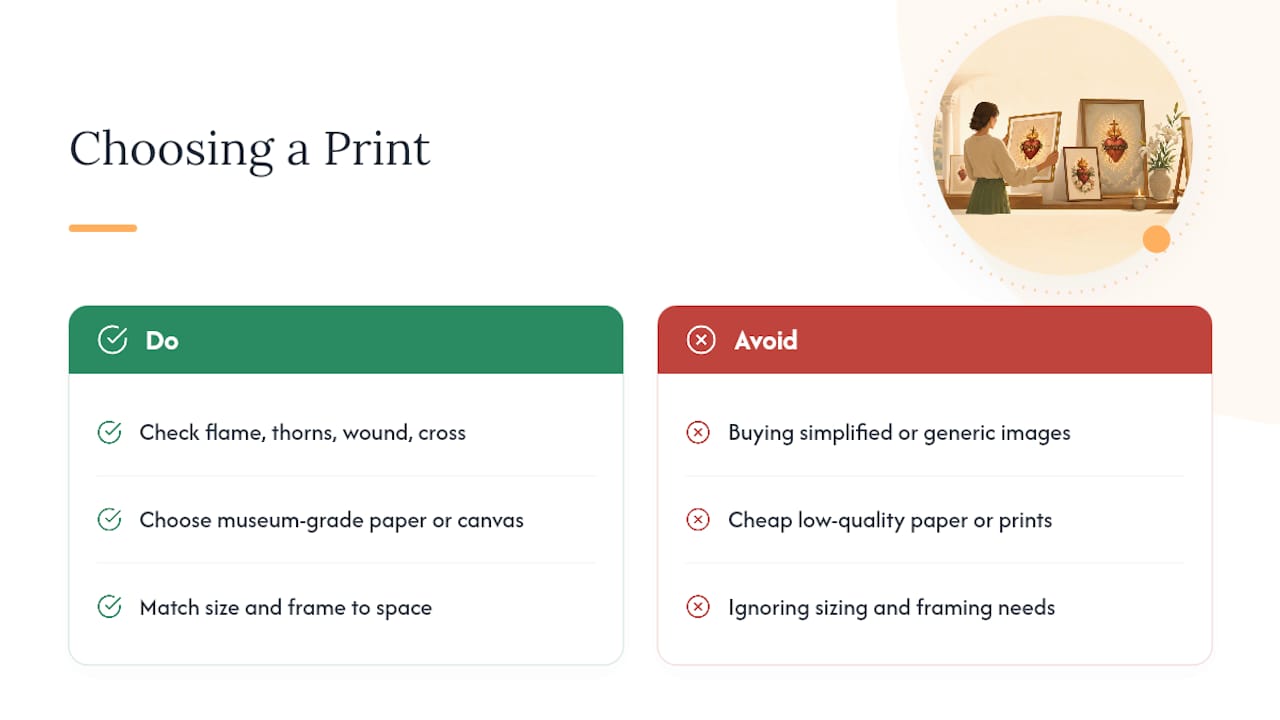
A few things separate a print worth hanging from one you’ll regret. First, check the iconography for accuracy: the flame, thorns, wound, and cross should all be present and proportioned the way tradition calls for, not simplified into something generic. Second, look at print quality, since a devotional image you’ll see every day deserves museum-grade paper or canvas rather than something that fades within a year. Third, think about scale and framing before you buy. A large canvas suits a parish hallway, while a smaller framed print fits a nightstand or office desk.
Divine Prints’ Sacred Heart of Jesus print follows the traditional iconography described throughout this article and comes available in multiple sizes and frame options, making it suitable as a personal devotional piece or as a Confirmation, baptism, or First Communion gift. Readers drawn to related imagery can also browse the full saint prints collection for complementary pieces, or explore a devotional cross earring as a wearable companion to the same symbolism. Visit the product page to check current sizing and framing options before you decide where it’s going to hang.
Where to Read More About the Sacred Heart
For readers who want to verify what’s covered here or dig deeper into primary sources, start with Vatican News on the devotion’s theological framing, the Catholic Answers guide for practical devotional history, and Britannica’s entry for an encyclopedic overview. GotQuestions.org covers the scriptural foundations in more depth. For art-focused reading, Divine Prints’ piece on Divine Mercy imagery offers a useful comparison in devotional symbolism.
Sources
- The Sacred Heart of Jesus: Fount of God’s love and mercy - Vatican News
- Sacred Heart | Britannica
- The symbolism of the Sacred Heart of Jesus - The Catholic Spirit
- Gotquestions