

The Divine Mercy image is a vessel of God’s mercy: the pale ray stands for the water of Baptism and grace, the red ray for the Blood of the Eucharist, and the inscription “Jesus, I trust in You” names the one condition attached to it. St. Faustina’s Diary records that trust, not the artwork’s beauty, is what draws mercy from the image.
TL;DR:
- The water and blood rays represent the sacraments of Baptism and Eucharist, originating from Christ’s opening heart as described in Faustina’s Diary.
- The inscription “Jesus, I trust in You” functions as a vessel for grace, emphasizing trust as the key condition for divine mercy rather than the image’s artistic quality.
- The gaze in the image reflects Christ looking from the Cross, connecting the viewer to Calvary and the message of mercy rather than tranquil serenity.
- Promised graces and protections are conditional upon trusting in Christ’s mercy, with devotion emphasizing outward acts of mercy rather than mere image veneration.
- Prayer practices include contemplating the image through visio divina, praying the Chaplet, observing Divine Mercy Sunday, and dedicating time at 3 p.m., the hour of Christ’s death.
Table of Contents
- Where the Divine Mercy image meaning comes from
- The symbolism explained: rays, gaze, wounds, and posture
- What the image asks of you: promises, sacraments, and mercy in action
- How to pray with the Divine Mercy image
- Common misunderstandings about the image, cleared up
- Living with the image in a home prayer space
- Bringing the image into your own prayer space
- Sources
Where the Divine Mercy image meaning comes from
Sister Maria Faustina Kowalska, a Polish nun in the Congregation of the Sisters of Our Lady of Mercy, described a vision of Jesus on February 22, 1931, in her convent cell in Płock. Rays of light streamed from His chest, one pale and one red, and He gave her a specific instruction that would define the devotion for the next century: “Paint an image according to the pattern you see, with the signature: Jesus, I trust in You,” He told her, adding that He desired the image “be venerated first in your chapel, and [then] throughout the world.” The vision and its wording come straight from her Diary, and the Divine Mercy image itself has been reproduced, painted, and repainted by different artists ever since, since Faustina had no formal training and needed help translating what she’d seen onto canvas.
The first attempt, painted by Eugeniusz Kazimirowski in Vilnius under her direction, left her in tears. She wrote that it didn’t capture the beauty she’d seen, and Jesus reassured her that the value was never in the pigment. A second, more widely reproduced version came later from Adolf Hyla in Kraków, which is why you’ll see the image rendered a little differently depending on where you encounter it.
Church recognition came slowly, then decisively. Key milestones:
- St. Faustina died in 1938, decades before the wider Church embraced her writings.
- Pope John Paul II, who grew up near her convent in Kraków, canonized her in 2000 and established Divine Mercy Sunday, the Sunday after Easter, as a feast on the universal Church calendar.
- The devotion, once viewed with caution by Church authorities in the 1950s and '60s, is now one of the most widely practiced Catholic devotions in the world, according to the Wikipedia entry on the image’s background.
That trajectory, from a nun’s private vision to a universal feast day, matters. It tells you the image isn’t folk piety tacked onto Catholic tradition. It’s been examined, tested, and formally received.
The symbolism explained: rays, gaze, wounds, and posture
Every element in the image answers to something specific in the Diary. Nothing about it is decorative filler, and that’s worth sitting with before you pray in front of one.
The two rays. Jesus told Faustina exactly what they mean: “The two rays denote Blood and Water. The pale ray stands for the Water which makes souls righteous. The red ray stands for the Blood which is the life of souls… These two rays issued forth from the depths of My most tender mercy when My agonized Heart was opened by a lance on the Cross,” as recorded in Diary entry 299. Water points to Baptism and sanctifying grace; Blood points to the Eucharist and the life it sustains in the soul. The image is, in that sense, a picture of the sacraments flowing outward from Christ’s pierced heart.
The inscription. “Jesus, I trust in You” isn’t a caption. Jesus called the image and its signature “a vessel” for drawing graces, telling Faustina that “I am giving people a vessel in which they are to keep coming for graces to the fountain of mercy,” a phrase drawn from Diary 327. The trust named in those five words is the mechanism, not a sentiment attached afterward.
The gaze. Faustina described Christ’s eyes in the image as looking “as if from the Cross,” a detail meant to connect the picture directly to Calvary rather than to a generic devotional portrait (Diary 326). You’re not looking at a serene, distant figure. You’re looking at the same eyes that looked down from the Cross, now turned toward you in mercy rather than judgment.
The wounds and posture. The pierced hands and feet keep the Paschal mystery, Christ’s death and resurrection, visibly present in the image. The white garment signals resurrection glory rather than the bloodied Passion scene, and the raised right hand in blessing is a gesture of peace, not command. Put together, the image holds the whole Christian story in one frame: suffering, atonement, and victory over death.
Trust is the one condition attached to every promise in the Diary. St. Faustina recorded Jesus saying, “The graces of My mercy are drawn by means of one vessel only, and that is, trust. The more a soul trusts, the more it will receive,” language repeated across her writings on the devotion’s foundations.
A few practical notes for reading the image devotionally:
- Read left to right, or right to left: it doesn’t matter. The rays and the inscription work together, not in sequence.
- The colors matter more than the artistic style. Different painters render the scene differently, but pale and red rays appear in every faithful version.
- Theological commentators, including Rev. Professor I. Różycki’s explanatory notes, describe the image as a visual synthesis of the mercy of the whole Trinity, not just a portrait of Jesus.
What the image asks of you: promises, sacraments, and mercy in action
The Diary attaches real promises to veneration of the image, but every one of them is conditional. Trust comes first; the specific graces follow from that trust, not from ownership of a picture.
The promises tied to the devotion generally include:
- Graces “flowing” to souls who approach the image with confidence in Christ’s mercy, described repeatedly across the Diary.
- Special protection at the hour of death for those who venerate the image with trust and receive the sacraments.
- An outpouring of mercy tied directly to Divine Mercy Sunday for souls who approach with contrite hearts.
None of these operate like a transaction. The image works because it points toward the sacraments, not around them. The pale ray’s link to Baptism and the red ray’s link to the Eucharist mean the picture is, structurally, an invitation back to the sacramental life of the Church rather than a substitute for it.
That’s also where the devotion gets practical instead of abstract. Theological commentary on the image consistently ties trust in Christ’s mercy to a threefold call: mercy shown through deed, word, and prayer. Looking at the image and feeling comforted isn’t the endpoint. The Lesson One catechesis from the Divine Mercy devotion frames the whole practice as one that moves outward, from gazing at mercy to extending it toward other people in concrete ways.
That outward turn is easy to skip. It’s much simpler to hang a print and feel devotional than to visit someone in a hospital or forgive a grudge you’ve been carrying for a decade. The image doesn’t let you stop at the first step.
How to pray with the Divine Mercy image
You don’t need special training to make the image part of your prayer life. A few structured approaches work well for beginners and longtime devotees alike.
- Try visio divina. Sit with the image for five minutes. Look at the rays first, then the wounds, then the eyes. Ask silently what each detail is inviting you to trust. Devotional guides recommend a simple rhythm: look, then speak, then act, letting the final step push you toward some concrete act of mercy that day.
- Pray the Chaplet of Divine Mercy. This uses ordinary rosary beads, and it’s the devotion most directly linked to the image, since Faustina received the Chaplet in the same period as the vision itself. It’s worth having a printed image nearby while you pray it, so the words and the picture reinforce each other.
- Mark Divine Mercy Sunday. The Sunday after Easter carries the fullest expression of the devotion in the liturgical calendar. If your parish exposes the image or offers confession that day, treat it as a priority, not an optional extra.
- Observe the Hour of Mercy. Three p.m. marks the hour of Christ’s death. Even sixty seconds of silence in front of the image at that hour, repeated daily, builds a habit that outlasts any single feast day.
Pro Tip: Keep the image somewhere you actually look, not somewhere you walk past. A nightstand or a spot near your morning coffee works better than a hallway you cross without slowing down.
Common misunderstandings about the image, cleared up
A few misconceptions keep circulating, and they’re worth correcting directly.
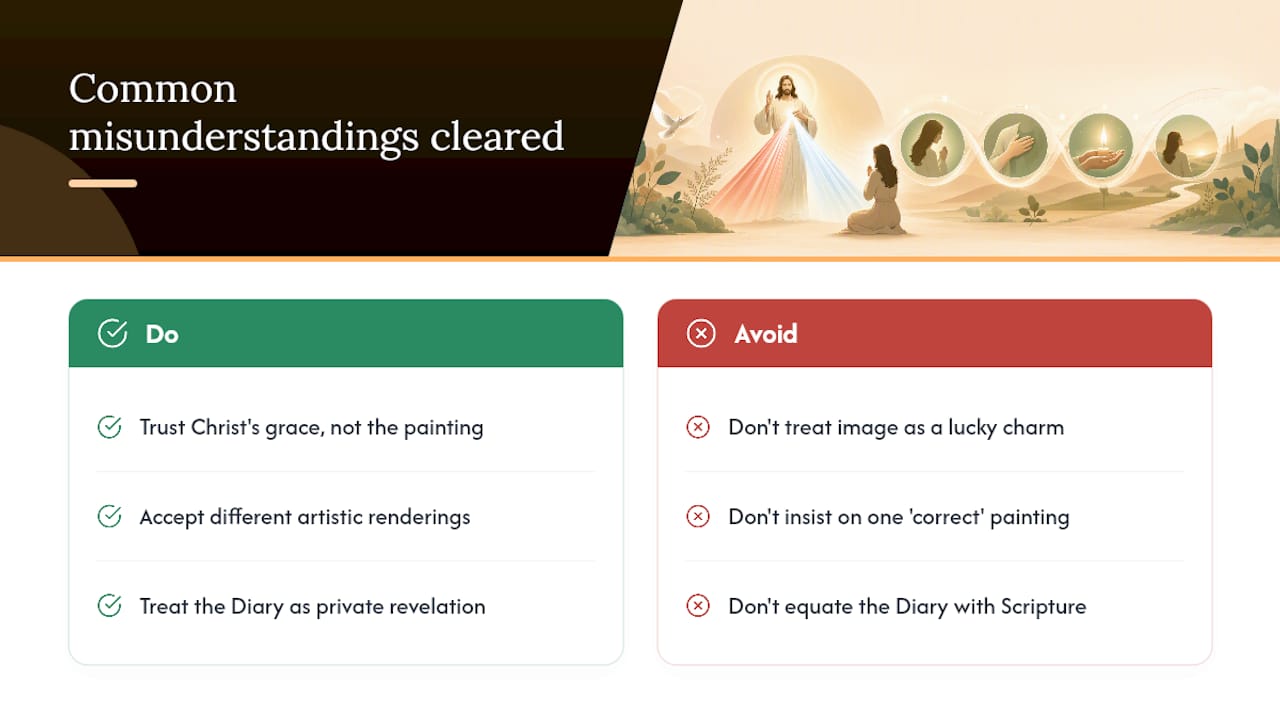
The image is not a lucky charm. Jesus told Faustina plainly that “the greatness of this image” lies in His grace, not in “the beauty of the color, nor of the brush,” a distinction recorded in the same vision account that gave the image its instructions. Owning one doesn’t guarantee an outcome; trust does the work.
Different painted versions exist because different artists interpreted Faustina’s description, not because the Church endorses one “correct” rendering. Some show a red robe, others gray; the theology stays constant across all of them.
And the Diary itself, as a private revelation, doesn’t carry the weight of Scripture or dogma. The Church approved the devotion because it found the content consistent with existing teaching, not because private revelation adds new doctrine.
Living with the image in a home prayer space

A printed image does something a phone screen can’t: it stays. You don’t scroll past it. Over years, a Divine Mercy print in a hallway or prayer corner turns into a quiet, repeated invitation to actually practice mercy, not just admire it as art. That’s the whole point of Faustina’s vision in the first place, a devotion that asks you to look, trust, and then go do something about it.
Divine Prints exists partly to help with that “staying” part. A well-made print of Faustina herself, or of related devotional subjects, gives a household something durable to return to. Pairing the image with real acts of mercy, a visit, a forgiveness, a phone call you’ve been avoiding, is what makes the devotion work as intended.
— Griffin
Bringing the image into your own prayer space
If you’ve been reading in front of a screen and want something more permanent, a printed devotional image changes how the practice feels day to day. The Saint Faustina Kowalska print from Divine Prints puts the visionary herself in your prayer corner, a fitting companion piece if you’re praying the Chaplet or reflecting on the Diary passages covered here.

For a broader devotional setup, the Sacred Heart of Jesus print pairs naturally with Divine Mercy themes, since both center on the wounded, merciful heart of Christ. It works equally well as a personal prayer aid or as a Confirmation or baptism gift for someone starting to build their own devotional life. Browse the full saint print collection if you’re shopping for a specific patron or a gift that needs to land with real meaning. Pick one, hang it where you’ll actually see it each morning, and let it do the quiet work of reminding you to trust.
Sources
- What is Divine Mercy? The Image | The Divine Mercy
- Image | Mercy - Saint Faustina
- Divine Mercy image — Wikipedia
- Divine Mercy Image Meaning: The Symbols Explained (EverythingCatholic)