

The Stations of the Cross are a devotion of 14 sacred moments that trace Jesus’s final walk to Calvary, letting you retrace his suffering step by step in prayer. Each station marks a specific event, from his condemnation to his burial, and moving through all 14 functions as a miniature pilgrimage you can complete without ever leaving your parish or your living room. This guide covers what the devotion means, the full ordered list with scripture anchors, a practical prayer routine you can use tonight, and where the tradition came from.
Here’s what you’ll find below:
- The devotional purpose and common formats of the Stations
- The complete ordered list of all 14 stations with reflections for each
- A step-by-step routine for praying them alone, with family, or in a group
- The history behind the devotion and why some stations aren’t in scripture
- Variations you’ll encounter, including the Scriptural Way and the 15th station
Key Takeaways
The Stations of the Cross work as a devotion because they combine physical movement, scriptural grounding, and unhurried silence to turn Christ’s Passion into something you personally walk through rather than simply read about.
| Point | Details |
|---|---|
| Core meaning | The devotion recreates Christ’s path to Calvary as a miniature pilgrimage for personal reflection. |
| Fourteen stations | Blend scriptural events with traditional scenes like the three falls and Veronica’s veil. |
| Ideal pacing | Sessions run 10 to 30 minutes, with 20 to 60 seconds of silence built in after each station. |
| Version choice | The Scriptural Way ties every station to a Bible verse; some parishes add a 15th Resurrection station. |
| Home practice | A single print, crucifix, or booklet is enough, and pieces from Divine Prints can serve as your visual focal point. |
Table of Contents
- What Is the Stations of the Cross Meaning Behind This Devotion?
- What Are the 14 Stations of the Cross in Order?
- How Do You Pray the Stations of the Cross Step by Step?
- Where Did the Stations of the Cross Come From?
- Why Do Some Versions of the Stations Look Different?
- What Does the Stations of the Cross Symbolism Mean for Daily Life?
- A Personal Way Into This Devotion
- Bringing the Stations Into Your Home
- Sources
What Is the Stations of the Cross Meaning Behind This Devotion?
The Stations of the Cross exist to put your body and your imagination inside the Passion narrative rather than just your intellect. You’re not reading about what happened to Jesus. You’re walking it, station by station, the way pilgrims once walked the actual route through Jerusalem. That physical movement, even if it’s just a few steps between framed images on a church wall, is part of the point.
The devotion serves three overlapping purposes: contemplating Christ’s suffering in detail, standing in solidarity with anyone enduring pain right now, and examining your own conscience along the way. It’s not passive remembrance. Each station asks something of you, whether that’s grief, gratitude, or a hard look at your own failures.
You’ll encounter the Stations in a few common formats:
- Fourteen images or carved reliefs mounted along the interior walls of a church
- Outdoor “ways” with stone or wooden markers, often on parish grounds or at retreat centers
- Printed booklets or prayer cards used for private devotion at home
- Digital or app-based guides, increasingly common for personal use during Lent
Most Christians associate the Stations with Lent, and especially Good Friday, when parishes hold a formal communal walk through all 14. But the devotion isn’t locked to a calendar. You can pray it any Friday, during a personal crisis, or as a quiet Tuesday-night practice. A typical session runs 10 to 30 minutes, depending on how much silence and reflection you build in between stations.
What Are the 14 Stations of the Cross in Order?
The traditional list of 14 stations blends direct scriptural events with scenes preserved through centuries of Christian tradition. Some stations, like Jesus falling three times, don’t appear explicitly in any Gospel account. Others, like the crucifixion itself, are drawn straight from the text. Knowing which is which helps you pray each one with the right posture, whether that’s scriptural meditation or reverent imagination.
- Jesus Is Condemned to Death. Scriptural (Matthew 27:24–26). Pilate washes his hands and hands Jesus over. Reflection: where in your own life have you stayed silent to avoid conflict?
- Jesus Takes Up His Cross. Scriptural (John 19:17). He accepts the weight without protest. Reflection: name one burden you’re carrying today and offer it here.
- Jesus Falls the First Time. Traditional, not in scripture. Reflection: think of a failure you’re still ashamed of, and picture him falling under that weight too.
- Jesus Meets His Mother. Traditional. Reflection: who in your life shares your pain without needing to fix it?
- Simon of Cyrene Helps Carry the Cross. Scriptural (Luke 23:26). A stranger is pulled in to help. Reflection: when did someone carry a burden for you that you didn’t ask for?
- Veronica Wipes the Face of Jesus. Traditional, not in the Gospels. Reflection: what small act of mercy could you offer someone suffering today?
- Jesus Falls the Second Time. Traditional. Reflection: repeated failure can feel like proof you’re beyond help. This station says otherwise.
- Jesus Meets the Women of Jerusalem. Scriptural (Luke 23:27–31). He turns his attention to their grief even in his own agony. Reflection: whose sorrow have you overlooked while absorbed in your own?
- Jesus Falls the Third Time. Traditional. Reflection: sit with how close he was to the end, and how he still didn’t stop.
- Jesus Is Stripped of His Garments. Scriptural (Matthew 27:35). Every dignity is stripped away publicly. Reflection: where do you feel exposed or humiliated right now?
- Jesus Is Nailed to the Cross. Scriptural (Luke 23:33). The physical suffering becomes explicit and total. Reflection: what would it mean to nail your resentment or fear to the cross instead of carrying it?
- Jesus Dies on the Cross. Scriptural (Matthew 27:50). The moment of surrender. Reflection: what do you need to finally let go of?
- Jesus Is Taken Down From the Cross. Traditional, drawn from the Pietà imagery rather than direct narrative. Reflection: grief needs space before it needs answers. Give yours that space here.
- Jesus Is Laid in the Tomb. Scriptural (Matthew 27:59–60). Reflection: sit in the silence of this station before rushing toward Easter joy. Waiting is part of faith too.
Notice the pattern: the three falls, Veronica’s veil, and Mary’s meeting with her son come from pious tradition passed down through centuries of pilgrims and preachers, not from the Gospel writers themselves. That distinction matters for how you approach each one in prayer, and it’s exactly why an alternate version of this devotion exists, which we’ll get to shortly.
How Do You Pray the Stations of the Cross Step by Step?
Praying the Stations follows a simple rhythm you can adapt for one person, a family, or a full parish group. The structure rarely changes even when the setting does.
- Open with a short prayer. Many use the Sign of the Cross followed by a brief prayer asking for grace to walk with Jesus in his suffering.
- Move to Station 1. If you’re using physical images or an outdoor way, actually walk to each one. If you’re praying alone with a booklet, pause and turn the page deliberately rather than skimming ahead.
- Read the station’s title and scripture or meditation. A leader typically reads this aloud; in private prayer, read it slowly to yourself.
- Pause in silence for 20 to 60 seconds. This is the step people skip, and it’s the one that matters most. Liturgical guides consistently emphasize slowing down rather than treating the Stations as a checklist to complete.
- Pray the response. A common leader/response pattern is “We adore you, O Christ, and we praise you,” answered with “Because by your holy cross you have redeemed the world.”
- Repeat for all 14 stations, then close with a final prayer, often the Our Father, or a moment of silent thanksgiving.
For timing, budget 10 to 30 minutes total, which comes out to roughly one to two minutes per station once you include the silence. If you’re short on time, you can shorten the meditations while keeping all 14 stations rather than cutting stations out. If you want to extend it, add a full minute of silence after each one rather than lengthening the spoken prayers.
At home, you don’t need elaborate setup. A single crucifix, a set of small prints, or a printed booklet works fine, and Ascension’s home-prayer guidance notes that a designated leader can simply point to or name each station as the family moves through them together. For a prayer corner that anchors this practice visually, even a small rotation of Passion-themed art gives everyone a focal point to return to.
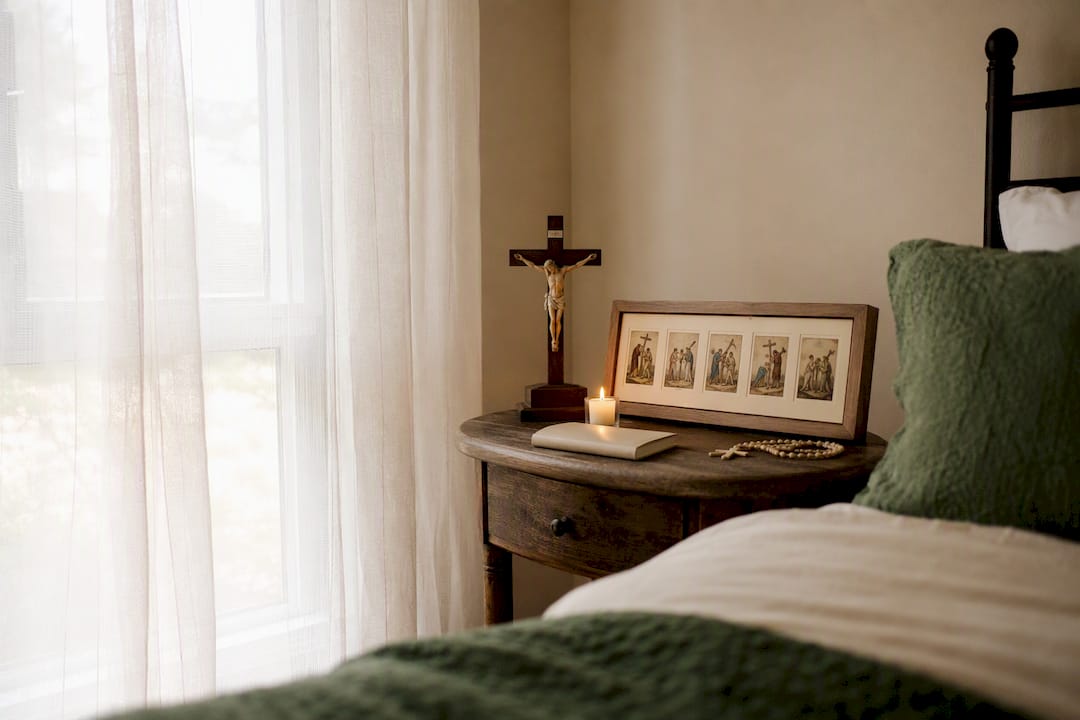
If you’re leading a small group, assign a different person to read the reflection at each station and offer one invitation to respond, something like “name one burden you bring to this station.” This keeps the pacing varied without dragging the service out.
Pro Tip: The single biggest mistake in group settings is racing through all 14 stations in under ten minutes just to “get it done.” Slow down. The silence between stations is doing more spiritual work than the words.
Where Did the Stations of the Cross Come From?
The devotion traces back to early Christian pilgrims walking the actual route Jesus took through Jerusalem, known as the Via Dolorosa, or “Way of Sorrows.” Visiting the Holy Land and physically retracing that path became a mark of deep devotion, but travel to Jerusalem was expensive, dangerous, and out of reach for most European Christians throughout the medieval period.
The solution was replication. Churches and monasteries across Europe began building their own scaled versions, sets of images or shrines representing the same sequence of events, so local worshippers could make the same spiritual journey without leaving home. These early replicas varied widely in number and content. Some had seven stations, others had more than twenty, depending on regional custom and which traditions a particular monastery favored.
The standardization to 14 stations developed gradually over centuries and became the common form used across Western churches. A few key threads in that history:
- Franciscan friars, who held custody of Christian sites in the Holy Land, played a major role in popularizing the devotion across Europe.
- The fixed set of 14 became the widely accepted standard, which is why nearly every Catholic church you visit today has exactly 14 stations mounted on its walls.
- The devotion’s design as a “miniature pilgrimage” was intentional from the start, giving ordinary parishioners access to something once reserved for those wealthy or mobile enough to travel abroad.
That history explains something a lot of people notice but don’t ask about: why do some stations feel biblical and others feel almost legendary? Because they came from two different sources, scripture and centuries of devotional tradition, that got merged into a single fixed sequence long before anyone standardized it.
Why Do Some Versions of the Stations Look Different?
You’ll run into a few different versions of this devotion, and none of them are wrong. The differences reflect different theological emphases rather than competing traditions.
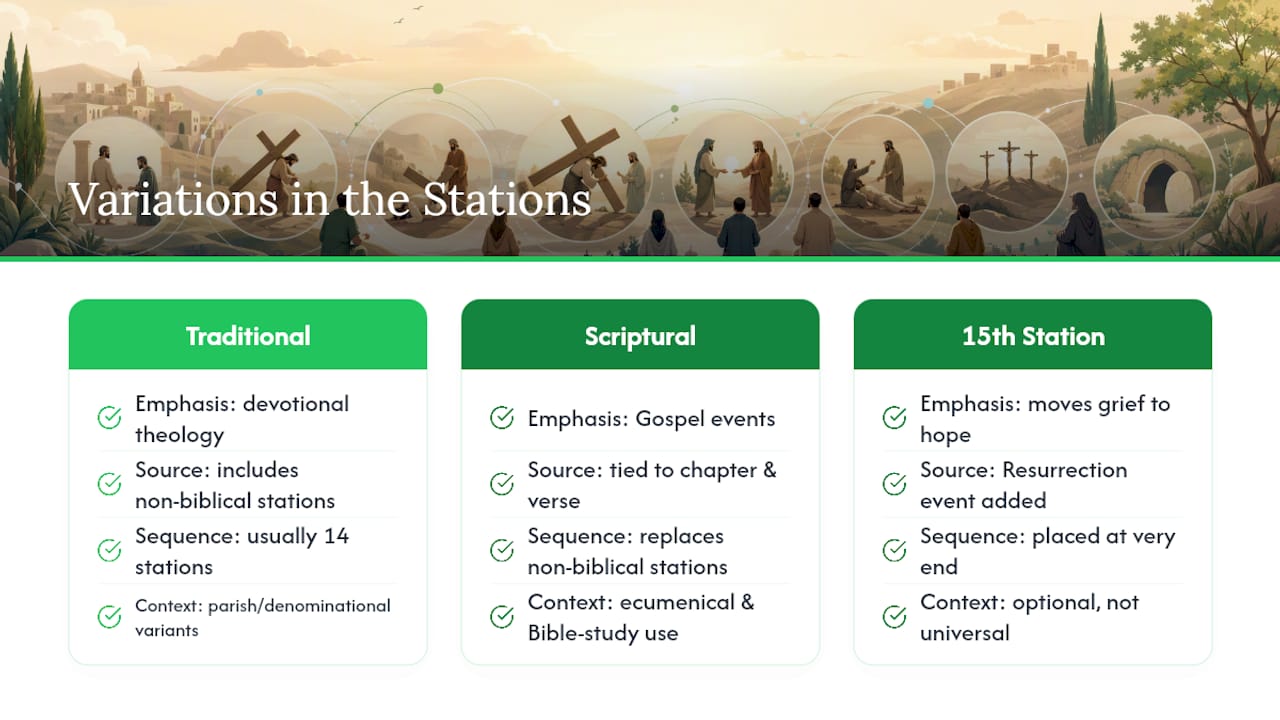
The Scriptural Way of the Cross replaces every traditional, non-biblical station with an event drawn directly from the Gospels. This version gained wide use after Pope John Paul II led it publicly at the Colosseum, and it’s particularly useful in ecumenical settings or Bible-study-centered communities, since every single station ties to a specific chapter and verse.
Some parishes also add a 15th station representing the Resurrection. This isn’t universal, but it exists precisely to keep the devotion from ending on despair. Communities that include it often place it at the very end as a deliberate bridge from Good Friday grief toward Easter hope.
Beyond that, expect small cultural and denominational variations in wording, prayer responses, and which hymns accompany the walk. Pick whichever version matches your community’s tradition, and if you’re praying alone, the Scriptural Way is a solid default if you want every station grounded in a specific biblical text.
What Does the Stations of the Cross Symbolism Mean for Daily Life?
The Stations aren’t meant to stay inside the church walls. Their real purpose is shaping how you carry your own hard seasons once you walk back out into ordinary life.
Three themes run through the entire devotion: union with Christ’s suffering, honest repentance, and compassion for people around you who are hurting. Station 5, where Simon of Cyrene is pulled into carrying the cross, has particular staying power for a lot of people. Simon didn’t volunteer. He was grabbed out of a crowd and forced into someone else’s suffering, and most of us can point to a moment we did the same for someone else, reluctantly at first, then not.
“Using image prompts or short reflective questions at each station helps those praying connect the Passion events to current personal or communal sufferings,” according to Ascension’s guidance on home prayer.
That’s the real work of the devotion. Station 2, Jesus taking up the cross without protest, becomes a lens for whatever weight you’re avoiding this week. Station 8, where Jesus turns toward the grieving women of Jerusalem despite his own agony, is a quiet challenge to notice other people’s pain even when you’re deep in your own. This same instinct, turning personal suffering into service for others, shows up outside formal devotion too, in things like donation-based care built on Christian compassion.
Pro Tip: Keep a small notebook by wherever you pray the Stations, and after each station, write down one sentence connecting it to something happening in your actual life right now. That single sentence does more for retention than the entire rest of the prayer.
A Personal Way Into This Devotion
The Stations hit differently depending on what season of life you’re in when you pray them. Walk them during an ordinary Tuesday and Station 9, the third fall, might barely register. Walk them the week after a genuine failure of your own, and that same station can undo you.
A simple practice worth trying: pray the Stations once a week for the rest of Lent, and after each one, write a single journal sentence connecting it to your week. Nothing elaborate. Just one honest line per station. By station 14, you’ll have a small, unfiltered record of where you actually were, not where you wished you’d been.
If you want a visual anchor for that practice, a single Passion-themed print near where you pray gives your eyes somewhere to rest between stations instead of drifting.
— Griffin
Bringing the Stations Into Your Home
There are plenty of ways to structure a Stations practice, but few things anchor it like having something physical to look at while you pray, especially when you’re praying alone and there’s no church wall of images guiding your eyes from one station to the next.

Divine Prints carries Biblical Event Prints built specifically for moments like this: Passion scenes and Gospel imagery sized for a prayer corner, a bedroom wall, or a small home altar where you can move visually from one station to the next even without 14 separate frames. A single piece like The Sacred Heart of Jesus works well as a fixed focal point you return to at the close of every station, a visual “amen” for the whole devotion. If you’re praying with kids or leading a small group, pairing that art with saint prints also makes a meaningful Confirmation or First Communion gift, tying sacramental milestones back to the same devotional habit. Check out the full Biblical Event Prints collection and pick one piece to anchor your Lenten practice this year.
Sources
- How to Pray: The Stations of the Cross - FOCUS
- Stations of the Cross — USCCB
- Way of the Cross — Catholic Encyclopedia (New Advent)
Recommended
- Passion of Christ Art: A Viewer’s and Collector’s Guide – Divine Prints
- How to Decorate a Prayer Room: Simple, Faith-Focused Steps – Divine Prints
- The Saint for Travelers: St. Christopher, Prayers, and Devotional Prac – Divine Prints
- Christian Wall Art: A Faith-Centered Home Decor Guide – Divine Prints