

Christ Pantocrator means “Ruler of All,” from the Greek roots pas (all) and kratos (power). The title names Christ as sovereign judge and merciful savior at once, a claim the canonical icon states visually rather than in words.
- Translation: “Ruler of All” or “Almighty,” depending on the translator’s emphasis
- Theological claim: the Son shares the Father’s omnipotence, echoing creedal language about God as “Almighty, Maker of heaven and earth”
- Visual shorthand: a frontal Christ, right hand raised in blessing, Gospel book held in the left arm
Every element in that last line carries weight. None of it is decorative.
Key Takeaways
Christ Pantocrator translates to “Ruler of All” and visually unites divine judgment with merciful salvation through its blessing hand, Gospel book, and direct gaze.
| Point | Details |
|---|---|
| Core meaning | “Pantocrator” combines Greek pas (all) and kratos (power), translating to “Almighty” or “Ruler of All.” |
| Two visual cues | The blessing hand spells IC XC, and the halo cross reads Ο Ω Ν, meaning “He Who Is.” |
| Oldest surviving example | A 6th-century encaustic panel at Saint Catherine’s Monastery, Sinai, survived Byzantine Iconoclasm due to its remote location. |
| Theological function | Facial asymmetry and paired gestures express Christ’s dual nature as both judge and merciful savior. |
| Devotional recommendation | A museum-grade print from Divineprints can anchor a home icon corner or church prayer space for daily reflection. |
Table of Contents
- What Does Pantocrator Mean? Tracing the Word’s Roots
- How Do You Read a Pantocrator Icon?
- Where Did the Pantocrator Image Come From?
- Why Does the Pantocrator’s Face Look Asymmetrical?
- Where Can You See the Most Important Pantocrator Icons?
- How Is the Pantocrator Used in Prayer and Worship?
- Where Divine Prints Fits Into This Tradition
- What the Pantocrator Still Demands From Us
- Bring the Pantocrator Into Your Own Prayer Space
- Sources
What Does Pantocrator Mean? Tracing the Word’s Roots
The Greek word splits cleanly into two parts. Pas means “all,” and kratos (or the related verb kratein) means “power,” “strength,” or “to hold fast and sustain.” Put together, Pantocrator does not just mean a ruler with authority over territory. It means one who actively upholds and sustains everything that exists, which is a subtly different claim than mere kingship.
The title did not originate with Christian iconographers. It appears repeatedly in the Septuagint, the Greek translation of Hebrew scripture, where it renders divine titles like “Lord of Hosts.” Early Christian writers picked it up and folded it into creedal language, applying to Christ the same absolute sovereignty scripture had reserved for God the Father. That move is theologically loaded: it asserts the Son’s full divinity, not a delegated or lesser authority.
This is why English translations split between “Almighty” and “Ruler of All”:
- “Almighty” emphasizes raw power and majesty, closer to a courtroom or throne-room feel
- “Ruler of All” emphasizes ongoing governance and care, closer to a shepherd sustaining a flock
Both are accurate. Neither captures the full Greek on its own, which is part of why the icon exists. The image does what a single English word cannot.
How Do You Read a Pantocrator Icon?
Once you know what to look for, a Pantocrator icon stops being a pretty picture and starts reading like a document. Every formal choice is intentional, and iconographers have treated these details as a fixed visual vocabulary for over a thousand years.
- The frontal gaze. Christ looks directly out of the panel, not off to the side or downward. Art historians describe this as an intentional break from narrative art. The eyes are not telling a story. They are addressing you, inviting self-examination rather than passive viewing.
- The blessing hand. The raised right hand forms a specific finger arrangement that spells out IC XC, the abbreviated Greek for “Jesus Christ.” The gesture itself is a confessional formula. It names who is being depicted while simultaneously extending a blessing.
- The Gospel book. Christ’s left arm holds a Gospel book, sometimes closed, sometimes open to a chosen verse. When the book is open to a specific text, the choice is rarely random. Donors and clergy often selected passages, turning the icon into an active teaching tool rather than a static portrait.
- The halo cross. A cruciform halo frames the head, inscribed with the Greek letters Ο, Ω, and Ν, forming the phrase “ho ōn,” meaning “He Who Is.” That’s a direct echo of the divine name given to Moses at the burning bush.
- The absence of regalia. No crown, no scepter, no throne of gold. The vestments are simple, and that omission is deliberate.
Pro Tip: Before looking anywhere else on a Pantocrator icon, find the blessing hand first. Once you can spot IC XC in the fingers, the rest of the composition starts to organize itself around that gesture.
Where Did the Pantocrator Image Come From?
The oldest surviving example of Christ Pantocrator is a 6th-century encaustic panel preserved at Saint Catherine’s Monastery on Sinai. Its survival is almost an accident of geography. The monastery sits in a remote stretch of desert, isolated enough that it escaped much of the destruction that swept through Byzantine territory during the two waves of Iconoclasm, roughly the 8th and 9th centuries, when religious authorities ordered the destruction of icons across the empire.
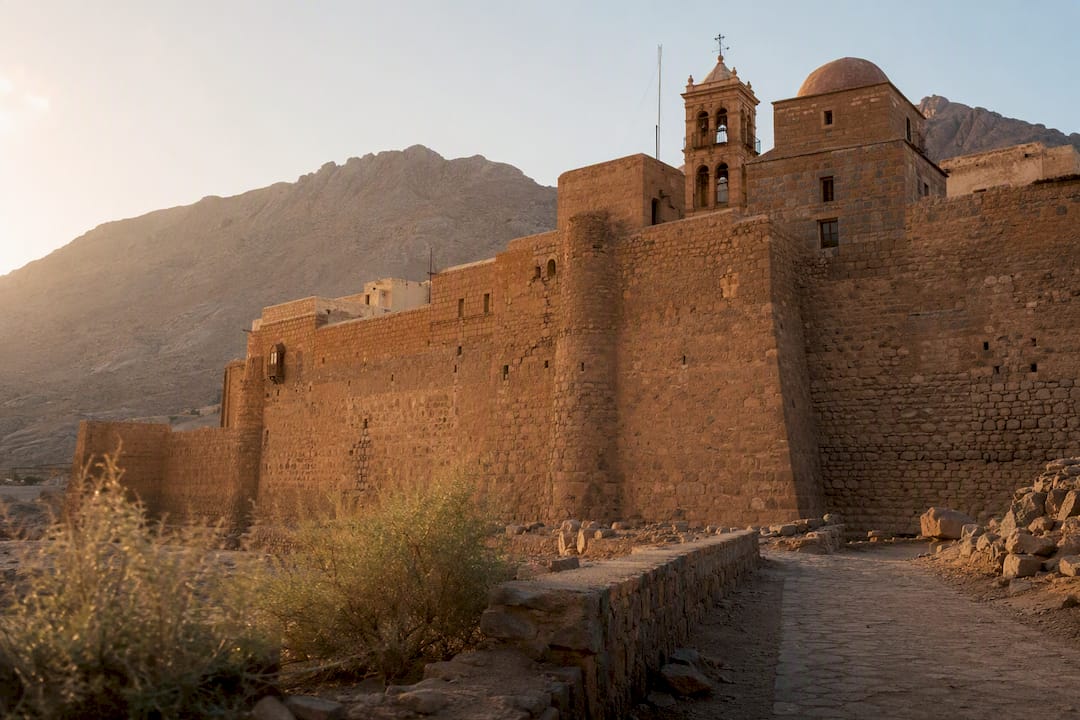
That isolation matters more than it might seem. Most icons from before the Iconoclastic period simply do not exist anymore. The Sinai panel gives scholars a rare, direct window into how the earliest iconographers approached the subject, before centuries of copying and stylistic drift.
Iconoclasm ended with the Second Council of Nicaea and a later restoration of icons, an event Orthodox Christians commemorate as the Triumph of Orthodoxy.
- After that restoration, the Pantocrator type spread widely and became a standard feature of Byzantine church architecture, especially in dome mosaics.
- Regional workshops developed their own stylistic variations, but the core elements (frontal pose, blessing hand, Gospel book) stayed remarkably stable across centuries.
That stability is unusual for any artistic tradition. It suggests the formula was never treated as a matter of artistic taste.
Why Does the Pantocrator’s Face Look Asymmetrical?
Look closely at the Sinai panel or any faithful copy, and the two sides of Christ’s face do not match. One side appears calmer, more serene. The other carries a sterner, more severe expression. This is not a flaw in early painting technique. Scholars read it as an intentional theological device, a way of encoding the doctrine of Christ’s two natures, human and divine, into a single face.
- The calmer side gestures toward Christ’s humanity and mercy
- The sterner side gestures toward his divine authority and role as judge
- The Gospel book reinforces the judgment side of that equation, while the blessing hand reinforces mercy
The icon holds judgment and mercy in the same frame without resolving the tension between them. That refusal to simplify is the entire theological point.
Placement reinforces the message. When the image fills a church dome, as it famously does in the Hagia Sophia tradition, Christ appears to look down from the heavens over the entire congregation. The dome itself becomes a symbol of the cosmos, with Christ positioned as the one who sustains and judges all of it at once, an idea rooted in the eschatological imagery of Christ returning in glory at the end of time.
Where Can You See the Most Important Pantocrator Icons?
A handful of surviving works define how scholars and worshipers alike understand this image today. Each one teaches something different.
- Saint Catherine’s Monastery, Sinai. The 6th-century panel here is the benchmark. Its facial asymmetry, encaustic technique, and remote survival make it the reference point every later Pantocrator gets measured against.
- Hagia Sophia, Istanbul. The mosaic tradition here shows the type at monumental scale, placed high in a dome or apse where the entire worship space is organized around Christ’s gaze. Visibility and public scale, not intimacy, define this version.
- The Fitzwilliam Museum. Museum holdings like the Fitzwilliam’s Pantocrator materials let researchers examine pigment, panel construction, and provenance up close, work that is nearly impossible to do with an icon still in devotional use in a church.
Together, these three locations cover the full range: the earliest surviving example, the grandest public display, and the closest scholarly study.
How Is the Pantocrator Used in Prayer and Worship?
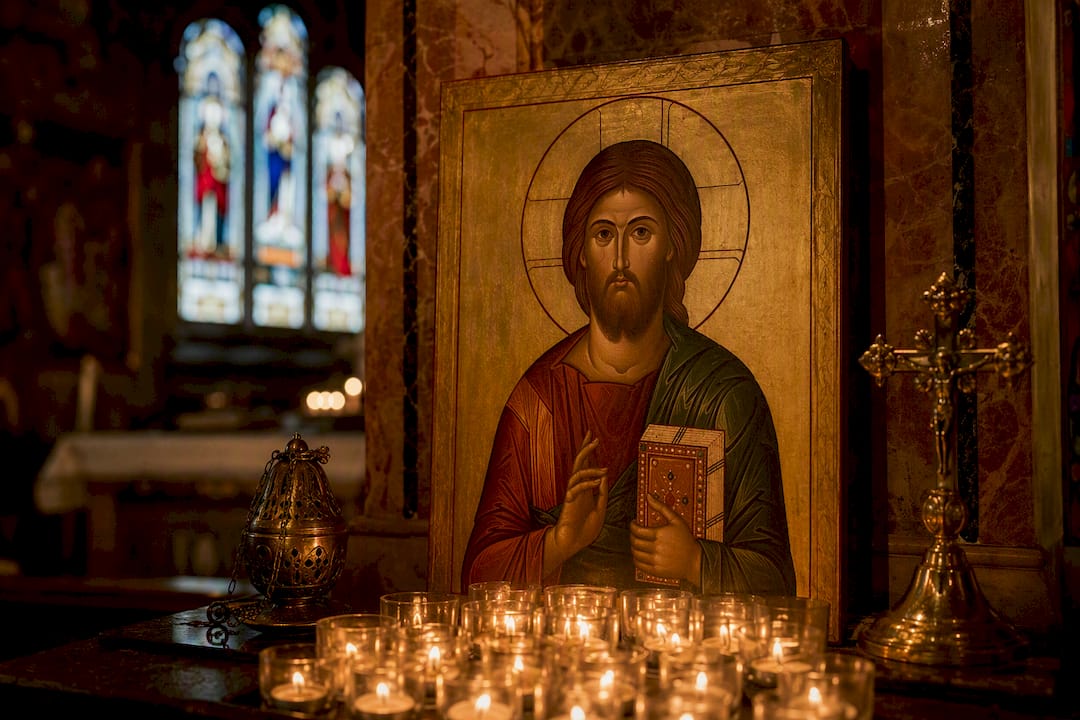
In Orthodox and Eastern Catholic churches, the Pantocrator’s dome placement isn’t just visual drama. It shapes the entire liturgy, positioning the congregation as gathered beneath Christ’s watchful, sustaining presence during corporate worship.
In private devotion, the same image works at a much smaller scale. Many households keep an icon corner, a fixed space for prayer, and the Pantocrator often anchors it alongside images of Mary or favorite saints.
- Veneration means honoring what the image represents, not worshiping the physical object itself
- A consistent prayer space, even a small one, supports daily devotional habits more than an elaborate one used occasionally
- Handle and display icons respectfully, treating them as sacred images rather than ordinary decor
Pro Tip: If you’re setting up an icon corner for the first time, place the Pantocrator at eye level. The gaze is meant to meet yours directly, not sit above or below your line of sight.
Where Divine Prints Fits Into This Tradition
Divineprints focuses on high-quality Christian and Catholic wall art, including prints centered on Christ, biblical scenes, and beloved saints. A well-made print does real devotional work: it anchors an icon corner, gives a prayer space visual weight, and keeps a theological image present in daily life rather than tucked away.
- Museum-grade printing preserves the fine detail that makes iconography legible, down to the halo lettering
- Framed and unframed options suit home prayer corners, church settings, and gift-giving alike
- Related reading, including Divineprints’ piece on Saint Irene Chrysovalantou, offers further context on reading and living with icons
What the Pantocrator Still Demands From Us
Scholarship can explain the halo letters and the finger positions, but none of that fully accounts for what happens when you actually stand in front of one of these faces. The gaze does something a textbook description can’t replicate. It doesn’t let you stay a spectator.
That’s the real argument for encountering the image rather than just reading about it. Give it time before you assign it meaning.
— Griffin
Bring the Pantocrator Into Your Own Prayer Space
A framed devotional print does more for daily prayer than a phone screen or a borrowed library book ever could. Divineprints offers museum-grade prints and canvases built specifically for that purpose, sized and finished for a home prayer corner, a parish office, or a gift for someone marking Confirmation or Baptism.
The Sacred Heart of Jesus print works well as a devotional anchor in the same tradition as the Pantocrator, pairing Christ’s mercy with striking visual clarity. For readers drawn to the broader saint tradition discussed throughout this piece, the Saint Prints collection offers dozens of patron and historical figures suited to home altars, church gifts, or Confirmation presents. Browse either collection and find a piece that fits the wall it’s meant for.
Sources
For readers who want primary sources and closer visual study, a few destinations stand out. The Vanderbilt Divinity Library entry explains the etymology and visual grammar in scholarly depth. The Fitzwilliam Museum’s collection page offers provenance detail for close museum study. The Wikipedia overview of Christ Pantocrator summarizes common iconographic conventions concisely, and OrthodoxWiki’s Pantocrator entry grounds the devotional and liturgical dimensions.
- Vanderbilt: Pantokrator artwork entry
- St. John the Forerunner and Saint Demetrios (icon description)
- Fitzwilliam Museum: Christ Pantokrator reference