

For Christian and Catholic households, Easter wall art means Resurrection-centered imagery, from the empty tomb to saints tied to the season, chosen for prayer and gift-giving rather than seasonal decor. Start by naming your devotional purpose, comfort, encounter, catechesis, or thanksgiving, then let that decide the subject before you ever think about size or medium. Divine Prints organizes its collection around exactly this logic, which makes it a practical starting point once you know what you’re looking for.
TL;DR:
- Choose devotional subjects that align with your prayer purpose, such as the empty tomb, Noli me tangere, or the Paschal Lamb, to foster prayerful engagement.
- Select artwork size based on 60 to 75 percent of the wall or furniture below it, and size matters more than image detail for proper visual impact.
- Use appropriate framing and materials depending on your room’s lighting and humidity conditions; upgrade framing and UV glass for areas exposed to sunlight or moisture.
- Hang art at eye level specific to your usual posture in the space, avoiding direct sunlight and using warm LED lights with dimmers to enhance devotional atmosphere.
- Prioritize purpose-driven placement and pairing of secular and sacred imagery to create intentional prayer spaces that support reflection rather than casual decoration.
Table of Contents
- Easter Wall Art Ideas for Prayer Corners and Living Rooms
- How to Choose the Right Devotional Print for Your Space
- Hanging and Lighting Devotional Art So It Actually Gets Prayed With
- Turning the Image Into an Actual Prayer Practice
- Giving Devotional Art as a Sacrament Gift
- Where Eggs and Bunnies Fit Around Devotional Art
- Making Your Own Easter Wall Art
- Color and Style Choices That Fit the Season
- Blending Traditional and Modern Devotional Styles
- Why Devotional Focus Beats Decorative Easter Art
- Bring the Idea Home With Divine Prints
- Sources
Easter Wall Art Ideas for Prayer Corners and Living Rooms
Every Easter image works differently on the soul. Some invite quiet contemplation. Others put you inside a Gospel scene. Knowing the category helps you pick something you’ll actually pray with, not just glance past on your way to the kitchen.
-
The empty tomb. Christian art has always leaned on absence to depict the Resurrection, since no one actually witnessed the moment itself. Discarded burial cloths and a stone rolled away carry more theological weight than a literal depiction ever could. Hang it in a hallway or entryway where morning light hits it first.
-
Noli me tangere. Mary Magdalene recognizing the risen Christ in the garden is one of the most personal encounter scenes in the Gospels. It suits a bedroom or a private prayer nook, somewhere you go when you need to be recognized yourself.
-
The road to Emmaus. Christ breaking bread with two disciples who didn’t recognize him until that moment pairs naturally with a dining room or kitchen. Families who pray before meals get daily mileage out of this one.
-
The Incredulity of Thomas. Doubt meeting proof. This image works well in a study, office, or anywhere someone wrestles with faith questions. It’s blunt reassurance for a skeptical mind.
-
The Anastasis, or Harrowing of Hell. Less common in Western homes but theologically rich, this Eastern-influenced motif shows Christ pulling Adam and Eve from the grave. It carries a cosmic-victory tone that fits a main living space where the whole household gathers.
-
The Paschal Lamb. A simpler, symbol-based option for anyone who wants Easter imagery without a full narrative scene. It reads well in a kitchen or as part of a smaller grouping.
-
Cross paired with Resurrection banner. The crucifixion and the empty tomb, shown together or as a two-piece set, tell the whole Easter story in one glance. This works as a focal piece above a mantel or sofa.
-
Saint prints tied to Easter witnesses. Mary Magdalene, the apostles, and other early witnesses to the Resurrection make meaningful additions to a gallery wall built around Eastertide. Divine Prints’ Saints collection covers dozens of these figures individually, so you can build out a set gradually rather than buying everything at once.
-
Scripture-phrase prints. A single verse, like Matthew 28:6’s “He is not here, for He has risen,” works as a quiet anchor piece next to a larger image. Good for a hallway transition point.
-
Icon-style Resurrection art. Byzantine-influenced icons, flatter perspective, gold tones, formal composition, fit naturally in a dedicated prayer corner rather than a general living space.
For layout, three approaches cover most homes. A single focal piece works best above a mantel, headboard, or entry table where you want one clear statement. A triptych, three related images hung together, tells a fuller story: crucifixion, tomb, and appearance, for instance. A small gallery of four to six mixed pieces, saints alongside Resurrection scenes, suits a stairwell or hallway. And a dedicated icon corner with one or two smaller, more intimate images works for a bedroom prayer nook where you’re not decorating so much as furnishing a place to kneel.
How to Choose the Right Devotional Print for Your Space
Start with purpose, not aesthetics. Are you buying something to sit with during morning prayer, something to greet guests during Easter dinner, or something to teach a child what the Resurrection means? That answer should drive every decision after it.
- Match subject to aim. Comfort points toward Emmaus or Noli me tangere; catechesis points toward the empty tomb or a clear narrative scene; thanksgiving fits a Paschal Lamb or a scripture print.
- Size the wall, not the image. A general rule: the artwork should span roughly 60 to 75 percent of the furniture or wall segment beneath it. Measure before you shop, not after.
- Pick the medium for the room’s exposure. Archival paper prints work well in low-light hallways. Canvas holds up better in humid bathrooms or kitchens. Framed prints with UV glass are worth the extra cost anywhere direct sun hits the wall.
- Check before you buy: confirm print materials, ask about framing options and turnaround time, and read the return policy in case a size doesn’t fit the space you had in mind.
Divine Prints’ guide to faith-centered home decor walks through sizing and framing decisions in more detail if you’re outfitting more than one room at once.
Pro Tip: Buy the frame and glass upgrade for anything going above a radiator, near a window, or in a bathroom. Humidity and UV light are the two things that actually ruin a print, not time.
Hanging and Lighting Devotional Art So It Actually Gets Prayed With
Placement changes how an image functions. In a dedicated prayer corner, hang art at eye level while kneeling or seated, not standing, since that’s the posture you’ll actually be in. In a living room focal wall, standard eye-level hanging (image center around 57 to 60 inches from the floor) works better since most viewing happens standing.
- Avoid direct sunlight. It fades pigment and yellows paper faster than almost anything else, regardless of print quality.
- Use warm LED picture lights rather than cool white bulbs; warm tones flatter skin, gold leaf, and traditional palettes.
- Add a dimmer if the piece sits somewhere you pray in the evening. Full brightness works for daytime display, not quiet reflection.
- Establish visual hierarchy in a gallery grouping: Christ images go centered or slightly higher, saints arranged around them rather than competing for the same sightline.
Intentional placement is what separates a prayer space from ordinary decor, according to guidance on building a Catholic prayer room. The image doesn’t do the work alone. The arrangement around it does.
Turning the Image Into an Actual Prayer Practice
Art on a wall is only as devotional as your habit around it. Visio Divina, a prayer method built on sitting with a sacred image, adapts easily to a busy household.
- Prepare. Sit or kneel facing the image for a moment of silence before you look at anything specific.
- Gaze. Spend a few minutes looking at one detail, the tomb’s opening, Christ’s hand, Thomas’s face, and let it hold your attention rather than scanning the whole piece.
- Respond. Close with one sentence, spoken or written: a request, a thank-you, a question you’re bringing to God.
With children, shorten the prompts. Ask a young child, “What do you think this person is feeling?” Ask a teenager, “Where in your week did you feel like Thomas, needing proof?” For parish settings, hallway displays tied to Holy Week and classroom corners with age-appropriate Easter scenes give students a visual anchor through the season using worship tools for Worship Teams. Some parishes supplement wall art with seasonal digital packages for projection during Lent and Eastertide services.
Giving Devotional Art as a Sacrament Gift
A patron saint print for a Confirmation candidate lands differently than a generic bouquet ever could, largely because the subject itself carries personal meaning rather than just seasonal timing.
- Match subject to occasion: a patron saint print for Confirmation, a Resurrection image for Easter houseguests, a Eucharist or Sacred Heart image for First Communion.
- Size small for gifting. An 8x10 or 11x14 framed print travels and wraps easier than anything oversized.
- Add a personal layer. A scripture card tucked behind the frame or a handwritten blessing on the back turns a purchased print into something the recipient keeps for decades.
- Order early. Confirmation and First Communion season clusters heavily in spring, so framing and shipping windows tighten fast in the weeks before Easter.
Where Eggs and Bunnies Fit Around Devotional Art
Secular Easter symbols aren’t off-limits, they just work as supporting elements rather than the main event. An egg motif or spring floral print hung beside a Resurrection image, rather than instead of one, keeps the room festive without diluting its devotional center.
Think of it as visual hierarchy again. A large empty-tomb print stays the focal piece; a smaller framed botanical or a subtle egg-pattern accent piece sits lower or to the side, doing seasonal work without competing for attention. Pastel color palettes, soft green, cream, blush, actually complement most devotional art better than bold liturgical purple or red, since Eastertide’s visual language leans lighter than Lent’s.
If you’re decorating a kids’ room or a shared family space where a purely devotional gallery might feel too formal, a spring-themed piece can act as a bridge. A rabbit or egg print near the door, a Resurrection or saint image at the room’s center, lets both registers coexist. The mistake to avoid is letting secular imagery dominate a space meant primarily for prayer. If the wall’s purpose is devotional, the devotional piece should always read as the anchor, with spring elements filling in the margins.
Making Your Own Easter Wall Art
A hand-lettered scripture verse is the easiest entry point for anyone without formal art training. Watercolor lettering of “He is not here, for He has risen” (Matthew 28:6) on cold-press paper, framed simply, holds up well as a personal or gift piece.

For families with kids, a collaborative tomb scene works surprisingly well: cut paper shapes for the stone, the cave opening, and burial cloths, then let each family member add a small detail. Mount the finished piece in a shadow box frame so texture stays intact.
Pressed spring flowers arranged around a printed scripture verse or small icon reproduction give a handmade piece some dimension without requiring painting skill. Botanical presses layered under glass in a simple frame look intentional rather than crafty.
If you have a photo of a meaningful visit, a shrine, a parish, a pilgrimage site, printing it large and pairing it with a smaller devotional print nearby personalizes a gallery wall in a way no purchased set can replicate. The DIY approach works best as a complement to a strong purchased anchor piece rather than a full replacement. A hand-lettered verse next to a well-made empty tomb print reads as intentional. A wall of only craft-store materials tends to read as unfinished.
Color and Style Choices That Fit the Season
Eastertide’s visual language runs lighter than Lent’s purples and Good Friday’s stark black. Cream, soft gold, sage green, and pale blue dominate most well-composed devotional Easter walls, echoing the season’s themes of renewal and light without tipping into pastel-Easter-basket territory.
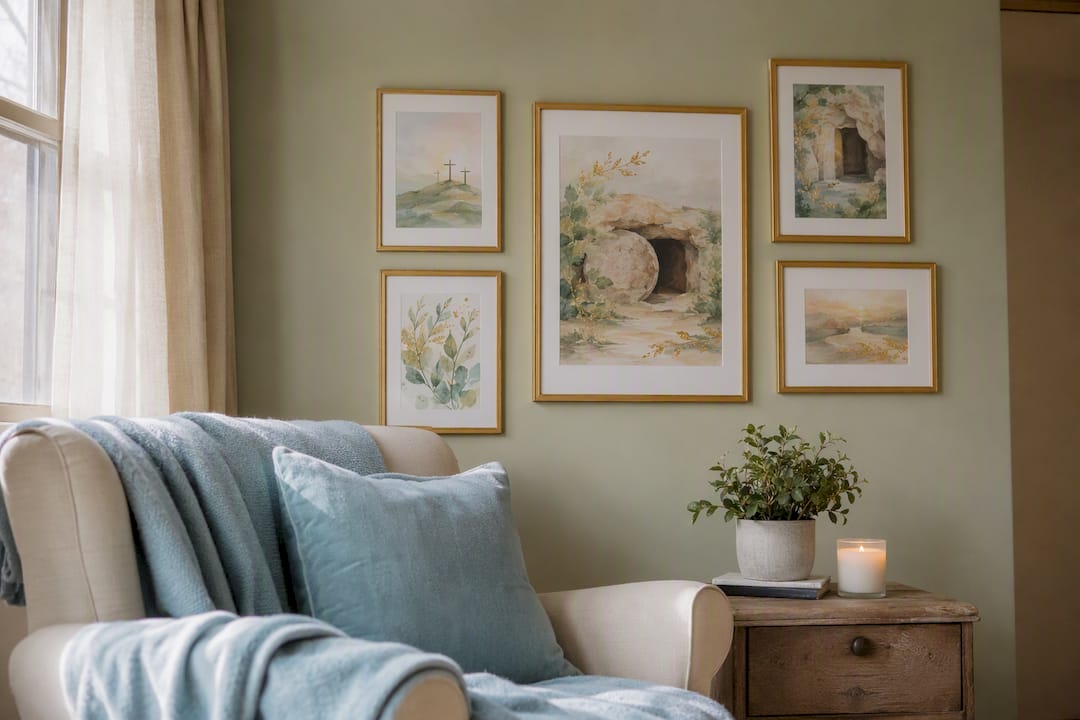
Gold leaf accents work particularly well on Resurrection and icon-style pieces, since gold has carried resurrection and divine-light symbolism in Christian art for centuries. If your existing decor leans neutral or modern farmhouse, a single gold-framed icon against cream walls reads as intentional rather than out of place.
For style, three broad lanes cover most homes: classical religious painting reproductions (rich color, traditional composition), icon-style flat perspective pieces (formal, gold-heavy, ideal for prayer corners), and modern minimalist devotional art (line drawings, muted palettes, simple typography). None is more theologically valid than another. The choice comes down to what your existing room supports and what actually draws your eye back day after day.
Blending Traditional and Modern Devotional Styles
You don’t have to pick one lane. A gallery wall that mixes a classical Sacred Heart reproduction with a minimalist line-drawing cross and a modern typographic scripture print usually reads better than an all-matching set, since the variation keeps the eye moving without feeling chaotic. Divine Prints’ gallery wall layout guide covers spacing and grouping principles if you’re combining formats for the first time.
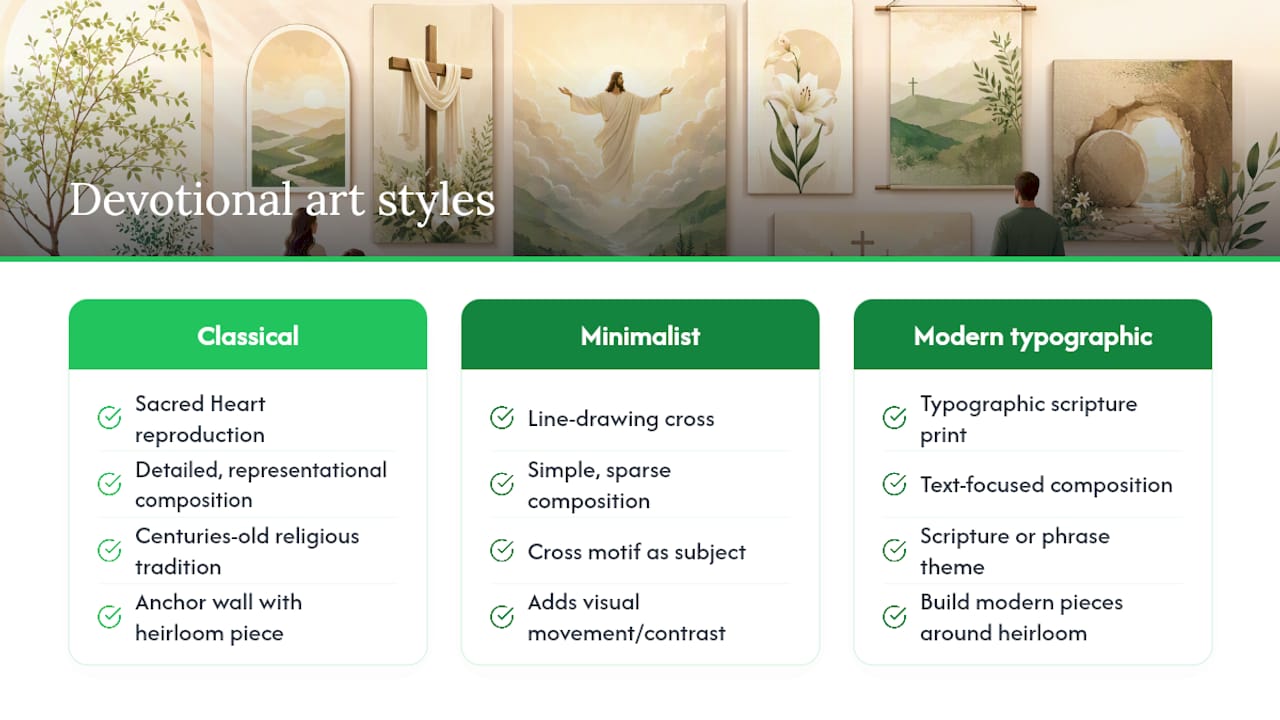
The trick is consistency in frame color or matting, even when the art styles differ. Black or natural wood frames across five different image styles unify the wall visually even though the underlying art spans centuries of tradition. If you’re starting with one traditional heirloom piece, a grandmother’s Sacred Heart print, for instance, build modern pieces around it rather than replacing it. That combination usually feels more personal than an entirely matched, single-style wall ever does.
Why Devotional Focus Beats Decorative Easter Art
Most seasonal guides treat Easter wall art as an extension of spring decorating: pastel eggs, bunny silhouettes, floral wreaths. That framing misses what actually matters for Christian households. The Resurrection is the central claim of the faith, not a backdrop for a color scheme, and the art you choose for it should reflect that weight.
The conventional advice to “match your existing decor” gets the order backward. Purpose should drive the choice, not the sofa fabric. A family that picks the empty tomb because it teaches their kids something true will get more out of it than one that picks a print because it matched the throw pillows.
What gets overlooked most often is display intention. People spend real money on a meaningful print, then hang it wherever there’s blank wall space, with harsh overhead light and no thought to sightline. The image itself rarely fails a household. The lack of intention around it does. Prioritize purpose first, placement second, and let style follow both rather than lead.
— Griffin
Bring the Idea Home With Divine Prints
Once you know the subject you want, whether it’s the empty tomb, a patron saint, or a Sacred Heart image for a prayer corner, Divine Prints turns that decision into a physical piece without the guesswork of framing and sourcing it yourself. The catalog runs deep on both fronts: the Saints collection for patronage-specific gifts and the Biblical Events collection for Resurrection and Gospel-scene pieces suited to Easter displays.

Product pages like The Sacred Heart of Jesus and The Transfiguration of Jesus show sizing and framing choices upfront, so you can match a print to a specific wall before ordering. Most pieces ship framed or unframed, with gift packaging available for Confirmation and First Communion timing. Check the sizing chart against your wall measurement, pick a frame finish, and place the order with enough lead time before Easter Sunday or a sacramental date.
Sources
- Resurrection of Jesus in Christian art — Wikipedia
- Creating a Catholic Prayer Room: Sacred Art That Transforms Your Space - Restored Traditions
- Lent + Easter Artwork for Churches and Ministries — Sacred Ordinary Days