

Our Lady of Guadalupe is the title given to the Virgin Mary following her reported 1531 apparitions to Juan Diego, an Indigenous convert, on Tepeyac Hill outside Mexico City. The image left on his tilma became a symbol of Mary as mother and intercessor bridging Indigenous and Christian worlds. Today she stands as patroness of the Americas and the single most recognizable emblem of Mexican identity.
TL;DR:
- The rapid spread of Guadalupe devotion was driven by her image’s cross-cultural symbolism, especially the pregnancy sign, which resonated instantly with Nahua viewers.
- The tilma image’s layered symbolism combines Aztec cosmology and Christian typology, making her both a maternal figure and a divine messenger for Indigenous and Spanish communities.
- The devotion became a key national symbol during Mexico’s independence movement and later in labor and civil rights struggles, blending religious reverence with cultural identity.
- Pilgrimages to the basilica attract 12 to 15 million visitors annually, with many leaving ex-votos and prayers for health, safety, and family protection.
- Engaging with Guadalupe devotion respectfully involves simple prayers, creating a personal altar, and understanding her Indigenous roots as part of her ongoing cultural and spiritual significance.
Table of Contents
- The History Behind Our Lady of Guadalupe’s Meaning
- The Symbolism Woven Into the Guadalupe Image
- What Our Lady of Guadalupe Represents Theologically
- Why Our Lady of Guadalupe Became a National Symbol
- How the Feast of Our Lady of Guadalupe Is Celebrated
- The Basilica of Our Lady of Guadalupe and Its Pilgrimage Tradition
- What Historians Debate About Guadalupe’s Origins
- Practicing Guadalupe Devotion With Respect
- Why This Image Still Speaks Across Cultures
- Bring the Meaning of Guadalupe Into Your Home
- Sources
The History Behind Our Lady of Guadalupe’s Meaning
The story unfolds over four days in December 1531, and the details matter because they explain almost everything about how the image later got read. Juan Diego, a widowed Indigenous laborer and recent convert to Christianity, was walking near Tepeyac Hill on the outskirts of what is now Mexico City when he reported the first encounter with a young woman surrounded by light.
- December 9, 1531: Juan Diego encounters the woman, who identifies herself and asks him to request a church be built on the site.
- December 10: The local bishop, Juan de Zumárraga, doubts the account and asks for proof.
- December 12: Juan Diego returns to Tepeyac, gathers flowers as instructed, and the image is later said to have appeared on the fabric of his tilma when he opened it before the bishop.
Tepeyac Hill was not a random location. It had long been a site associated with Tonantzin, an epithet meaning “our mother,” tied to Indigenous mother-goddess veneration in the region. That overlap between an existing sacred site and a new Marian apparition is one of the most-debated details in the whole story, and it shows up again later in the article’s look at scholarly interpretation.
Juan Diego himself, later canonized as Saint Juan Diego Cuauhtlatoatzin, became central to the narrative not just as a witness but as the human link between two religious worlds. He was a Nahua man, not a Spanish colonist, and that detail shaped how the story spread.
The primary textual source for the apparition narrative is the Nican Mopohua, a Nahuatl-language account whose title translates roughly to “here it is told.” Scholars generally date its composition to sometime in the mid to late 1500s, decades after the reported events, and its authorship is traditionally linked to Antonio Valeriano, though that attribution is contested. Early printed accounts followed in the centuries after, cementing the chronology into what became the standard devotional narrative.
Church recognition came gradually rather than all at once. Devotion grew organically through the 1500s and 1600s, formal ecclesiastical recognition of the shrine followed, and Pope Benedict XIV declared Our Lady of Guadalupe patroness of New Spain in 1754. Recognition expanded over the following two centuries until she was proclaimed patroness of the Americas, a title that reflects how far the devotion traveled beyond its original Mexican context.
What is worth sitting with here is how fast the devotion took root compared to typical Marian apparitions in that era. Within a generation, a local hillside shrine had become a pilgrimage destination drawing Indigenous and Spanish worshippers alike, something historical scholarship attributes largely to how the image itself communicated across the cultural divide, a point the next section unpacks in detail.
The Symbolism Woven Into the Guadalupe Image
The tilma image rewards close looking, because almost nothing on it is decorative. Every element carries a layer of meaning, and in most cases it carries two, one legible to a Spanish Catholic eye and another legible to a Nahua one.
Here is what appears on the image and what each piece was understood to communicate:
- The turquoise mantle. Turquoise was a color reserved for Aztec royalty and divinity, so a mantle in that shade signaled the woman’s high status to Nahua viewers immediately, while Spanish viewers read blue as a traditional Marian color.
- The stars scattered across the mantle. Some scholars connect the star placement to constellations visible over central Mexico around the winter solstice of 1531, layering Nahua cosmology onto a garment that also echoes the “Woman clothed with the sun” imagery from the Book of Revelation.
- The floral tunic. The flowers on her rose colored garment include a four-petaled blossom resembling the Nahui Ollin, an Aztec symbol tied to movement, the sun, and cosmic order, positioned directly over her womb.
- The black sash tied high at the waist. This was the customary Aztec sign that a woman was pregnant, and its placement is one of the most direct pieces of evidence for reading the image as a pregnant woman rather than a generic Marian portrait.
- The sun rays surrounding her figure. They evoke both the Christian “Woman of Revelation” clothed in the sun and the Aztec solar deity Huitzilopochtli, effectively placing her above or equal to the sun god Indigenous viewers already revered.
- The crescent moon beneath her feet. For Christian viewers this recalls the Immaculate Conception imagery of Mary standing above the moon; for Nahua viewers it evokes the moon god Tecciztecatl, again positioning her as greater than an existing deity.
- The angel supporting her. The winged figure beneath her feet has feathers resembling an eagle, tying into Aztec eagle symbolism associated with the divine and the founding of Tenochtitlan.
- Her downward, gentle gaze. Unlike triumphant or combative Marian imagery common in Spanish art of the period, her expression is calm and humble, closer to an approachable mother than a distant queen.
That last point explains a great deal about why the devotion spread as fast as it did. A queen demands homage. A mother invites approach. Britannica’s overview of the image notes this combination of European and Aztec symbolism was central to how the image took hold in colonial religious life, and that dual legibility is the whole reason the tilma became something more than a regional curiosity.
Pro Tip: If you want to understand the image quickly, look at where your eye lands first. Most people’s eyes go to the sash at the waist. That single detail, the pregnancy sign, is the one Nahua viewers would have caught instantly and Spanish viewers likely missed for generations, which tells you a lot about whose eyes the image was really speaking to.
None of this was accidental layering added by later devotion. The historical argument is that the visual language intentionally combined Nahua cosmology with Christian typology, functioning simultaneously as a teaching tool for new converts and as a recognizable maternal figure for people whose religious vocabulary was still Indigenous. That dual function is why art historians still study this single image more intensively than almost any other Marian apparition depiction in the Americas.
What Our Lady of Guadalupe Represents Theologically
Strip away the visual complexity and the theological claim underneath Guadalupe devotion is fairly direct: Mary appears as mother and intercessor, present to the poor and the marginalized without requiring formal status or education to approach her.
The pregnancy symbolism carries specific theological weight beyond a general nod to motherhood. A pregnant Mary is Mary in the act of bringing Christ into the world, which connects the image to the Incarnation itself rather than to an abstract idea of maternal comfort. That reading also links the image to Revelation 12’s “woman clothed with the sun,” a passage long associated in Catholic tradition with both the Church and Mary’s role bearing Christ into a hostile world. The sun rays and crescent moon on the tilma echo that same passage almost point for point, which is part of why theologians treat the image as more than a devotional portrait.
In parish life, priests and lay ministers lean on Guadalupe imagery for several recurring pastoral purposes:
- Framing Mary as approachable to people who feel distant from institutional Church life, particularly recent immigrants and the working poor.
- Teaching the Incarnation and Mary’s role in it through a visual image rather than abstract doctrine.
- Anchoring December devotions and novenas that build community participation ahead of Christmas.
- Offering a maternal, non-threatening entry point for catechesis with children and new converts.
- Connecting the theme of intercession, Mary carrying prayers to Christ, to the lived experience of people who feel unheard elsewhere.
Devotional emphasis has always leaned toward mercy over judgment. The traditional account has the apparition specifically directed at an Indigenous man of low social standing rather than a bishop or nobleman, and that detail is not incidental to how the devotion developed. It became, and remains, a devotion associated with protection of the poor, comfort in illness, and refuge for people navigating displacement, themes that resonate directly with how motherhood devotions function more broadly in Catholic practice.
Why Our Lady of Guadalupe Became a National Symbol
Guadalupe devotion did not stay confined to churches for long. Within a few centuries the image had migrated into flags, murals, protest banners, and government buildings, carrying a civic weight most Marian devotions never acquire.
The shift started during Mexico’s independence movement in the early 1800s, when Miguel Hidalgo reportedly carried a Guadalupe banner during the uprising against Spanish rule. That single choice mattered enormously: it associated the image with Mexican self-determination rather than colonial religious authority, a strange twist for an image originally used partly to convert Indigenous populations to the colonizers’ faith. Nation-building efforts in the following century leaned on that same association, turning Guadalupe into shorthand for Mexican identity itself rather than one religious devotion among many.
The pattern repeated in the 20th century. Cesar Chavez carried Guadalupe imagery during United Farm Workers marches in the United States, deliberately invoking her as a symbol of dignity for laborers rather than purely as a devotional figure. That choice folded Guadalupe into labor organizing and civil rights movements far from her original geographic context, and it stuck.
A few patterns show how far the symbolism traveled beyond the sanctuary:
- Murals of Guadalupe appear across Mexican and Mexican-American neighborhoods, often blending devotional imagery with civic or activist themes.
- Her image appears in government buildings and public installations in Mexico, treated as a civic emblem alongside religious use, something AP reporting on the image’s dual role has documented directly.
- Chicano art movements in the United States reworked her image repeatedly, sometimes recasting her as a warrior or activist figure rather than a passive devotional subject.
- Tattoos, lowrider art, and streetwear carry her image as an assertion of cultural belonging, independent of how observant the wearer is.
For Mexican-American communities specifically, the image does double duty that few other religious symbols manage. It functions as devotional practice tying people to Catholic tradition, and it functions as a marker of cultural continuity for families navigating identity across a border. Scholarship on Guadalupe in Mexican-American contexts describes this reinterpretation through art and activism as both preserving her devotional role and recasting her as a symbol of dignity and social justice at the same time.
How the Feast of Our Lady of Guadalupe Is Celebrated
December 12 is the day the entire devotional calendar built around Guadalupe centers on. It is treated in much of Mexico with the weight of a major national holiday rather than a routine feast day.
- Attend or organize a novena. The nine days leading up to December 12 traditionally include prayers, hymns, and gathered reflection, often rotating between family homes or parish halls.
- Join or watch a pilgrimage procession. Communities organize walking pilgrimages to local shrines or, for those near Mexico City, to the Basilica itself, sometimes covering significant distances on foot as an act of devotion.
- Sing the traditional mañanitas. Early morning on December 12, communities gather to sing birthday-style songs to the Virgin, a tradition that blends folk celebration with liturgical observance.
- Set up a home altar or ex-voto display. Families often place flowers, candles, and small painted or written offerings of thanks near an image of Guadalupe during the feast period.
- Share a communal meal. Tamales are the traditional food associated with the feast in many Mexican households, tied to the timing near the winter harvest season.
If you are attending a celebration for the first time, dress modestly, follow the lead of parish organizers on procession etiquette, and understand that for many participants this is as much a cultural homecoming as a liturgical event. The shrine’s own account of the devotion’s development notes how firmly the feast became embedded in community life well beyond formal church settings, which is exactly why outsiders should approach it with some care rather than treating it as generic Marian devotion.
The Basilica of Our Lady of Guadalupe and Its Pilgrimage Tradition
The Basilica of Our Lady of Guadalupe in Mexico City is built on the original Tepeyac site and functions as the devotion’s global headquarters. The original tilma, still displayed behind protective glass above the main altar, remains the object every pilgrim ultimately travels to see.
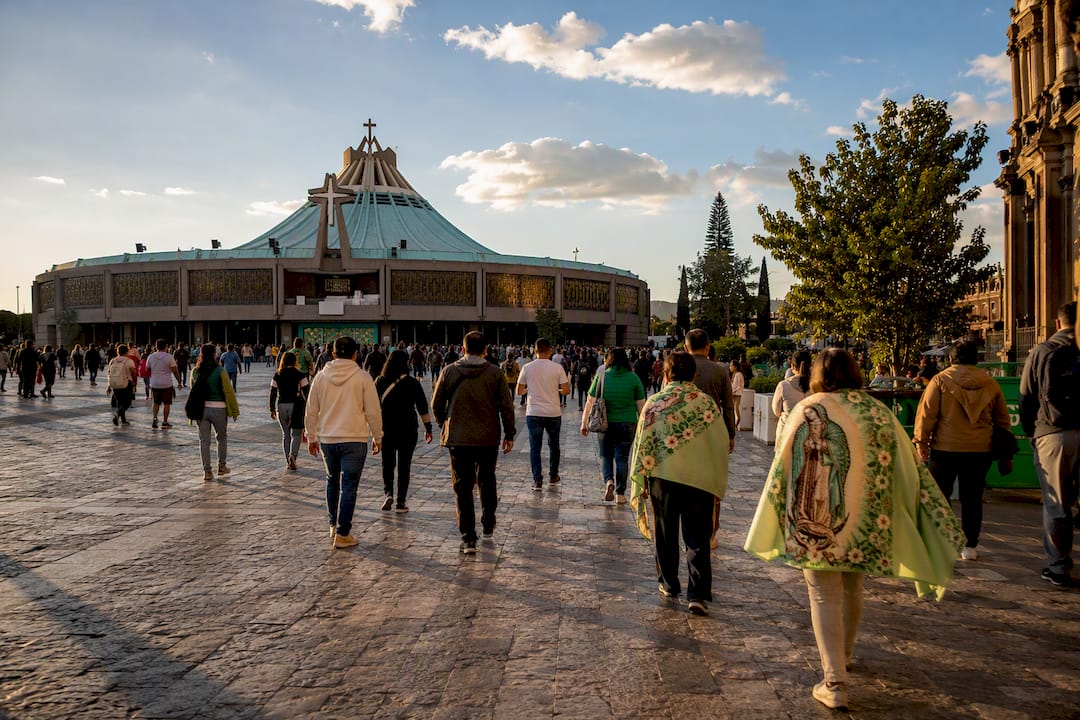
The scale here is genuinely hard to picture. The basilica draws roughly 12 to 15 million visitors annually for pilgrimages and the December feast, putting it among the most visited Catholic pilgrimage sites anywhere in the world, ranking alongside destinations like Vatican City in raw annual footfall.
Pilgrims typically arrive carrying specific intentions rather than general devotion:
- Candles and small votive offerings left in dedicated chapels near the main basilica.
- Ex-votos, small painted or written testimonials of a favor received, often describing healing from illness or safe passage through hardship.
- Requests tied to family health, safe immigration journeys, and protection for children.
- Thanksgiving visits made specifically to fulfill a vow made during a previous crisis.
The tilma itself is preserved under climate-controlled glass, moved on a mechanized walkway beneath it so pilgrims can view the image without disrupting the flow of the enormous crowds that pass through daily. That logistical detail says something on its own: an image nearly five centuries old still draws crowds large enough to require a moving walkway just to keep the line functional.
What Historians Debate About Guadalupe’s Origins
Not every account of Guadalupe gets equal treatment from historians, and the honest version of this story includes real scholarly disagreement rather than settled consensus.
- Dating the Nican Mopohua remains contested. Because the earliest surviving copies date decades after the reported 1531 events, some historians question how much of the narrative reflects the original oral tradition versus later theological shaping.
- The Tonantzin connection splits scholars into two camps. Some read the shared site at Tepeyac as evidence of deliberate syncretism, Christian missionaries adapting an existing Indigenous devotion to speed conversion; others argue it reflects genuine continuity of Indigenous reverence for a mother figure that simply found a new expression.
- Political use of the image draws separate scrutiny. Historians note that Guadalupe has been invoked by opposing sides of the same conflicts, colonial authorities and independence fighters, conservative clergy and labor activists, which complicates any simple reading of what she “stands for” politically.
- Miracle claims get treated with particular caution. Academic historians generally distinguish between the devotional tradition, which they document as a real and significant cultural phenomenon, and the historicity of specific miraculous claims, which they treat as matters of faith rather than verifiable history.
Scholarship on Guadalupe’s role as a Mexican national symbol generally treats these debates as evidence of the devotion’s depth rather than a reason to dismiss it, since few religious images anywhere have generated this much sustained academic attention across five centuries.
Practicing Guadalupe Devotion With Respect
Engaging with Guadalupe devotion, whether you come from a Mexican Catholic background or are approaching it as an outsider, works best when it stays rooted in the same humility the story itself centers on.
A few practical starting points:
- Learn a short traditional prayer or novena rather than improvising devotional language that misreads the tradition’s specific imagery.
- Set up a devotional corner with an image of Guadalupe, a candle, and space for quiet prayer rather than treating the image as decoration alone.
- Join a parish novena or feast day procession if one is available near you, rather than observing only privately.
- Support charitable meal sharing or almsgiving tied to the feast, echoing the devotion’s historical association with the poor.
- If you are not from a Mexican or Mexican-American background, approach the Indigenous roots of the story, especially the Tonantzin connection, as history to learn rather than an idea to appropriate casually.
Pro Tip: A home altar does not need to be elaborate to be meaningful. A single well-made image, a candle, and five quiet minutes a day will teach you more about why this devotion has lasted five centuries than reading about it ever will.
Why This Image Still Speaks Across Cultures
What strikes me most about Guadalupe is how badly the simple explanations fail her. She is not just a conversion tool, not just a nationalist symbol, not just a folk devotion. She is all three at once, and the image was built to carry that weight from the start, which is rare for any religious icon to sustain across five centuries without collapsing into just one meaning.
The pregnancy sash gets overlooked by casual observers, yet it is the detail that turns her from a distant queen into a mother in the act of bringing life into a broken world. That is the meaning that outlasts the politics and the academic debates. Devotional art exists to keep that meaning present in daily life, in a home, a bedroom, a prayer corner, long after the history lesson fades, much like the striking examples found in Photographie de Culte | Chase Fine Art that showcase worship and devotional imagery with museum-quality presentation.
— Griffin
Bring the Meaning of Guadalupe Into Your Home
A framed image does something a phone screen or a passing thought cannot: it keeps devotion physically present in the rooms where you actually live. Divineprints makes that possible with museum-grade prints and canvases of Guadalupe-adjacent saints and Marian imagery, printed to hold their color and detail for years rather than fading like a poster.
The Saints collection covers patron saints, Marian devotions, and holy figures suited to a home altar, a Confirmation gift, or a parish gift shop shelf. Pieces like The Sacred Heart of Jesus and The Transfiguration of Jesus show the same print quality and framing options across the catalog, whether you want something for a bedroom prayer corner or a gift for a First Communion. Browse the Saints collection now and pick a piece that fits the space where your own devotion happens.