

Choose fine-art paper when precision, fine text, or a framed presentation matter most. Choose canvas when texture, low glare, and ready-to-hang convenience matter more than pixel-level detail. Paper wins on sharpness and archival control; canvas wins on scale, mood, and ease of display.
TL;DR:
- Fine-art paper provides sharper detail and better archival stability, especially for images with fine text or intricate linework, but requires framing and brightness control.
- Canvas offers a textured, low-glare surface ideal for large, atmospheric scenes and ready-to-hang displays, with less sensitivity to lighting conditions.
- The durability of paper depends on proper framing, glazing, and environmental control, while canvas longevity relies on coating quality and fiber type, requiring careful handling and conservation.
- Size and viewing distance influence material choice: detailed works or small inscriptions benefit from paper, whereas large, sweeping images are better on canvas.
- Finished, framed, and protected prints should be compared to each other, as cost and presentation depend on mounting, framing, and finishing choices beyond raw materials.
Table of Contents
- Paper vs Canvas: Comparing the Attributes That Actually Matter
- How Paper and Canvas Are Built (and Why It Changes the Look)
- What Actually Threatens Paper and Canvas Over Time
- Matching the Material to the Project
- Comparing Finished Products, Not Raw Materials
- Handling, Shipping, and Display Care
- Choosing for Devotional Art: What Divineprints Recommends
- A Quick Checklist Before You Order
- Bring Your Chosen Format Home
- Sources
- FAQ
Paper vs Canvas: Comparing the Attributes That Actually Matter
The “which is better, canvas or paper” question has no universal winner. It depends on what the image needs to do on your wall.
Appearance and texture. Paper has a flat, smooth surface (or a subtle cotton texture on rag stock) that renders images the way they were designed. Canvas has a visible weave that reads almost like brushwork, which flatters paintings and atmospheric scenes but can compete with crisp lines.
Detail fidelity. Fine text, hairline crosshatching, and delicate facial features hold up better on paper because there’s no fiber texture interrupting the ink. This is where the canvas print vs paper print debate gets practical fast: a saint’s face rendered in fine linework can blur slightly into a canvas weave at close range.
Glare and lighting. Canvas, especially with a matte varnish, handles bright rooms and overhead lighting better than glazed paper, which can throw reflections under strong light.
Handling and shipping. Stretched canvas arrives ready to hang and tolerates minor bumps. Paper needs a mat, backing, and glazing to reach the same durability, but travels flat or rolled with less bulk.
- Paper: sharper detail, needs framing, slight glare risk unframed
- Canvas: textured look, low glare, ships ready to hang
- Both: final quality depends on finishing, not just the substrate
How Paper and Canvas Are Built (and Why It Changes the Look)
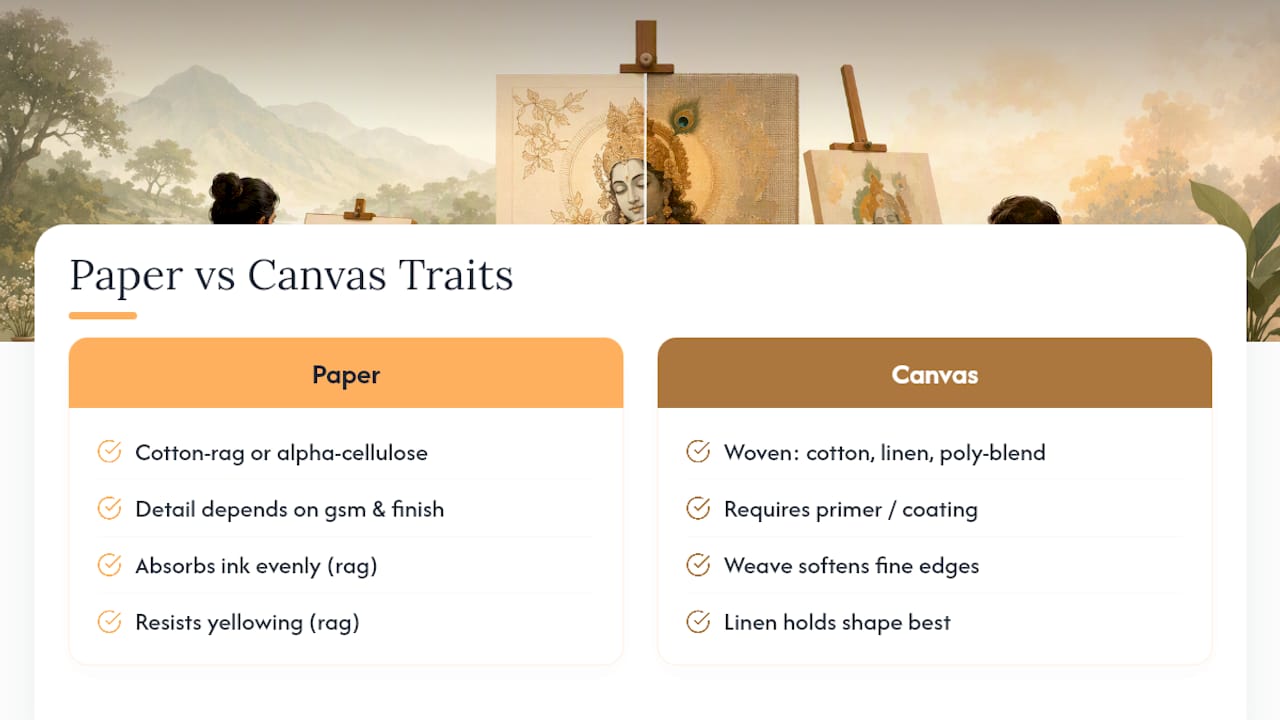
Paper for fine art usually falls into two families: cotton rag and alpha-cellulose. Cotton rag has longer fibers, absorbs ink more evenly, and resists yellowing. Alpha-cellulose is wood-pulp based, more affordable, and slightly less stable over decades. Weight (measured in gsm) and finish (matte, luster, or textured) change how much detail the surface can hold.
Canvas is a woven textile, most often cotton, linen, or a poly-cotton blend, and it is a fundamentally different support material from paper, not a variant of it, according to conservation research published in npj Heritage Science. Linen holds its shape better over time than cotton. Whatever the fiber, canvas needs a primer or inkjet-receptive coating before it can take ink or paint cleanly, and that coating, along with the weave itself, is what softens fine edges and adds the sense of scale collectors associate with oil paintings.
Pro Tip: If your image has text or fine linework smaller than a quarter inch, ask for a cropped proof at full size before deciding between fine art paper vs canvas. What looks fine in a thumbnail can soften once it hits a woven surface.
What Actually Threatens Paper and Canvas Over Time
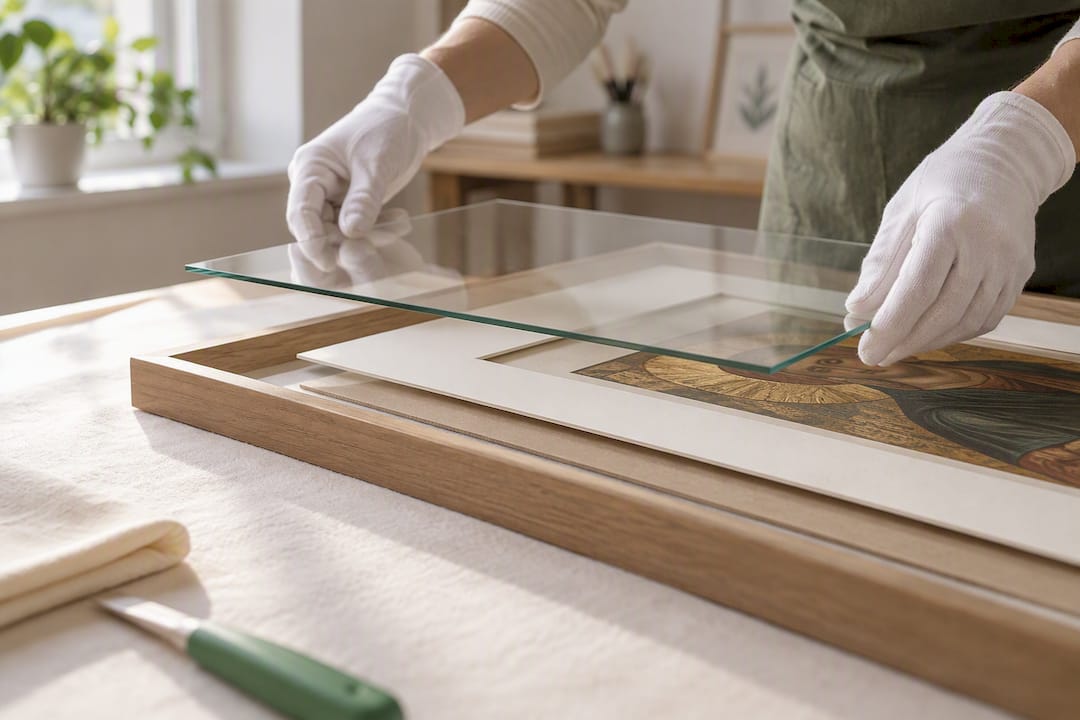
Paper’s enemies are light, humidity, and mechanical stress: fading, yellowing, and embrittlement top the list when it’s displayed without protection, according to the Library of Congress. The fix is straightforward. Acid-free mats, backing board, and controlled glazing turn a fragile sheet into a display piece that can last generations. Framed paper, done right, regularly outlasts a poorly finished canvas.
Canvas faces different risks: sagging over time, tears from impact, and coatings that degrade if the print wasn’t properly varnished after production. Correct outgassing and vacuum settings during printing affect how well the surface holds up years later, per inkjet-receptive canvas manuals. Scholarly conservation work on canvas lining and stabilization treatments confirms that “canvas” isn’t one material with one lifespan. It’s a category where fiber choice, priming, and finishing decide the outcome, as detailed in research on canvas support stabilization.
When a piece carries real sentimental or historical weight, a conservator can advise on treatment before damage sets in rather than after.
Matching the Material to the Project
Different projects favor different substrates, and viewing distance matters as much as subject matter.
- Photography and fine-detail portraits. Paper preserves sharp edges, subtle tonal gradations, and skin detail that canvas texture can obscure.
- Saint portraits with inscriptions or small text. Choose paper. Names, prayers, or scripture verses under an inch tall need a smooth surface to stay legible.
- Large devotional scenes and atmospheric landscapes. Canvas adds depth and a painterly quality that suits sweeping compositions viewed from a few feet away.
- Ready-to-hang pieces for busy rooms. Canvas skips the frame entirely and handles glare from windows or overhead lighting.
As a rule of thumb: the closer someone will stand and the smaller the finest detail, the stronger the case for paper. The larger the piece and the more it’s meant to be seen across a room, the stronger the case for canvas.
Comparing Finished Products, Not Raw Materials
It’s a mistake to compare a bare sheet of paper to a finished, gallery-wrapped canvas. The honest comparison is a framed print, mat and glazing included, against a stretched canvas with its finish applied. That’s the real paper vs canvas prints cost conversation.
- A framed paper print adds mat board, acid-free backing, and glazing (or anti-glare glass) on top of the print cost.
- A canvas print adds stretcher bars, corner keys, and a protective varnish, but skips framing entirely.
- Anti-glare glazing costs more upfront but pays off in rooms with bright windows or gallery lighting.
- Canvas suits casual or ready-to-hang display; framed paper suits a more formal, gallery-style presentation.
Neither format is cheaper across the board. A large canvas with hardwood stretcher bars can cost as much as a modestly sized framed paper print, and a giclee print vs canvas comparison should always include the frame or finish, not just the print.
Handling, Shipping, and Display Care
Small habits protect either substrate for decades.
- Handle prints by the edges or with clean cotton gloves. Skin oils and creases are the most common preventable damage.
- Transport paper rolled in a rigid tube with acid-free tissue between layers, never folded.
- Ship stretched canvas flat or upright with corner protectors, since the frame edges are the most vulnerable point.
- Keep both away from direct sunlight and away from bathrooms or kitchens where humidity swings are frequent.
- Dust canvas gently with a dry, soft brush; never use liquid cleaners on either material without professional guidance.
Pro Tip: If a canvas arrives with a slightly loose stretch, don’t panic. Most framers can re-tension it in minutes with wedge keys built into the stretcher bars.
Choosing for Devotional Art: What Divineprints Recommends
For a small saint portrait meant for a nightstand, desk, or prayer corner, framed fine-art paper keeps facial detail and inscriptions crisp. For a large-scale altar piece or a sweeping biblical scene meant to anchor a living room or parish hall, gallery-wrapped canvas delivers the scale and texture the composition deserves.
- Small saint portraits with text or fine linework: paper, framed
- Large devotional scenes or altar pieces: canvas, gallery wrap
- Gift pieces for Confirmation or baptism: either, based on size and display space
Readers weighing specific pieces can find more guidance in this practical breakdown of canvas vs. paper for devotional art.
A Quick Checklist Before You Order
Answer three questions honestly: does the image have fine text or detail (favor paper)? Do you want visible texture and less glare (favor canvas)? Do you need it ready to hang with no framing (favor canvas)? Order a proof first and check edges, text, and skin tones up close before committing to a full run.
— Griffin
Bring Your Chosen Format Home
Prints are made to order on museum-quality matte fine art paper or durable canvas; orders carry a warranty against defects or fading, with worldwide shipping available. That means you get to make the paper vs canvas decision once, per piece, without worrying about whether the finish will hold up in ten years.
If a saint’s face or a scripture inscription needs to stay sharp, browse the Saint Prints collection and choose the paper option at checkout. If you’re picturing a large-scale devotional scene for a living room or parish hall, the Biblical Event Prints collection offers canvas sizing built for that kind of presence. For a Sacred Heart or Transfiguration piece meant to anchor a room, the Jesus Prints collection covers both formats. Pick your image, choose your substrate, and request framing advice at checkout if you’re not sure which way to go.
Sources
- Novel nanomaterials to stabilise the canvas support of paintings assessed from a conservator’s point of view | npj Heritage Science
- Collections care: The essentials | Library of Congress
- Inkjet Receptive Canvas – An overview
FAQ
Is Paper Considered a Canvas?
No. Paper is a pressed sheet of fibers, while canvas is a woven textile, most often cotton or linen, according to conservation research. They’re distinct support materials with different absorption, texture, and handling properties.
What Are the Two Main Types of Canvas?
The two most common fibers are cotton and linen, though poly-cotton blends are widely used for prints. Linen tends to hold its shape better over time, while cotton is more affordable and widely available for both painting and printing.
Are Canvas Prints Outdated?
No. Canvas remains a popular choice for large devotional scenes, landscapes, and ready-to-hang display because of its texture and low glare. It’s not outdated, it’s simply better suited to certain images than others, particularly large compositions viewed from a few feet away.
What Is Better, Canvas or Print?
That’s really a question of fine-art paper vs canvas, and it depends on the image. Paper wins for fine detail, text, and framed presentation; canvas wins for texture, scale, and glare-free, ready-to-hang display, and Divineprints offers both across its saint, Jesus, and biblical event collections.