

Saint Sebastian is the patron saint of athletes, and Catholic tradition has held that title for him longer than for any other figure. His feast day falls on January 20, and his association with sport grew out of how artists painted him: young, strong, and enduring arrows without flinching. Athletes who want other options also turn to Saint John Paul II, Blessed Pier Giorgio Frassati, Saint Christopher, and Saint Luigi Scrosoppi, each for different reasons rooted in their own lives.
TL;DR:
- Saint Sebastian is the most widely recognized patron saint of athletes, symbolized by endurance through suffering, beyond actual athletic achievements.
- Blessed Pier Giorgio Frassati’s real outdoor climbing and mountaineering make him a practical model for endurance athletes seeking spiritual and physical elevation.
- Saint John Paul II’s personal athletic background makes him a favored patron for teams and youth groups integrated into faith and sports.
- Athletes often pray simple intentions to their saints and use devotional objects like medals, prayer cards, and wall art as daily spiritual reminders.
- There is no official patron saint of female athletes; women often choose saints like Joan of Arc or Gianna Molla based on personal inspiration rather than formal church designations.
Table of Contents
- Notable Patron Saints for Athletes and Their Stories
- Why These Saints Are Linked to Sports and Endurance
- How Athletes Pray to Their Patron Saints Today
- How to Choose a Patron Saint for an Athlete
- Why Sacred Images Matter for an Athlete’s Daily Life
- Bring That Devotion Home With Saint Wall Art
- Sources
- FAQ
Notable Patron Saints for Athletes and Their Stories
Picking a patron saint isn’t like picking a mascot. Each of the names below carries a real biography, a feast day, and a reason athletes reach for that particular saint rather than another. Some earned the connection through symbolism. Others actually lived the athletic life they’re now associated with.
1. Saint Sebastian
Sebastian was a Roman soldier in the third century, executed for his Christian faith after Emperor Diocletian discovered he had been secretly aiding persecuted Christians. The famous account has him tied to a tree and shot with arrows, then surviving that ordeal only to be martyred later by clubbing. That survival, paired with centuries of Renaissance and later artwork depicting him as a muscular, youthful figure pierced but unbroken, built the visual shorthand that eventually got him named patron of athletes. His feast day is January 20, and he’s also patron of soldiers, archers, and plague victims. Athletes commonly carry Saint Sebastian medals, keep prayer cards in gym bags, or pray a short novena to him before a season starts.
2. Saint John Paul II
Before he became pope, Karol Wojtyla skied, hiked, kayaked, and played goalkeeper in soccer matches as a young man in Poland. That lived athleticism is part of why Catholic sports ministries and youth groups invoke him so readily. He also championed the idea that physical culture and faith formation aren’t separate tracks, a theme that shows up repeatedly in Catholic sports outreach today. Teams and school athletic programs that want a patron connected to actual sport, not just symbolic endurance, often land on him, reflecting the integration of faith and athletic discipline discussed in the Structured Fasting Athletic Lifestyle guide.
3. Blessed Pier Giorgio Frassati
Frassati is arguably the most athletically literal name on this list. He climbed mountains across the Italian Alps, often organizing group hikes that ended with Mass celebrated at the summit. The USCCB holds him up as a model for young people specifically because he integrated outdoor physical challenge with an active prayer life rather than treating them as competing priorities. His motto, “Verso L’Alto,” meaning “to the heights,” has become a rallying phrase at World Youth Day gatherings, where the climb up a mountain doubles as a metaphor for spiritual ascent. For athletes drawn to endurance sports, hiking, or mountaineering, Frassati resonates in a way Sebastian’s symbolic link doesn’t.
4. Saint Christopher
Christopher’s traditional patronage covers travelers, not athletes specifically, but the overlap is easy to see. Runners, cyclists, and anyone whose sport involves covering distance under physical strain have long adopted him informally, largely because his legend centers on carrying others across a river despite exhaustion and danger. He’s not the primary patron of athletes in any official sense, and it’s worth being direct about that distinction, but his medal remains one of the most common items found in gym bags and on car dashboards among athletic families.
5. Saint Luigi Scrosoppi
Scrosoppi is a more specific case. Catholic sports resources cite him as patron of soccer players and, by extension, stadium crowds. He founded a religious congregation dedicated to caring for orphans and the poor in 19th-century Italy, and his connection to soccer is a later devotional development rather than something from his own biography. For players and fans of the sport specifically, though, he fills a niche none of the others do.
Are there patron saints specifically named for female athletes? No single saint holds that official title. Some Catholic women athletes choose Saint Joan of Arc for her courage under pressure, or Saint Gianna Beretta Molla for her example of dedication under physical and moral strain, but these are personal devotional choices rather than a Church-designated patronage. The absence of one official female patron for athletes is itself worth noting, since it means the door stays open for a woman athlete to choose based on personal resonance rather than a fixed assignment.
Why These Saints Are Linked to Sports and Endurance
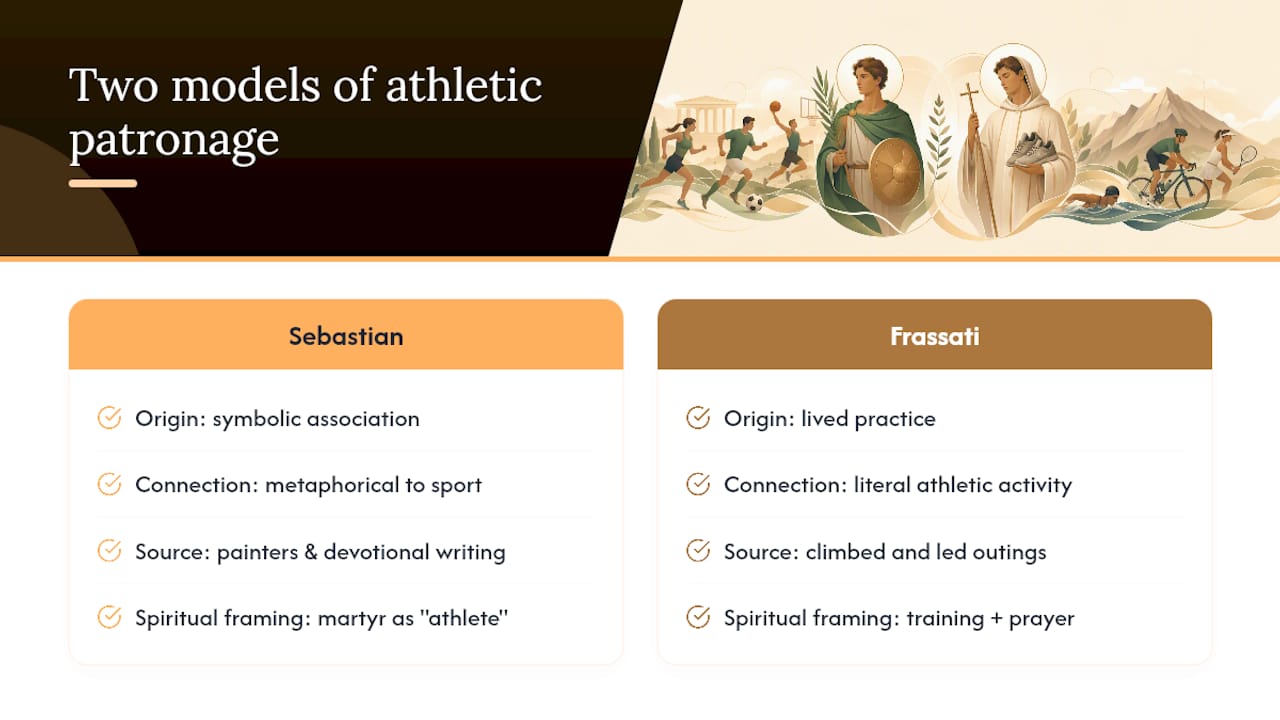
Sebastian’s connection to athletics isn’t a historical fact about his life. It’s a symbolic association that built up over centuries through art and devotional writing, and historians and Catholic commentators alike are clear that nothing in the earliest accounts of his martyrdom mentions sport. What it does mention is endurance: a man shot through with arrows who did not die from that wound. Painters ran with that image, and devotional culture followed the painters.
Scripture gives the broader tradition its vocabulary. Saint Paul repeatedly reached for athletic metaphors when describing the Christian life. He wrote about running a race to win a prize and fighting like a boxer who trains his body with discipline. Early Christian writers picked up that language and extended it, describing martyrs as “athletes of God,” men and women whose suffering was itself a kind of spiritual competition demanding stamina and discipline. That framework is exactly why a martyr like Sebastian could later become a patron of literal athletes: the metaphor Paul used for spiritual endurance got applied backward onto physical endurance.
Frassati represents the opposite path to patronage. There’s no metaphor required to connect him to athletes, because he actually climbed mountains and organized the outings himself. That contrast matters for anyone choosing between the two models: Sebastian offers a symbol of enduring pain without breaking, while Frassati offers a working example of someone who trained his body and called it part of his spiritual life. Neither approach is more legitimate than the other in Catholic tradition, but they answer different needs.
How Athletes Pray to Their Patron Saints Today
Devotion doesn’t require anything elaborate. Most athletes who adopt a patron saint build a small, repeatable habit around that saint’s memory rather than treating it as a one-time gesture.
A common Saint Sebastian prayer used before competition reads roughly: “Saint Sebastian, who withstood every arrow and stayed faithful to Christ, grant me the strength to endure hardship in my training and my life, and the courage to compete with honesty and grace.” Athletes devoted to Frassati often pray simple lines invoking his “Verso L’Alto” motto before a race or a climb, asking for the same union of physical effort and spiritual focus he modeled. Those drawn to John Paul II sometimes use his own writings on sport and youth as informal meditation before games.
Beyond prayers, the devotional objects athletes lean on are consistent across saints:
- Small medals worn on a chain or pinned inside a gym bag
- Prayer cards kept in a locker or a car
- Rosaries carried to tournaments, even by athletes who aren’t daily rosary-prayers otherwise
- Framed images placed in a home training space or a team locker room
Ministries have formalized some of this. Catholic Athletes for Christ works directly with professional and Olympic athletes to build faith practices into training life, and World Youth Day gatherings regularly lean on Frassati’s mountaineering legacy to connect physical challenge with spiritual growth for thousands of young pilgrims.
Statistic Callout: National Catholic Reporter’s coverage around the Rio Olympics noted that Sebastian’s endurance under suffering, not any documented athletic career, is what continues to draw Olympic and professional athletes to invoke him before competition. Ministries that work with athletes are careful to frame this as encouragement toward virtues like perseverance and humility, not a promise of victory.
How to Choose a Patron Saint for an Athlete
Start with the athlete’s own story, not the saint’s résumé. A sprinter drawn to endurance-under-suffering will connect differently with Sebastian than a trail runner who wants a saint who actually laced up boots and climbed something.
- Look for a life detail that mirrors the athlete’s own experience. Injury recovery, competitive pressure, or a love of the outdoors can all point toward a specific saint.
- Try a season-long devotion before committing. A short novena or a feast-day practice is enough to test whether the connection feels real before adopting a saint for life.
- Make it official with a small ritual. A blessed medal given at the start of a season, a team prayer before games, or a framed image in a shared training space turns a private devotion into something a family or team can share.
Ask whether the saint’s core virtue, endurance, discipline, humility, is one the athlete actually wants to grow in, not just admire from a distance. The biggest red flag is choosing a saint purely because the artwork looks striking, with no attention to whether that saint’s story maps onto the athlete’s own struggles or goals.
Pro Tip: Pick a saint whose defining virtue matches a habit you’re already trying to build, like Frassati’s discipline for early morning training runs, so the devotion reinforces something you’re doing anyway instead of sitting separate from your routine.
Why Sacred Images Matter for an Athlete’s Daily Life
A saint’s story only shapes you if you keep running into it. That’s the whole logic behind hanging a devotional image where an athlete actually spends time, a bedroom wall, a locker, a home gym, rather than leaving that connection to memory alone. Divine Prints exists because faith needs physical reminders, not just good intentions.
An athlete who prays to Frassati before a climb or keeps Sebastian’s story in mind before a meet benefits from seeing that saint’s image regularly, not just recalling a name from a homily months ago. Consider how a devotional print might sit alongside an athlete’s training gear as a quiet, constant reminder that discipline and faith were never meant to run on separate tracks.
— Griffin
Bring That Devotion Home With Saint Wall Art
A medal in a gym bag is easy to lose. A framed print on a bedroom wall or a locker isn’t going anywhere, and that permanence is exactly what makes it a stronger daily reminder than a prayer card that gets buried under gear.

The site offers fine art prints and canvases of Saint Sebastian and other patrons athletes turn to, available in multiple sizes and framing options so the piece fits a locker room wall as easily as a bedroom or a parish athletic office. These make natural Confirmation gifts for young athletes heading into a new season, team presents before a tournament, or simply a steady visual anchor in a home training space. If you’re weighing which saint fits your athlete best, these five steps for choosing a lasting patron can help narrow it down before you commit to a print. Browse the full Saint Prints collection to find a piece that matches the devotion you’re building, whether that’s Sebastian’s endurance or Frassati’s climb toward the heights.
Sources
- Saint Sebastian
- Saint Pier Giorgio Frassati | USCCB
- St. Sebastian: patron saint of Rio and athletes everywhere | National Catholic Reporter
- Athletic imagery in the New Testament letters | Bible Odyssey
FAQ
Is there a patron saint of athletes?
Yes. Saint Sebastian holds that title most widely, with his feast day on January 20, though Saint John Paul II, Blessed Pier Giorgio Frassati, Saint Christopher, and Saint Luigi Scrosoppi are also commonly invoked depending on the sport or the athlete’s personal story.
Is Saint Christopher the patron saint of athletes?
Not officially. Christopher is traditionally the patron of travelers, and runners and cyclists have informally adopted him because of the physical endurance in his legend, but Sebastian holds the primary title for athletes overall.
What is the Saint Sebastian prayer for athletes?
A common version asks Sebastian, who withstood every arrow while staying faithful to Christ, to grant strength to endure hardship in training and the courage to compete with honesty and grace.
Who is the patron saint of female athletes?
There is no single, officially designated patron saint for female athletes. Some Catholic women in sport choose Saint Joan of Arc or Saint Gianna Beretta Molla based on personal resonance with their courage and dedication, rather than a fixed Church assignment.