

St. Joseph is the patron saint of fathers, honored by the Catholic Church for his quiet, faithful care of Jesus and Mary as head of the Holy Family. Pope Francis’ 2020 letter Patris Corde reinforced this patronage, reminding the Church that fathers “are not born, but made.” A short list of other saints and a handful of practical prayers follow below.
TL;DR:
- Fathers can find inspiration in St. Joseph’s quiet, decisive actions, such as risking social risk for marriage and protecting Jesus from Herod.
- Saintly patrons for fathers include Sts. Joachim and Anne for passing faith, St. Louis Martin for family devotion, and St. John Bosco for guiding teens.
- A simple daily routine involving a brief invocation, specific intention, and evening offering can build a consistent prayer to St. Joseph.
- Choosing a patron based on personal life circumstances or proximity to their feast day helps establish a meaningful devotion.
- Physical reminders like saint prints or icons in visible spots reinforce prayer habits better than digital notifications or superstitions.
Table of Contents
- Who Is St. Joseph and Why Fathers Turn to Him
- Other Saints Fathers Commonly Invoke
- Prayers and Devotions Fathers Can Use Today
- How to Choose a Patron and Start a Simple Devotion
- Common Misconceptions and Cautions
- Why a Visible Reminder Changes a Prayer Habit
- Bring St. Joseph Into Your Home With a Devotional Print
- Sources
- FAQ
Who Is St. Joseph and Why Fathers Turn to Him
Scripture gives St. Joseph almost no dialogue. He never speaks a recorded word in the Gospels, yet he acts decisively every time it matters. He marries Mary despite social risk, moves his family to Egypt overnight to protect an infant from Herod, and raises Jesus in the trade of carpentry. Parish resources describe him as a model of faithful, quiet servant leadership, the kind of care that shows up in decisions rather than speeches.
That pattern is exactly why fathers gravitate toward him. He is not a warrior-saint or a scholar-saint. He is a working man trusted with the two most important people in salvation history, and he does the job without complaint or credit.
His formal patronages stretch well beyond fatherhood. According to the Year of St. Joseph patronage list, he is also invoked for:
- Families and married couples
- Workers, especially tradesmen and laborers
- A happy and peaceful death
- The universal Church itself, a title Pope Pius IX declared in 1870
Pope Francis made the connection to modern fatherhood explicit. In Patris Corde, he writes that being a father means introducing a child “to life and reality” rather than holding onto them, and that fatherhood is proven through daily, often invisible acts of care. That single phrase, fathers are “not born, but made,” has become a go-to line for priests counseling adoptive fathers, stepfathers, and foster fathers who worry that a biological tie is what defines the role. Joseph’s own story argues otherwise: he wasn’t Jesus’ biological father, and the Church holds him up as the model father anyway.
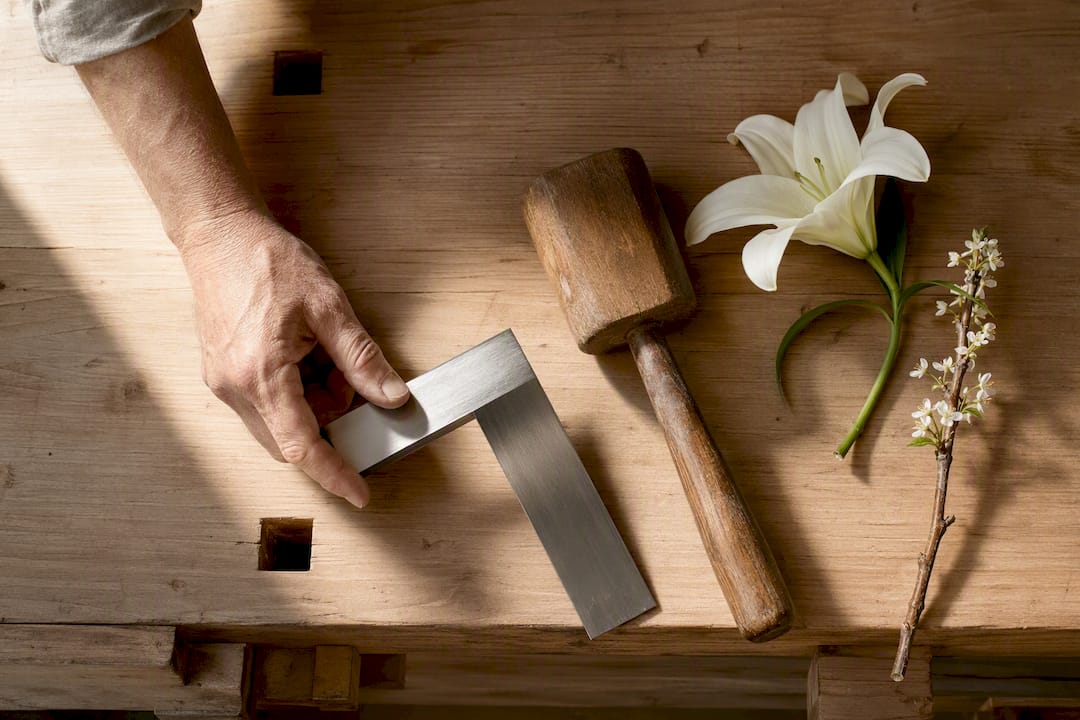
The Church celebrates him twice a year: March 19 (Solemnity of St. Joseph) and May 1 (St. Joseph the Worker); for those seeking ministry contacts and Catholic rites, Catholic Funeral Services Singapore offers support linked to these devotions. Devotional art traditionally shows him holding carpenter’s tools, a white lily for purity, or a flowering staff, each symbol tied to different strands of his story and worth knowing if you’re choosing an image for a prayer corner.
Other Saints Fathers Commonly Invoke
St. Joseph is the primary answer, but he isn’t the only saint fathers and families lean on. Different saints speak to different seasons of fatherhood, from raising toddlers to guiding teenagers to holding a family together during hardship.
- Sts. Joachim and Anne — Venerated by tradition as Mary’s parents, they’re the go-to patrons for parents and grandparents focused on passing faith down through generations. Feast day: July 26.
- St. Louis Martin — Father of St. Thérèse of Lisieux and four other religious daughters, canonized alongside his wife Zélie as a married couple. He’s the patron for fathers who want a model of ordinary, devoted family life. Feast day: July 12.
- St. John Bosco — A priest who dedicated his life to educating poor and at-risk boys, making him a natural choice for fathers navigating discipline, schooling, or a difficult teenager. Feast day: January 31.
- St. Thomas More — Lord Chancellor of England who chose execution over betraying his conscience, invoked by fathers who want to model moral courage and integrity for their children. Feast day: June 22.
- St. Isidore the Farmer — A married layman who worked the land his entire life while maintaining deep personal prayer, a strong fit for fathers in agriculture, trades, or any physically demanding job. Feast day: May 15.
- St. Maximilian Kolbe — A Franciscan priest who offered his own life in place of a stranger at Auschwitz, held up as the ultimate example of self-sacrifice for fathers facing crisis or asked to put someone else first. Feast day: August 14.
Each of these figures gets pulled from a wider tradition of saints known for their fatherhood or paternal example, and none of them compete with St. Joseph so much as complement him. A father dealing with a stubborn teenager might feel closer to St. John Bosco on a given week; a father burying a parent might reach for St. Joseph’s own patronage over a happy death.
Prayers and Devotions Fathers Can Use Today
The best-known modern prayer to St. Joseph comes straight from Patris Corde. Pope Francis included the “Hail, Guardian of the Redeemer” as a closing prayer for the whole Church, and it’s short enough to memorize in a week:
Hail, Guardian of the Redeemer, Spouse of the Blessed Virgin Mary. To you God entrusted his only Son; in you Mary placed her trust; with you Christ became man. Blessed Joseph, to us too, show yourself a father and guide us in the path of life.
A shorter, everyday version fathers can carry in their head: “St. Joseph, help me love as quietly and faithfully as you did.” You don’t need a formal liturgy to make that count.
A simple three-step routine keeps the practice sustainable instead of one more thing that quietly drops off the calendar:
- Invocation — Say Joseph’s name or a one-line prayer first thing in the morning, even before coffee.
- Intention — Name one specific thing you’re asking his help with that day, whether it’s patience with a toddler or a hard conversation at work.
- Offering — At night, offer the day’s small failures and small wins back to him in a sentence or two.
Feast days (March 19 and May 1) are natural anchor points for a longer family prayer, but the routine above works better as a brief daily habit than a once-a-year event. A short, weekly family blessing tends to outlast a longer daily devotion that eventually lapses, so don’t over-engineer it. For fuller prayer texts, diocesan prayer compendia and USCCB resources are reliable places to look.
How to Choose a Patron and Start a Simple Devotion
Picking a patron saint doesn’t require a theology degree. Start with what actually fits your life right now.
- Personal resonance — Does the saint’s story mirror something you’re going through (a career change, a difficult child, a health scare)?
- Life situation — A tradesman might click with St. Isidore; a father raising teenagers might click with St. John Bosco.
- Feast day proximity — Some fathers pick whichever saint’s feast day falls near their birthday or their child’s baptism.
Once you’ve picked one, keep the starter plan small: read one short account of the saint’s life, set a weekly cue (Sunday night, or the feast day itself), and invite your family to join even if it’s just thirty seconds at the dinner table.
Pro Tip: Displaying a print or icon of your chosen saint somewhere you’ll actually see it, a nightstand, a hallway, a desk, does more for habit formation than any app reminder. Devotion follows sight more often than willpower.
Common Misconceptions and Cautions
One popular practice, burying a small St. Joseph statue upside down in the yard to help sell a house, has spread far beyond its original devotional intent. Traditional Catholic writers caution that this kind of ritual risks sliding into superstition when it’s treated as a guaranteed transaction rather than an act of faith.
A few things worth keeping straight:
- Prayer and imitation of a saint’s virtues matter more than any physical ritual.
- No statue placement replaces sincere petition or trust in God’s timing.
- If a practice from another culture or family tradition feels unfamiliar, approach it with curiosity rather than dismissal. Devotional customs vary widely, and most come from a place of genuine faith even when the form looks unusual.
— Griffin
Why a Visible Reminder Changes a Prayer Habit
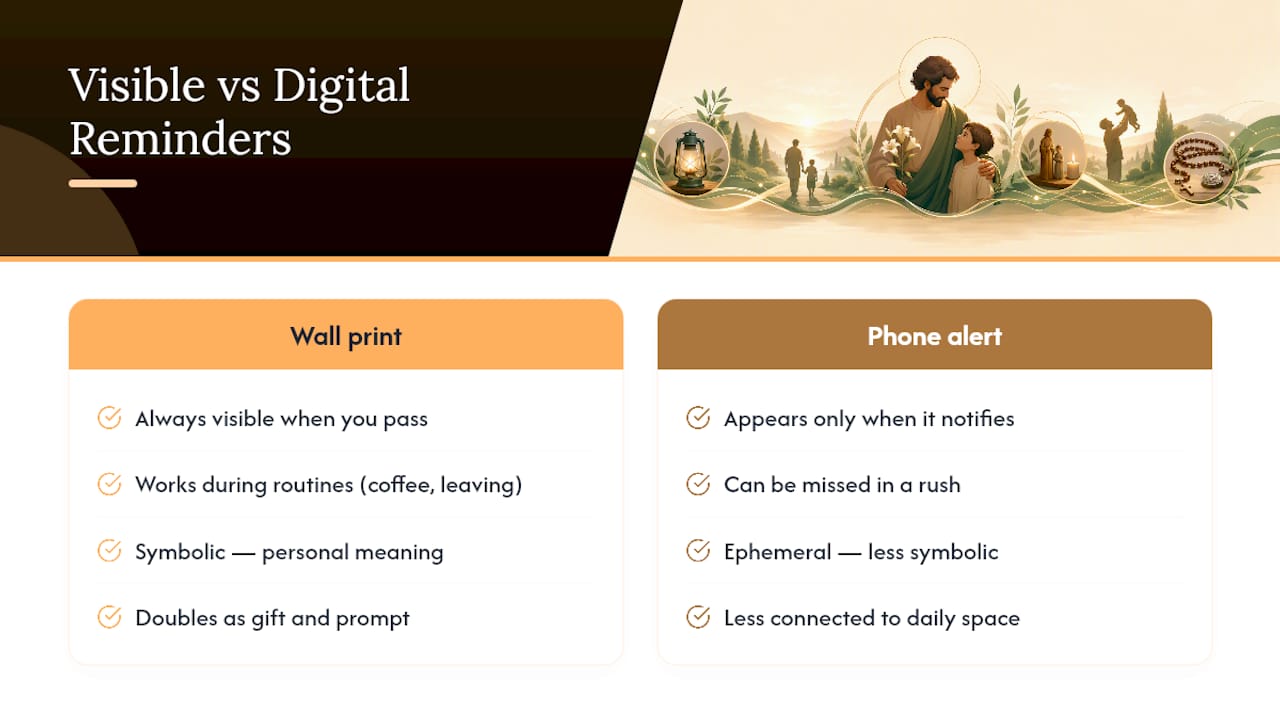
Fathers who stick with a devotion almost always have something they can see, not just something they can remember. A saint print on a wall does quiet work that a phone notification can’t: it’s there every time you walk past, whether you’re rushing out the door or sitting with a coffee at 6 a.m.
Divineprints builds its saint wall art collection around exactly that idea, with pieces like the St. Joseph symbolism guide helping fathers pick imagery that actually means something to their situation, not just whatever looks nice on a shelf. A print of Joseph holding the infant Jesus works as well as a Father’s Day gift as it does a personal prompt to pray.
Bring St. Joseph Into Your Home With a Devotional Print
A framed saint print does something a phone reminder never will: it’s simply there, every morning, whether or not you remembered to open an app. Divineprints’ saint prints collection is built around that kind of everyday visibility, with museum-grade fine art prints and canvases sized for a hallway, an office desk, or a nightstand.

The Saint Joseph holding baby Jesus print captures the exact image most fathers reach for when they picture his patronage: quiet, protective, present. It works as a Father’s Day gift, a baptism gift for a new dad, or simply a piece you hang where you’ll actually see it during your morning prayer. If St. Maximilian Kolbe’s story of sacrifice resonates more with your season of fatherhood, Divineprints also carries a Saint Maximilian Kolbe print sized the same way. Browse the collection and pick the image that matches the saint you’ve chosen to walk with this year.
Sources
For verified prayer texts and Church teaching, start with Pope Francis’ Patris Corde, diocesan prayer compendia, and USCCB parish resources.
- St. Joseph Compendium of Prayers (diocesan PDF)
- Saint Joseph: Patron Saint of Fathers and Father Figures | Our Lady of Peace Church & School
- Year of St. Joseph — Patronages
- Catholic
FAQ
Who Is the Patron Saint of Fathers?
St. Joseph is the patron saint of fathers, recognized for his role as foster father of Jesus and his enduring model of quiet, faithful care within the Holy Family.
What Is the Prayer to St. Joseph for Fathers?
The “Hail, Guardian of the Redeemer,” included in Pope Francis’ Patris Corde, is the most widely used modern prayer, asking Joseph to “show yourself a father and guide us in the path of life.”
Is There a Patron Saint for Grieving Fathers or Families?
St. Joseph is also traditionally invoked for a happy and peaceful death, making him a comforting choice for fathers grieving a loss, alongside saints like St. Maximilian Kolbe for those facing crisis or sacrifice.
Who Are the Patron Saints of Parents in General?
Sts. Joachim and Anne, venerated by tradition as Mary’s parents, are commonly invoked as patrons for parents and grandparents, especially around passing faith down to children.
Is Burying a St. Joseph Statue a Real Catholic Practice?
Burying a statue to sell a house is a popular custom, not official Church teaching, and traditional Catholic writers caution against treating it as a guaranteed ritual rather than an act of genuine prayer.