

An icon is a liturgical image, written to strict canons and venerated in prayer as a “window into heaven.” Sacred art is a broader category that includes narrative paintings, decorative pieces, and inspirational works meant to teach or move the viewer, not to receive liturgical veneration. The theological root of that split is the Incarnation, affirmed at Nicaea II. Divine Prints sells the second kind: devotional wall art for the home, not consecrated icons for the altar.
TL;DR:
- Icons are strictly created for liturgical veneration based on inherited patterns, always representing real prototypes through prayer and fasting.
- Sacred art, including prints and paintings, is designed to inspire and instruct without the canonical rules or spiritual function of icons.
- Iconography features reverse perspective, flattened figures, gold backgrounds, inscriptions, and symbolic colors to transmit theological truths, not realism.
- Veneration of icons passes through to the prototype and is distinct from worship reserved for God alone, preventing idolatry.
- Modern devotional prints are suitable for home prayer spaces but do not substitute for canonically blessed icons used in liturgical settings.
Table of Contents
- Sacred Art vs Icons: Definitions and the Theology Behind Them
- Why Icons Look the Way They Do
- How Icons Function in Worship and Prayer
- Iconoclasm, the Reformation, and Today’s Image Debates
- How to Approach an Icon or Sacred Art Piece Respectfully
- What Divine Prints Offers, and Where It Fits
- Theology Shaped Style, Not the Other Way Around
- Materials and Methods: How Icons and Sacred Art Are Actually Made
- How Contemporary Artists Are Reworking Both Traditions
- Common Misconceptions About Icons and Sacred Art
- Icons and Sacred Art Across Christian Traditions
- Why This Distinction Still Matters
- Bring Devotional Art Into Your Home
- Sources
- FAQ
Sacred Art vs Icons: Definitions and the Theology Behind Them
An icon, in the strict sense, is a religious image produced according to inherited visual patterns, blessed for use in worship, and treated as an object of veneration rather than mere decoration. It is not “inspired by” a saint or a Gospel scene so much as it claims to make that person or event present to the one praying. Sacred art, by contrast, covers a much wider field: stained glass, devotional paintings, sculpture, prints, and murals created to instruct, commemorate, or simply lift the heart, without carrying the liturgical weight of an icon.
The theology that separates them starts with the Incarnation. Because God took on a human body in Christ, the Church argues that matter itself became capable of carrying divine presence, which is why images of Christ, the saints, and angels can be venerated without that veneration becoming idolatry. This exact question came before the Seventh Ecumenical Council at Nicaea II in 787, which drew a hard line between latreia, the adoration owed to God alone, and proskynesis, the honor given to an image that passes through to the person it depicts. That distinction is still the backbone of how the Catholic Church explains image veneration today.
A few terms are worth knowing before going further, since they get used loosely online:
- Latreia: adoration reserved for God alone, never directed at an image.
- Timetike proskynesis: the respectful honor given to an icon, which passes to its subject rather than stopping at the wood and paint.
- Prototype: the actual person or event an icon represents. The honor shown always travels to the prototype.
- Canon: the body of inherited rules governing an icon’s composition, proportion, and symbolism, which an iconographer is not free to improvise away from.
Sacred art operates under none of these constraints. A Renaissance painting of the Annunciation can take theatrical liberties with lighting, gesture, and setting because it was never meant to be venerated. It was meant to move you.
Why Icons Look the Way They Do
Icons follow a visual grammar that trained eyes recognize almost instantly, and every element in that grammar carries meaning rather than serving decoration. Here’s what to look for:
- Reverse perspective. Lines that would converge toward a vanishing point in Western painting instead widen outward, so the image seems to open toward the viewer rather than recede from them. This is deliberate, a rejection of the idea that the icon is a window you look into. It is meant to meet you where you stand.
- Flattened figures and stylized faces. Icons avoid the muscular realism of classical sculpture. Elongated features, large eyes, and a lack of cast shadow signal a transfigured body, not an anatomically accurate one.
- Gold backgrounds. Gold represents uncreated light, the light of eternity rather than a sun falling from one direction, which is why icons rarely show a light source.
- Inscriptions. Nearly every icon carries the name of its subject in Greek, Church Slavonic, or another liturgical language, confirming exactly who is depicted and anchoring the image to the Church’s tradition rather than an artist’s imagination.
- Halos and symbolic color. Reds, blues, and specific garment colors follow inherited conventions tied to the subject’s role, not the iconographer’s personal palette.
Traditional practice holds that icons are “written,” not painted, a phrase that signals the process is closer to transcription than invention. Iconographers work from established prototypes, often preparing through prayer and fasting, because the goal is theological accuracy rather than personal expression. Western sacred art moves in the opposite direction: it prizes naturalism, dramatic emotion, and often bears the artist’s signature as a mark of individual achievement, from Caravaggio’s chiaroscuro to a modern illustrator’s stylized Nativity scene.
Pro Tip: If a religious image has gold leaf, a flattened face with no visible light source, and an inscribed name in the background, you are almost certainly looking at an icon rather than a painting meant purely for admiration.
How Icons Function in Worship and Prayer
Icons are not wall decoration inside a church. They occupy specific, functional roles: the iconostasis separating nave from sanctuary in Orthodox churches is essentially a wall of icons arranged in a theological order, and feast icons rotate to the center of the church to mark the liturgical calendar. Processions carry icons through the congregation on major feasts, and many households keep a dedicated prayer corner where an icon anchors daily devotion.
The physical gestures around icons follow patterns worth understanding rather than guessing at:
- Lighting a candle before an icon as a visible sign of prayer offered.
- Kissing or bowing before an icon, a gesture of honor directed at the subject, not the wood.
- Asking a priest to bless a newly acquired icon before placing it in a home prayer space.
- Making the sign of the cross while approaching or departing from an icon corner.
None of these actions are aimed at the paint or the panel. The honor passes through the image to the prototype, the actual saint, the actual moment in Christ’s life, which is precisely the safeguard Nicaea II built into Church teaching to prevent veneration from sliding into idolatry. Catholic teaching draws the same line: images are venerated, never adored, and pastors are encouraged to reinforce that distinction so devotion doesn’t drift into superstition. Sacred art carries no equivalent liturgical function. A painting of the Last Supper hanging in a dining room might inspire reflection at dinner, but no one lights a candle in front of it or expects a priest to bless it before display.
Iconoclasm, the Reformation, and Today’s Image Debates
The fight over sacred images is old, and it got violent more than once. The Byzantine Empire spent much of the 8th and 9th centuries locked in the iconoclast controversy, with emperors ordering icons destroyed on the grounds that image veneration bordered on idol worship. Defenders like St. John of Damascus argued that destroying icons denied the reality of the Incarnation itself: if Christ truly took flesh, matter could truly carry his image.
Nicaea II settled the dispute in 787, affirming that veneration of icons was lawful and theologically sound, a ruling that still anchors Orthodox and Catholic defense of images today.
The Reformation reopened a version of the same argument centuries later. Protestant reformers worried that image veneration inevitably slid into idolatry, and many insisted on the primacy of the preached Word over visual devotion. That concern drove the removal of images from many Reformed churches, a practice that still shapes the visually plain interiors common in many Protestant traditions.
That divide hasn’t fully closed, but it has softened in places:
- Orthodox and Catholic communities continue to treat icons as essential to worship and catechesis.
- Many Protestant traditions permit sacred art for teaching and inspiration while rejecting formal veneration of any image.
- Some Western theologians and artists are now revisiting icon theology, drawn to its emphasis on presence over realism, without adopting the full liturgical practice around it.
How to Approach an Icon or Sacred Art Piece Respectfully
Standing in front of an icon calls for a different posture than standing in front of a painting. Slow down, let your eyes rest rather than scan, and treat the encounter as a moment of prayer rather than an art critique. If gestures like a bow or a candle feel unfamiliar, watching quietly is always acceptable. Sacred art invites a different kind of attention: read the scene, notice the historical or scriptural context, and let it teach or move you without expecting it to function as a devotional object.
If you’re setting up a prayer corner or devotional display at home, a few habits keep things grounded:
- Choose a quiet spot with steady, soft lighting rather than harsh overhead light that flattens detail.
- Ask a parish priest whether a piece should be blessed before it enters regular use in prayer.
- Keep prints and canvases clean and treated with care, but resist any impulse to treat the object itself as having power apart from what it represents.
- Avoid mixing devotional imagery with purely decorative items in a way that blurs the line between prayer space and general decor.
- When buying for a gift, match the piece to the occasion, a patron saint print for Confirmation, a Nativity scene for a family living room.
A faith-filled guide to Christian artwork for the home covers placement and framing choices in more depth if you’re building out a full prayer space.
What Divine Prints Offers, and Where It Fits
Divine Prints focuses on devotional wall art, saint prints, Gospel scenes, and inspirational imagery designed for home prayer spaces, not consecrated liturgical icons. If you’re trying to identify a saint by the symbols in a painting, the guide to saint iconography and symbols walks through the attributes artists use again and again, keys, lilies, palm branches, and what each one signals.
If your goal is a piece for personal or family devotion, a print serves that purpose well. If you specifically need a canonically written icon for liturgical use, that’s a conversation for your parish priest or a trained iconographer.
Theology Shaped Style, Not the Other Way Around
The visual differences between icons and sacred art didn’t emerge from taste. They emerged from doctrine. Orthodox and early Catholic theology insisted that icons transmit an unchanging truth about Christ and the saints, so iconographers inherited fixed proportions, gestures, and color codes precisely to prevent personal interpretation from creeping into the image. A face rendered too realistically risked implying the subject was merely human; flattening it pointed instead toward transfiguration.
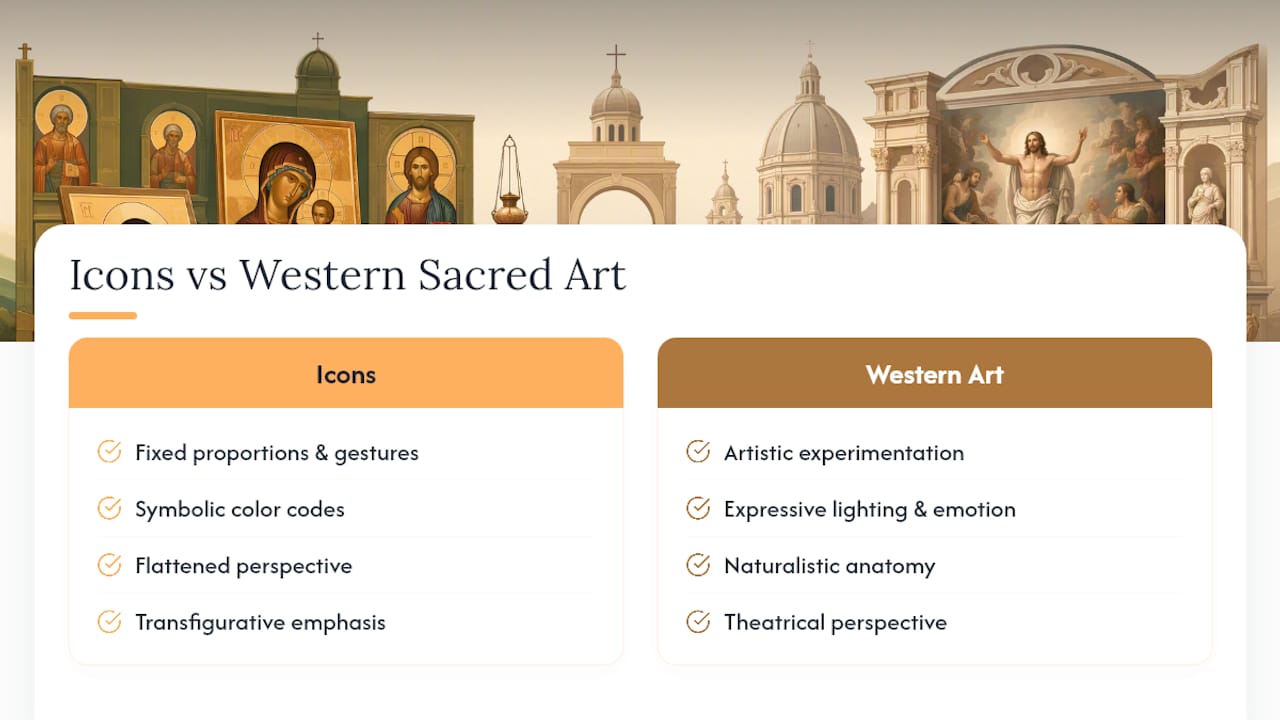
Western Christianity, especially after the Renaissance, moved toward a theology that welcomed human creativity as a reflection of divine creativity itself. That shift gave painters like Fra Angelico, Michelangelo, and later Caravaggio room to experiment with light, anatomy, and emotional intensity because the goal had shifted from liturgical transmission to spiritual persuasion and instruction. A crucifixion scene could now be staged with theatrical shadow and visible anguish, something an icon would never attempt, because sacred art was free to appeal to the senses in ways icon canons deliberately restrict.
The split still plays out today. A parish choosing between a traditional iconostasis and a series of narrative murals is really choosing between two theological instincts: fidelity to inherited form, or freedom to interpret sacred history for a contemporary audience.
Materials and Methods: How Icons and Sacred Art Are Actually Made
Traditional icons are built from natural materials chosen for durability and symbolic weight: wood panels prepared with linen and gesso, egg tempera paint mixed by hand, and gold leaf applied in thin sheets over a red clay base called bole. The process is slow by design, often stretched over weeks, and historically bound up with prayer and fasting rather than treated as ordinary studio work.
Sacred art draws on a much wider toolkit. Oil paint, fresco, stained glass, marble, bronze, and now digital illustration and giclée printing all fall under the category, since the only requirement is a religious subject, not a prescribed method. A modern devotional print, for instance, might start as a digital painting and end as an archival canvas reproduction, a process with no equivalent in traditional iconography, where the handmade transmission of the image is part of its theological claim.
That difference in method is also a difference in intent. An icon’s materials are chosen to serve a ritual, unchanging function. Sacred art’s materials are chosen to serve whatever expressive or practical goal the artist and patron have in mind, whether that’s a stained glass window built to survive a century or a printed canvas made for a bedroom wall.
How Contemporary Artists Are Reworking Both Traditions
Traditional iconography hasn’t stood still. Contemporary iconographers, most trained through apprenticeship rather than art school, continue producing new icons of recently canonized saints and modern martyrs, working within centuries-old canons even as their subjects are recent. The discipline stays fixed even when the subject matter is new.
Sacred art, unsurprisingly, has moved much faster. Digital illustration, minimalist line art, and mixed-media collage now sit alongside oil painting as legitimate ways to depict Christ, Mary, and the saints for a contemporary audience. Some Western artists and theologians are explicitly borrowing from icon theology, incorporating flattened perspective or symbolic gold tones into otherwise modern compositions, without claiming their work functions as a liturgical icon. The result is a growing category of art that sits deliberately between the two traditions: stylistically inspired by iconography, but sold and displayed as devotional decor rather than blessed for veneration.
That middle ground is exactly where most home devotional art on the market today actually lives.
Common Misconceptions About Icons and Sacred Art
The most persistent myth is that any painting of Jesus or a saint qualifies as an “icon.” It doesn’t. The word has a specific liturgical meaning in Orthodox and Catholic practice, and using it loosely for any religious picture blurs a distinction the Church has defended since Nicaea II.
A second misconception treats icon veneration as worship of an object. It isn’t. Honor shown to an icon passes to the prototype it depicts, never stopping at the paint or wood, a distinction the Church has been explicit about for over a thousand years.
A third myth assumes sacred art is theologically lesser or purely decorative. That undersells its real function: teaching, evangelizing, and moving people toward reflection, none of which requires liturgical status to matter. A fourth misconception claims Protestant traditions reject all religious imagery outright. Most don’t; they reject the veneration of images while still using sacred art extensively for teaching and inspiration in Sunday school materials, stained glass, and book illustration.
Icons and Sacred Art Across Christian Traditions
Eastern Orthodox practice treats icons as essential, not optional, woven into every liturgy through the iconostasis, processions, and home prayer corners. Roman Catholic practice recognizes icons, particularly in Eastern Catholic rites, while also embracing a much broader tradition of sacred art, stained glass, statuary, and Renaissance painting, that never carries the same canonical restrictions. Protestant traditions vary widely: many Reformed and evangelical communities avoid venerated images altogether, favoring plain worship spaces, while still commissioning sacred art for education, publishing, and personal reflection.
That range explains why the same painting of the Nativity can mean completely different things depending on where it hangs, treated as catechetical decoration in one tradition, quietly avoided in another, and impossible in place of an icon in a third.
Why This Distinction Still Matters
Understanding the difference between icons and sacred art isn’t about winning a semantic argument. It changes how you approach an image, whether you light a candle in front of it or simply let it teach you something. Different Christian traditions have landed in different places on this question, and that’s worth approaching with curiosity rather than judgment. If a piece of art draws you toward prayer, ask what kind of prayer it’s actually meant to hold, and don’t be afraid to ask a priest or a knowledgeable friend when you’re unsure.
— Griffin
Bring Devotional Art Into Your Home
Divine Prints focuses entirely on devotional art built for prayer spaces, not mass-market decor stretched to fit a religious theme. Every collection, from patron saint portraits to Gospel scenes, is made to order on high-quality matte paper or canvas, and comes with shipping options for many locations worldwide.

The Saint Prints collection works well for Confirmation and baptism gifts, giving someone a patron saint to keep close in a bedroom or office. The Jesus Prints collection suits a living room or prayer corner where you want a Gospel scene as a daily point of reflection, while the Biblical Event Prints line fits classrooms and parish settings that need narrative art for teaching. If you’re building out a prayer space, the Angel Prints collection rounds things out with imagery that works as both décor and devotion.
None of these pieces replace a canonically written, blessed icon, and if that’s specifically what you need, talk to your parish priest first. For everything else, from a First Communion gift to a print for your own prayer corner, browse the full Divine Prints collection and pick the piece that fits your space.
Sources
- How are icons different from religious paintings? - St. Michael Antiochian Orthodox Christian Church
- Veneration of holy images — EWTN
- Icons differ from all other art in its mysticism — Pravmir
- Sacred Images and Icons | Apologia Catholic
- Windows to Heaven or Doors to Idolatry? Defining the Icon — John Carpenter Substack
FAQ
Why do Protestants reject icons?
Most Protestant traditions reject the veneration of icons over fears that honoring an image could slide into idolatry, and many emphasize the preached Word over visual devotion. That concern drove many Reformed churches to remove images entirely during the Reformation, though most Protestant communities still use sacred art for teaching and illustration.
Is Jesus considered an icon?
An image of Jesus becomes an icon specifically when it is written to canonical form and used liturgically for veneration, not simply because it depicts him. A painting of Christ meant for reflection or decoration, like most pieces in Divine Prints’ Jesus Prints collection, falls under sacred art rather than iconography.
What is the difference between an icon and iconography?
An icon is the actual image itself. Iconography is the broader system of symbols, poses, colors, and inscriptions that give icons their meaning, the visual vocabulary an iconographer draws on rather than the finished object.
Why are Orthodox Christians so devoted to icons?
Orthodox devotion to icons rests on the Incarnation: because Christ took on real flesh, matter can carry divine presence, a principle Nicaea II affirmed against the iconoclasts in 787. Icons function as a central part of Orthodox liturgy and personal prayer rather than as optional decoration.
Can I display devotional prints at home without them being blessed?
Yes, devotional prints like those from Divine Prints work fine unblessed for personal reflection and home prayer corners. If you want a piece formally blessed for regular devotional use, ask your parish priest, since blessing is a pastoral practice rather than a requirement for owning the art.