

St. Dymphna is the patron saint of anxiety recognized in Catholic tradition, invoked by name for mental illness, panic, and emotional turmoil. St. Francis of Assisi is often paired with her as a patron of peace. Both serve as intercessors, not treatment. If anxiety is disrupting daily life, prayer works alongside a doctor or therapist, not instead of one, and the 988 Suicide & Crisis Lifeline is available any hour, day or night.
TL;DR:
- St. Dymphna is primarily invoked for anxiety and mental illness, with her devotion rooted in her own tragic history of family trauma and abuse.
- Pilgrimages to Geel, Belgium, where her shrine is located, influenced community-based mental health care practices that still impact treatment today.
- Prayer to St. Dymphna is most effective when short, repeated, and accompanied by visual reminders like prayer cards or images placed in daily view.
- The connection between saints and mental health is informal and based on longstanding popular devotion rather than official Church doctrine.
- Prayer and professional mental health treatment work together, with faith providing emotional support alongside therapeutic care and crisis resources like the 988 Lifeline.
Table of Contents
- Which Saints Do Catholics Pray to for Anxiety?
- Who Was St. Dymphna and How Did She Become the Anxiety Saint?
- How Do You Pray to St. Dymphna for Anxiety?
- When Do Catholics Honor St. Dymphna’s Feast Day?
- Does Prayer Actually Help With Anxiety, or Do You Still Need a Doctor?
- Why a Saint Who Suffered Herself Changes How People Pray
- Bring St. Dymphna Into Your Daily Prayer Space
- Sources
- FAQ
Which Saints Do Catholics Pray to for Anxiety?
St. Dymphna sits at the top of nearly every list of saints for anxiety, and for good reason. She’s the recognized Catholic patron for those suffering from mental illness, anxiety, and depression, and her story gives sufferers something rare: a saint who understood trauma firsthand rather than one assigned the role by committee. But she isn’t the only name worth knowing. Depending on what you’re actually feeling, a different saint might fit the moment better.
- St. Dymphna – the go-to intercessor for mental distress, panic, and anxiety specifically; also patron of runaways and victims of abuse.
- St. Francis of Assisi – invoked for peace and calm when anxiety feels more like restlessness than crisis.
- St. Philip Neri – known as the “Apostle of Rome” and prayed to for cheerfulness, lightness, and relief from gloom.
- St. Rita of Cascia – called on for comfort during long, grinding suffering that doesn’t resolve quickly.
- St. Benedict Joseph Labre – patron for those who feel lost, homeless in spirit, or on the margins of mental health struggles.
If your anxiety feels acute and overwhelming, start with St. Dymphna. If it’s more of a low simmer of worry, St. Francis or St. Philip Neri might feel closer to home. There’s no wrong door here. Catholics have prayed to more than one of these saints at once for centuries.
Who Was St. Dymphna and How Did She Become the Anxiety Saint?
St. Dymphna was a 7th-century Irish noblewoman, the daughter of a pagan king and a devout Christian mother. When her mother died, her father descended into what many accounts describe as grief-driven madness and demanded Dymphna marry him. She fled to Geel, in modern-day Belgium, with her confessor, Father Gerebernus. Her father tracked her down and, when she refused him, killed her. She was around 15.
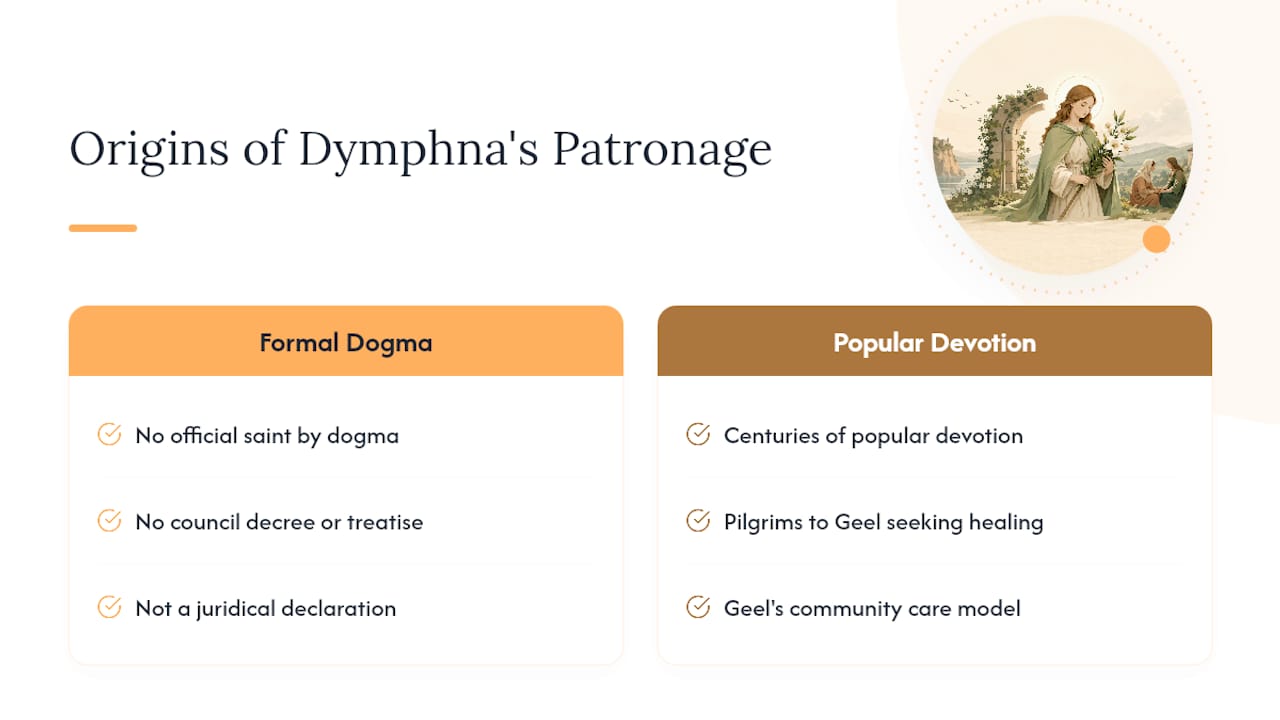
That single, brutal episode is the entire basis of her patronage. There’s no theological treatise behind it, no council decree. The connection between Dymphna and mental illness grew organically from pilgrims who traveled to her shrine at Geel seeking healing for relatives suffering from what we’d now call psychiatric conditions. Over centuries, the town built something remarkable around that devotion: a system where families with mentally ill members lived boarded with local townspeople instead of being locked away. Historians point to Geel’s model as one of the earliest examples of community based care for the mentally ill anywhere in Europe.
It’s worth being precise about what “patron saint” means here. The Catholic Mental Health Ministry is clear that no saint of anxiety exists by formal Church dogma. Dymphna’s role is traditional, built through centuries of popular devotion rather than an official declaration. That doesn’t make it less real to the millions who’ve prayed to her. It just means her patronage is a living inheritance from ordinary believers, not a courtroom ruling.
How Do You Pray to St. Dymphna for Anxiety?
A short, memorized prayer works better for anxiety than a long one. You can recite the following when panic rises, before sleep, or during a quiet moment in the morning:
“St. Dymphna, patroness of those with mental and emotional distress, intercede for me before the throne of God. Ask Him to grant me courage, peace of mind, and the healing I seek. Help me trust in His care even in my darkest hour. Amen.”
A novena, nine consecutive days of focused prayer, gives that same request more structure and staying power. A simple version looks like this:
- Pick the same time each day, morning coffee or before bed tends to stick best.
- Read a short passage about Dymphna’s story to ground the prayer in her real history.
- Recite the prayer above, adding your specific concern by name.
- On day nine, add a prayer of thanksgiving regardless of outcome, since novenas are about trust, not transactions.
Physical reminders help more than most people expect. EWTN’s devotional resources list prayer cards and images among the most common tools the faithful use, and there’s a reason: a visual anchor turns a scattered thirty second prayer into a habit. Many Catholics build a small prayer corner with a saint image, a candle, and nothing else, placed somewhere they’ll actually see it daily, not tucked in a drawer.
Pro Tip: Keep the prayer card or image where your eyes land naturally, a nightstand, a bathroom mirror frame, a car dashboard, so the prayer becomes reflexive instead of another task you forget.
When Do Catholics Honor St. Dymphna’s Feast Day?
St. Dymphna’s feast day falls on May 15, and many parishes build extra devotion around that date each May, sometimes running a nine-day novena leading up to it. Some parishes hold a special Mass intention or prayer service for those struggling with mental illness; others simply encourage private devotion at home.
If you can’t make it to a formal service, the feast day is still worth marking privately. Light a candle, say the novena prayer one more time, or simply sit with her story for a few minutes. Geel remains a pilgrimage site today, and its centuries-old tradition of sheltering the mentally ill within ordinary households still shapes how the town treats mental illness now. You don’t need to travel there for the devotion to mean something. The town’s history is context, not a requirement.
Does Prayer Actually Help With Anxiety, or Do You Still Need a Doctor?
Prayer and professional treatment aren’t competing options. They’re two different kinds of support that work on different parts of the problem, and pretending otherwise does a disservice to people who are genuinely struggling.
Anxiety disorders affect a meaningful share of American adults each year, and NIMH data makes clear this is a widespread, clinically significant condition, not a personal failing or a lack of faith.
That statistic matters because it reframes the whole conversation. Anxiety isn’t a spiritual weakness that stronger prayer alone fixes. It’s a documented health condition with real biological and psychological mechanisms, and it responds to treatment the same way a broken bone responds to a cast. A review published in PubMed Central found that spiritual practices can meaningfully support people coping with mental illness, particularly when those practices run alongside, not instead of, clinical care.
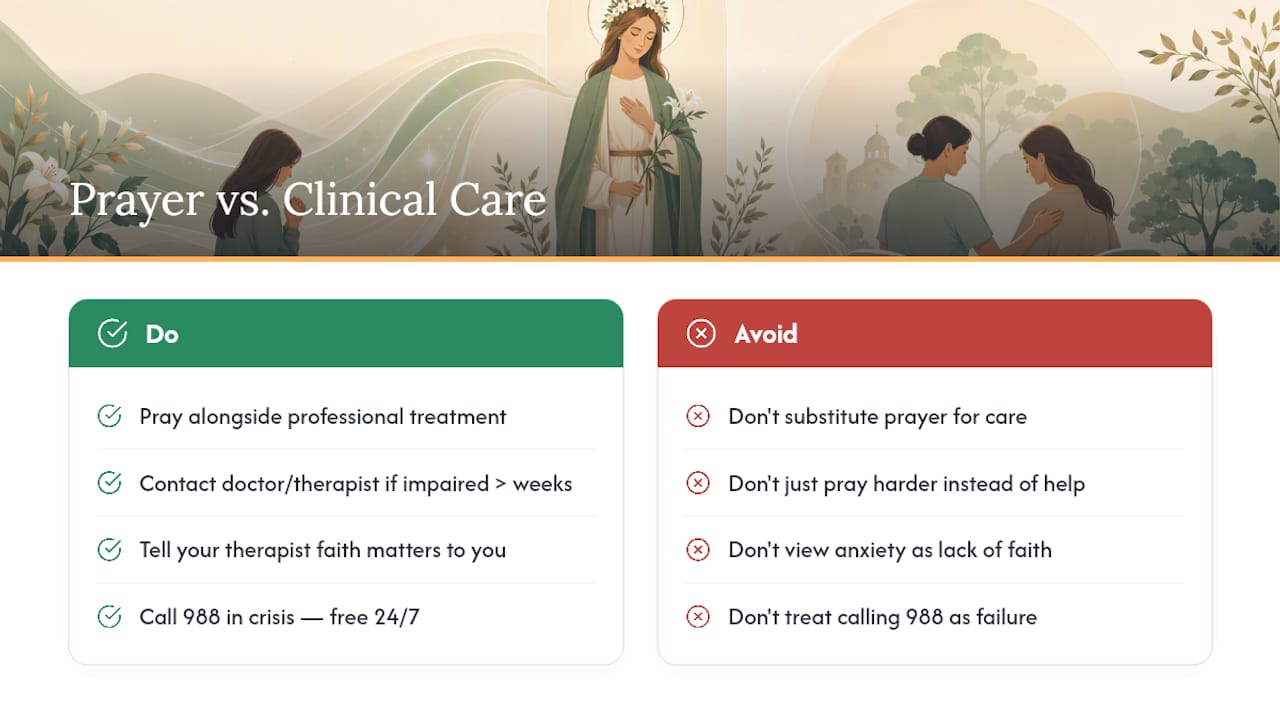
So what does combining the two actually look like day to day? If anxiety is interfering with sleep, work, relationships, or basic functioning for more than a couple of weeks, that’s a signal to contact a doctor or therapist, not just to pray harder. Tell your therapist that faith is part of how you cope. Good clinicians work with that rather than around it. Keep praying to St. Dymphna during treatment, not as a replacement for it, but as the emotional and spiritual scaffolding around the clinical work you’re doing.
If you or someone you love is in crisis, the 988 Suicide & Crisis Lifeline connects you to trained counselors free, 24 hours a day, in English and Spanish. That number exists for exactly this kind of moment, and using it isn’t a failure of faith. It’s the same instinct that sent Dymphna’s pilgrims searching for help centuries ago.
Why a Saint Who Suffered Herself Changes How People Pray
Dymphna’s appeal isn’t abstract theology. It’s the fact that she died fleeing genuine family trauma, not a comfortable death in old age surrounded by admirers. That detail is why her intercession lands differently for people carrying anxiety rooted in family dysfunction or abuse. She isn’t a distant figure handing down blessings from a position of ease. She’s someone who understood fear from the inside.
A visible image does something a mental note never quite manages. It catches your eye mid-morning and pulls you back into a two-second prayer you’d otherwise skip entirely. That’s not superstition. It’s how memory and habit actually work, and it’s part of why devotional art has survived as a spiritual tool for as long as the Church itself. Faith communities, professional care, and small daily anchors like a prayer card or a print on the wall all pull in the same direction: toward steadiness.
— Griffin
Bring St. Dymphna Into Your Daily Prayer Space
A prayer corner works best when it has something to look at, not just words to recite. Divine Prints’ Saint Prints collection offers museum-quality fine art prints and canvases of St. Dymphna and other intercessors, made to order with free worldwide shipping and a lifetime warranty against fading or defects.
Whether you’re setting up your own quiet corner or looking for a meaningful gift for someone carrying anxiety, a framed print keeps her story visible where a prayer card can get lost in a drawer. It’s not a substitute for pastoral counseling or medical care, but it’s a steady, tangible reminder that someone else walked through fear before you and found peace on the other side. Browse the collection and find a size or frame that fits your space, then let it anchor a daily prayer instead of one more thing you meant to do.
Sources
- Saint Dymphna | Patron Saint of Mental Illness
- EWTN Mission: St. Dymphna
- NIMH — Any Anxiety Disorder
- Review on spirituality and mental health (PubMed Central)
- Catholic Mental Health Ministry: St. Dymphna
FAQ
Who Is the Saint That Helps With Anxiety?
St. Dymphna is the saint most Catholics turn to for anxiety, panic, and mental illness, with St. Francis of Assisi commonly invoked alongside her for general peace of mind.
What Is a Catholic Prayer for Relief of Anxiety?
A common one asks St. Dymphna to intercede before God for courage, peace of mind, and healing, often paired with the Serenity Prayer or a novena said over nine days.
Who Is the Patron Saint of Overthinkers?
There’s no separate saint officially designated for overthinking, but many people praying through racing or obsessive thoughts turn to St. Dymphna, since her patronage covers mental and emotional distress broadly.
What Saints Struggled With Anxiety or Mental Distress Themselves?
St. Dymphna’s own life included trauma and family violence that inform her patronage, and several other saints, including St. Benedict Joseph Labre, lived with conditions modern readers associate with mental health struggles.
Where Can I Find Devotional Art of St. Dymphna?
Divine Prints offers St. Dymphna prints and canvases in multiple sizes and frame options, suited to a home prayer corner or as a gift.