

Archival print quality means a print is made from inks and paper chosen to resist fading, yellowing and decay for a long time. The word alone does not promise a number of years. A real lifespan comes from a specific ink on a specific paper, kept in specific conditions. If you are choosing a saint, a crucifix scene or a Sacred Heart print to hang for decades, look at the materials, the way it is framed and where it hangs, and look for a written guarantee that covers fading.
TL;DR
- “Archival” has no fixed meaning for inkjet prints. It signals the maker’s intent, not a guaranteed lifespan, according to Wilhelm Imaging Research.
- The materials that matter most are pigment-based inks and acid-free, lignin-free paper, ideally 100% cotton rag, as NEDCC explains.
- Where you hang a print matters as much as how it was made: light, humidity and heat do most of the damage.
- Our prints are made to order on museum-quality matte fine art paper or durable canvas, and carry a lifetime warranty against defects or fading.
Table of Contents
- What “archival” actually promises
- The paper: the base everything sits on
- The ink: pigment versus dye
- How to read a longevity claim
- How long can a good print last?
- Where and how to hang it
- Paper or canvas: what changes
- A short checklist for choosing devotional art
- Where to find lasting saint and devotional prints
- Our perspective
- FAQ
- Sources
What “archival” actually promises
Most people read “archival” as “will last 100 years.” That is a reasonable guess, but it is not what the word guarantees. Wilhelm Imaging Research, a long-standing print permanence lab, states that for inkjet inks and papers the term has no specific meaning about how long a print lasts before noticeable fading. It tells you the manufacturer intended the product to last a reasonable time.
A real permanence figure is narrower. It belongs to a named ink on a named paper under stated display conditions. The standard Wilhelm conditions, for example, assume a print framed under glass and lit at 450 lux for 12 hours a day. Lux is simply a measure of light intensity: a bright office is a few hundred lux, direct sun is tens of thousands.
So when you see “archival quality” on a product page, read it as a direction, not a result. The useful questions are these:
- What is the paper made of?
- What kind of ink is used?
- Is there a written guarantee?
- Will the print hang somewhere that helps it last?
The rest of this guide answers each one.
The paper: the base everything sits on
Paper is the part of a print most people overlook, and it is half the permanence story. Cheap paper is made from wood pulp. The Print Council of America notes that wood pulp fibers and leftover papermaking chemicals make paper degrade faster. That is why old newspaper turns brown and brittle while a cotton-based sheet can stay bright.
For long life, look for these traits:
- 100% cotton rag or alpha-cellulose fiber. FESPA, the printing industry’s trade body, reports that papers made this way, free of acid and lignin, give a stable base that resists yellowing and breakdown. Lignin is the natural substance in wood that turns paper yellow over time.
- Acid-free and buffered. NEDCC, a U.S. conservation center, recommends coated papers whose base is acid-free, buffered, lignin-free and free of optical brighteners. Brighteners make paper look whiter at first and can fade or change later.
- Recognized standards. FESPA notes that many manufacturers develop archival media to ISO 9706, an international standard for paper durability, and some also meet ISO 11108, which covers archival documents.
Matte fine art paper is a natural fit here. In general, matte and fine art papers tend to be the most stable kind of photo-quality paper, and they also suit devotional imagery well: no glare from a window or a lamp while you pray in front of it.
Our own prints are made to order on museum-quality matte fine art paper, or on durable canvas for those who prefer it. If you want to go deeper on what to check in a sheet, our guide on verifying archival paper specs walks through it.
The ink: pigment versus dye
Ink is the other half. Two families dominate home and professional printing:
- Dye inks dissolve into the paper. They give very vivid color but fade sooner.
- Pigment inks are made of solid particles. NEDCC explains that pigment molecules are about a thousand times larger than dye molecules, which makes the ink significantly more lightfast and less affected by the environment. “Lightfast” means resistant to fading in light.
Pigment inks have trade-offs that printers manage, such as a somewhat smaller color range and a tendency toward metamerism, where a color looks slightly different under different light sources. For devotional art, with its deep blues, golds and reds, a well-made pigment print on good paper is the standard path to lasting color. FESPA reports that modern pigment ink systems on archival-quality papers offer high fade resistance.
If you want a plainer breakdown of what the ink side means, see our article on archival ink for collectors.
The combination counts too. NEDCC names three main factors in a digital print’s life: the quality of the materials, the combination of ink and paper, and the storage and display conditions afterward. A great ink on a poor sheet, or the reverse, does not make a lasting print. Even a home printer’s results depend on this pairing; the guide on how to print color at home shows how paper and settings change the finished color and why the match between them matters.
How to read a longevity claim
Two things separate a meaningful longevity claim from a slogan.
It names its materials. Independent permanence labs test one ink and paper pairing at a time. NEDCC advises matching the specific combination to published results from labs such as Wilhelm or Aardenburg Imaging, because a result for one pairing does not carry over to another.
It states its conditions. Aardenburg reports lightfastness in megalux hours, which measures the total dose of light a print receives. Its conservation ratings give a range at which a print stays in visually excellent condition, rather than one “years on display” number, which its founder considers a gross oversimplification. That is a useful way to think: a figure like “100 years” means little unless you know how bright the room is.
For a buyer, the practical takeaway is simple. A print backed by quality materials and a clear written guarantee is a stronger choice than one that only uses the word “archival.” We stand behind our prints with a lifetime warranty against defects or fading, so the promise is in writing and not left to interpretation.
How long can a good print last?
Under Wilhelm’s standard conditions, pigment inks on good cotton papers earn ratings of a century or more for color work. Dye inks earn a fraction of that. These are laboratory estimates under stated light, not promises for every wall. The University of Illinois preservation guide agrees that pigment inks on good paper can last more than 100 years, while high humidity, intense light and pollutants such as ozone cause yellowing, staining and fading.
The lesson is that the print and the room share the result. Halve the light and the rating roughly doubles; put the same print in direct sun and it can shrink many times over. So the next sections matter as much as the printing itself.
Where and how to hang it
Conservators who care for centuries-old works on paper give guidance that scales well to a home or a parish hall. You do not need museum conditions, but a few habits protect a print for decades.
Light
Visible light, not just ultraviolet, drives most fading. Wilhelm’s 2000 study found that UV-filtered glass gave little protection to inkjet prints compared with bare-bulb conditions, because visible light was the main cause. So the simplest protection is placing the print out of direct sun.
For reference, the Print Council of America says light on works on paper should not exceed about 10 foot-candles (roughly 100 lux), and about 50 lux for very sensitive media. A living room wall away from windows is generally far gentler than a sunlit one. Our guide to lighting art like a museum covers the angle and warmth of lamps.
Walls, heat and humidity
The Library of Congress advises hanging framed paper on interior walls, out of direct sunlight, and away from fireplaces, radiators and vents. The Print Council of America adds a target of 65 to 72°F with relative humidity of 40 to 55%, and warns against attics, basements, entranceways and uninsulated exterior walls. In plain terms: skip the bathroom, the kitchen wall over the stove and the sunny window wall.
For a prayer corner, a hallway interior wall or a bedroom wall away from the window all work well.
Framing materials
The Library of Congress describes chemically stable framing for works on paper:
- 100% cotton rag or lignin-free matboard
- UV-opaque acrylic glazing that does not touch the print
- acid-free backing
- a moisture barrier behind the print
The point is that the frame package should not harm the paper inside it. A mat that is acidic will stain the print over the years, whatever ink was used.
For routine care once it is on the wall, see our notes on protecting framed prints at home.
Storage when not on display
If you rotate art with the liturgical seasons, store the print flat in an acid-free enclosure. NEDCC recommends enclosures that meet ISO 18902, kept cool at 68°F or lower with 30 to 40% relative humidity, and away from oxidizing household chemicals such as bleach and some cleaners.

Paper or canvas: what changes
Paper and canvas age differently, and the choice shapes how you display the work.
Conservation guidance sets a limit of about 50 lux for paper objects and about 200 lux for finished canvas paintings, according to a collections care manual. Canvas tolerates a brighter room, and it hangs without glass. That makes it a practical choice for a church hall, a classroom or a busy family room where glare and glass are a nuisance.

Paper offers a finer, softer surface for detailed inscriptions and fine line work, and framing it under glazing gives it extra protection from dust and handling. Both can be a lasting choice when the materials are good. Our comparison of paper versus canvas for devotional art and the five-step guide to choosing between them go through the decision. If you are caring for canvas in a parish setting, four essentials for devotional canvas will help.
Metal prints are sometimes offered as a third option. The Metropolitan Museum of Art’s handling guide says metals are not particularly light-sensitive, though moisture speeds corrosion. That is a different material question and a different product from fine art paper or canvas.
A short checklist for choosing devotional art
Use this before you buy a print meant to last a lifetime, whether for your home, a Confirmation gift or a parish entrance.
- Paper: cotton or other acid-free, lignin-free fine art paper, or durable canvas.
- Print type: a giclée-style inkjet print on fine art media, not an offset poster. Our explanations of what a giclée print means and giclée versus lithograph cover the difference.
- Guarantee: a written warranty that covers fading, not just a descriptive word.
- Size and frame: pick a frame type and size that suits the wall and that keeps the print away from the glazing.
- Placement: an interior wall, out of direct sun and away from heat sources.
For a broader view of choosing pieces for a modern home, see our buyer’s guide to Christian art prints.
Where to find lasting saint and devotional prints
Every piece at Divine Prints is made to order and printed on museum-quality matte fine art paper or durable canvas. Each one comes with a lifetime warranty against defects or fading, and shipping is free worldwide. Whether you are choosing a patron saint for a Confirmation gift or a scene for a parish hall, you can browse by subject:
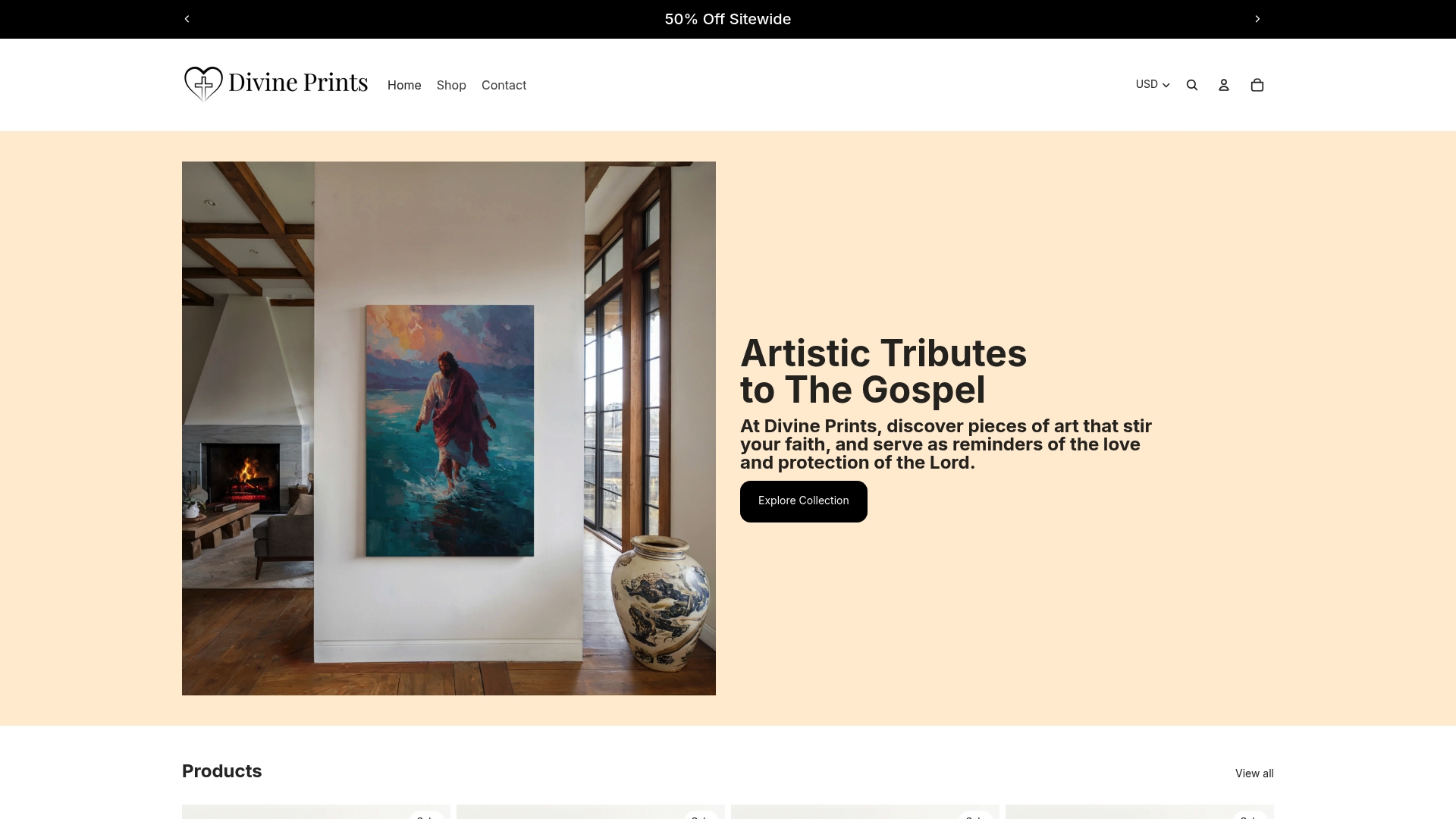
Start with our Saint Prints, or look at Jesus Prints, Biblical Event Prints and Angel Prints. They are designed for easy installation at home or in church.
Our perspective
We make devotional art, and the question we hear most is how long a print will stay as beautiful as the day it arrives. Our honest answer starts with materials. A saint’s face, the gold of a halo, the deep blue of a robe: these only keep their meaning if the paper and the color stay true.
That is why we print to order on museum-quality matte fine art paper or durable canvas, and why we put a lifetime warranty against defects or fading behind every piece. A word like “archival” is easy to print on a label. A promise in writing is harder, and we think it is the one that counts for families who hang a print where they pray.
The second half is the wall. Keep a print out of direct sun, on an interior wall, away from heat, and it will serve you for years. Art in a church or a home is meant to be lived with, and a print that quietly holds its color lets the image do its work.
Griffin
FAQ
Does “archival” mean a print will last 100 years?
Not by itself. For inkjet prints, the term only signals that the maker intended the print to last a reasonable time, according to Wilhelm Imaging Research. A figure such as 100 years applies to a named ink and paper under stated light conditions, such as 450 lux for 12 hours a day.
Are pigment inks better than dye inks for long-lasting prints?
Pigment inks are significantly more lightfast and less affected by the environment than dyes, according to NEDCC. They pair best with acid-free, lignin-free cotton or alpha-cellulose paper. Together they are the standard choice for prints meant to hold color for decades.
Is canvas or paper better for a lasting print?
Both can last when the materials are good. Canvas tolerates somewhat brighter rooms and needs no glass, while paper has a fine surface and does well framed with acid-free mats. Choose based on where it will hang and how much glare the room has.
Where should I hang a print to keep it from fading?
Choose an interior wall out of direct sunlight and away from fireplaces, radiators and vents, as the Library of Congress advises. Avoid kitchens, bathrooms, attics and basements. Aim for stable room temperature and moderate humidity.
Sources
- Inkjet Prints Compared with Traditional (Wilhelm Imaging Research)
- 5.4 Creating Long-Lasting Inkjet Prints (NEDCC)
- Print to Preserve (FESPA)
- Print Council of America: Studying, Collecting, Care
- Conservation display ratings for digital print permanence (Aardenburg Imaging)
- Preservation Guidelines for Matting and Framing (Library of Congress)
- Collections Care Manual
- How to Print Color at Home: Settings, Paper and Fixes